


December Holiday Language & Literacy Books
Children enjoy children’s literature throughout the year and December is an ideal time to finish the year using excellent books in speech/language therapy, the classroom, and during family literacy time. These are my recommendations for December Holiday Language & Literacy Books.
The Nutcracker in Harlem by T.E. Mc Morrow
This is an amazing book that is set during the Harlem Renaissance era in New York City. It was a time of heightened artistic and intellectual expression. Blacks during this time truly flourished in many ways. Some were a part of the great migration from the South while others lived in the Northeast for some time. Many Caribbean people also went to NYC and became a vibrant part of NY society. I love how this book transports the reader to a different time period and evokes them to imagine along with Marie the main character. The book opens with Marie the beautiful girl on the cover gathered around the love of her family at a holiday party. You can almost hear the tunes of the piano and chatter in the background as you read the pages. Then the scene changes to her opening a present, the nutcracker. What transpires after that will spark the curiosity of children. I recommend this book for children in grades 2nd-5th. It’s an excellent book to enjoy the whimsical moments of the season while also making inferences about certain story events. Additionally, it’s a great opportunity to provide historical information about the Harlem Renaissance era. Here is an excellent read aloud.
Bear Stays Up for Christmas by Karma Wilson
Books in this Bear series are a favorite for many children, SLPs, and teachers. This book is great for children in preschool and kindergarten-2nd grade. In this story, Bear, is sleeping in his cave. His animal friends are eager for him to wake up and stay awake for the special Christmas holiday. The friends go looking for the perfect tree in the woods and hoist in on Bear’s back to decorate his lair or cave. They hang stockings by the fire light and Bear is busy preparing food and gifts for Christmas morning. His friends fall asleep on Christmas Eve while he stays awake until Christmas morning. You can use my WH Questions quick listening comprehension activity after an interactive read aloud of this book.
Hanukkah Bear by Eric Kimmel
This is a fun and light hearted book that is great for children and families to get an introduction into the Jewish holiday of Hanukkah or Festival of Lights that celebrates the rededication of the temple in Jerusalem. This children’s literature selection is a fiction tale about an elderly lady who is expecting the Rabbi or leader of the temple to visit one Hanukkah night. However, she does not see very well and mistakes an unusual visitor, Bear, as the Rabbi. She is so excited to have the Rabbi in her home that she serves him all the delicious Potato Latkes that she made. This is a traditional dish that is served in many Jewish homes during Hanukkah. It is fried in oil and reminds families of the Hanukkah miracle in which there was enough oil to light the menorah for 8 days rather than just one. She plays dreidel and even gives Bear a special gift, a winter scarf. It is not until other family and friends come knocking at her door that she realizes that her special visitor was not the Rabbi but in fact a real bear! Yikes! Children will get a kick out of this story. Remember, as adults you set the stage when using books at home, in speech/language therapy, or the classroom. Kids will be interested in certain stories when you present them in an engaging manner. Here is a read aloud of this book.
Grandma’s Gift by Eric Velasquez
Grandma’s Gift is a heartwarming story about a boy who spends his winter break from school with his grandma because his parents have to work. She picks him up from school and they go shopping for special items for a family holiday dinner. They even take a special trip to the Metropolitan Museum of Art in NYC so that he can complete an assignment for school. While there his grandmother spots a portrait of a famous artist that she recognizes. This sparks the little boy’s interest as he aspires to be an artist one day. This is a good book for young boys to know that they too can achieve what they desire. It is equally important that their interests are encouraged like the grandmother did in this book.
The author, Eric Velasquez, is an Afro-Puerto Rican author from Harlem, New York. This book won a Pura Bulpre award and he was awarded the Coretta Scott King Award and an NAACP Image Award for Outstanding Literary Work.
Dasher by Matt Tavares
Children and adults get excited for Christmas and winter break! Children love this book and I do too! It’s amazing how much they enjoy the magical and imaginative element of the holiday season. Matt Tavares wrote this captivating story about Dasher, a young reindeer, who embarks on a journey to follow the North Star. It’s definitely different than the usual Rudolph story. Mother reindeer tells Dasher all about life at the North Pole. Unfortunately, their reindeer family is now a part of a traveling circus owned by grouchy Mr. Finnegan. Luckily one night, Dasher escapes the circus and meets important characters in a pivotal moment. What will occur as the story unfolds? Use my WH Questions, quick listening comprehension activity, after an interactive read aloud of the story.
Red & Lulu by Matt Tavares
This is a new book that I discovered this year while shopping for new books for my niece. It tells the story of Red & Lulu, two birds who reside in a tall evergreen tree outside a family’s home. They love all the seasons of the year but especially winter because the family would decorate it with lights and join in with singing. One cold morning, Red, the cardinal flies off to find breakfast. Upon returning back she witnesses the tree being cut down and hauled away on the back of a flatbed truck. Where is Lulu? Red follows the truck above the interstate and across bridges until he loses sight of the tree. Now in a new and unusual place, Red searches for his beloved Lulu in a big city. One night, he hears voices singing their favorite song. Red follows the familiar tune and is amazed with what he sees! He’s ecstatic! The illustrations by Matt Tavares are inviting and capture the season. I recommend this book for family literacy time to build a love for different kinds of books and essentials skills. Add it to your library for future speech/language sessions or educator lessons too. There are numerous extension activities that you can do to facilitate building communication and language skills. The author was inspired to write this book thanks to the red cardinals who frequented his backyard and by reflecting about the iconic Rockefeller Christmas tree in NYC. Here’s a great read aloud of the book.
I hope that you discovered some new books to use in speech/language therapy sessions, in the classroom, or at home with your kids during December. I enjoy sharing my children’s literature recommendations. It’s great to visit my website each year for updates. Here is a look at Winter speech/language activities. I wish you all the best in the New Year! Make it great on purpose!
Tamara Anderson, M.S., Ed.S, CCC-SLP
Speech Language Pathologist
Education Specialist/Consultant
Diversity & Equity Advocate

Native American Heritage- Language & Literacy Books
Every country around the world has indigenous people who are the original inhabitants of the land. In North America, there are numerous First Nation or Native American tribes. These tribes live in the United States of America and Canada. They have a rich culture that should be recognized, taught in schools, and remembered by all. In the United States there are 574 federally recognized tribes and 231 of these are in Alaska. There are other tribes that are unrecognized by the U.S. government because they were unable to provide evidence of land claims. There is tremendous diversity among the various First Nation tribes and they have their own Tribal Government. It is important that authentic history is taught to children and adolescents. It is equally important for adults to truly understand authentic history about the Native American tribes that are most often not remembered and celebrated as they should be.
I remember learning about the Miccosukee Tribe and Seminole Tribe when I lived in Florida. These tribes are the two remaining Native American indigenous people of that state. The Miccosukee Tribe were originally part of the Seminole Tribe until they received federal recognition as an independent tribe in 1962. Additionally, this tribe was a part of the Creek Indians of Georgia. They established communities along the Tamiami Trail, a roadway that connected the historic Everglades in South Florida, Miami, and Tampa.
There are currently no Federally recognized Native American tribes in Georgia, but there are 5 non-recognized ones including the Cherokees of Georgia and Lower Muskogee Creek Tribe. In North Carolina where I lived previously, there are approximately 16,000 individuals that are a part of the Eastern Band of Cherokee Indians. When I researched this, I was a bit surprised that there were not other tribes listed. When I attended UNC-Chapel Hill, I personally knew many students who had heritage from other tribes such as Lumbee and Haliwa Saponi. I think it’s important to know about the history and culture of First Nations people who lived and still live in the state where you and your family currently reside. You can learn more about the tribes here.
Over the years, I have shared a few Native American children’s literature recommendations that may be used meaningfully in speech/language therapy sessions, the classroom, and during family literacy time. Using books, is an amazing way to retell and honor the stories and legacy of Native American tribes. I know that some public school curriculums include some lessons about Native American tribes, but it is truly minimal. We can all do better in this area to honor the First Nations people who are indigenous to North America.
Here are 6 books that I recommend that may be purposefully used in speech/language therapy sessions, the classroom, or during family literacy time throughout the year that honor the First Nation tribes.
How the Stars Fell into the Sky- A Navajo Legend
This book is written by Jerri Oughton and illustrated by Lisa Desimini. It tells the story about the Navajo, Native American tribe, in the Southwestern U.S. In this book, the main character, First Woman, desired to write the laws of the land. She speaks with First Man about where she should write them so that people will always remember and follow them. She thinks about writing it in the dessert sand, the water, and finally decides to write them in the sky using her jewels. However, a coyote intervenes and prevents her purposeful and strategic plan that changes things forever.
Speech/Language Tip- Have children name the characters, characters’ traits, problem, and solution. Then have the children retell the story with key events in the beginning, middle, and end of the book.
Interesting Fact- This tribe is the second largest federally recognized tribe in the U.S. and has the largest reservation in the U.S. In 2015, there were over 300,000 people enrolled as tribal members.
We are Water Protectors
This book is written by Carole Lindstrom, and beautifully illustrated by Michaela Goade. They are both talented Native American women who are passionate about telling the stories of First Nations people through their art. The cover of this book is absolutely captivating and the story teaches children that water is nourishing and sacred. The main character is a brave indigenous girl who is standing up against environmental injustice that is threatening to harm the community’s water supply, environment, and sights sacred to Native Americans. In the book a snake is threatening to harm and unleash it’s poisonous venom. The snake symbolizes a pipeline that is threatening to pollute the water supply. It reminds the readers that the Native American people are still here and advocating for their community. This book encourages young readers to treasure and protect their environment. It is inspired by the Standing Rock Sioux Tribe Dakota protest against the Dakota oil pipeline construction that began in 2016. In May of 2017, the first oil was sent through the pipeline that runs across 4 states and 50 counties from North Dakota to Illinois. There has been concern about the environmental effects of this pipeline on the air, water, wildlife, and potential oil leaks in Native American and adjoining communities.
Speech/Language Tip: During a picture description task, have children produce oral sentences about each page. They can practice using correct morphology and syntax. SLPs, teachers, and parents can also ask “wh” and “how” questions about the book to check for comprehension and their ability to draw conclusions from the story.
Interesting Fact: In July of 2020, a U.S., District Judge ordered the massive pipeline to be emptied of oil until an environmental review was completed. However, in August of this year that decision was appealed in court. The Native American people continue to advocate for their community.
Tall Chief, America’s Prima Ballerina
This book is a biography about the life of Maria Tallchief. She is of Native American and Scottish/Irish heritage. This children’s book is written by Maria Tallchief and Larry Kaplan and Illustrated by Gary Kelley. As a child, Maria lived on the Osage reservation in Fairfax, Oklahoma with her family. She vividly remembers hearing the native drumming music and watching native dancing at family powwow gatherings with her father’s Osage tribe. Her father told her that when he was young, oil was discovered on Osage land and overnight the tribe became wealthy. She was subsequently provided different opportunities to explore ballet and other hobbies. In the book, the readers learn that her family moved to California to pursue new opportunities and Maria developed her talent as a ballet dancer. She eventually moved to New York City and performed with the Ballet Russe de Monte Carlo and later the New York City Ballet. She danced in numerous roles and became a popular and world recognized ballerina.
Speech/Language Tip: This book is recommended for older elementary school aged children and middle school aged adolescents. This book has plenty of rich tier 2 vocabulary words and lots of details in the story. SLPs can ask children listening comprehension questions to check for recall of information and story comprehension. SLPs can provide opportunities for children to use sentence and paragraph context to identify/name the meanings of tier 2 words.
Interesting Fact- Maria Tallchief was inducted in the National Women’s Hall of Fame, received a National Medal of Arts, and received a Kennedy Center Honor for lifetime achievements. She is the first woman and Native American to achieve the recognition of “prima ballerina.”
Fry Bread, A Native American Family Story
I recommend this book as a read aloud for preschool and kindergarten-2nd grade students. I like the way the author, Kevin Mallard, uses a Native American food, Fry Bread, to weave a story about family unity and how we can all share Fry Bread literally and metaphorically. The illustrations done by Juana Martinez-Neal are inviting and depict children from diverse backgrounds enjoying time with a Native American family. Food is something delicious that connects us all. At the end of the book, the author skillfully reminds the readers and listeners that the Native American tribes still exist today and are present throughout the United States. Fry bread is food. Fry bread is time. Fry bread is nation. Fry bread is us.
Speech/Language Tip– SLPs can use this book during a picture description task. Children can practice formulating sentences using correct vocabulary, morphology, and syntax to describe the pages.
Interesting Fact– This book is a 2020 American Youth Literature Picture Book Honor Winner and the 2020 Robert F. Sibert Informational Book Medal. Did you know that Fry Bread is a flatbread that is usually eaten plain or with toppings like honey, jam, venison, or beef ? It can also be used to make tacos. Some tribes such as the Navajo and Creek make this food while others consider it a food that represents colonialism.
Crossing Bok Chitto
After listening to or reading this story, it will definitely evoke a variety of emotions. Tim Tingle, is a Choctaw Nation storyteller and author. He skillfully tells this story about how the lives of Native Americans and African Americans came together. In this story, the two groups live parallel yet different lives. This book is set during the time of slavery in which Blacks had no rights yet the Native Americans led “freeish” lives. The main characters are a young Native Choctaw girl and African American boy who is a slave. Over the years, they develop a friendship and use a secret path across the river stones to visit each other. One day, the Black family’s life is about to change due to forced separation. The young boy seeks the help of his Native Choctaw friend one night that will positively change his family’s life. She requests the help from her tribe as well. This book is quite interesting and depicts the intersection between the contrasting lives of the characters.
Speech/Language Tip– I recommend this book for upper elementary school aged and middle school students. This is an excellent book to work on critical thinking and tier 2 vocabulary. The SLP can have children and adolescents make inferences and draw conclusions. They can also answer vocabulary questions using sentences and paragraph context.
Interesting Fact– Some African-American families in the U.S. have Native American heritage. Often times, slaves who escaped and found their way into these communities were protected and lived along side various First Nation tribes. This is evident in certain communities in Florida, North Carolina, and many other states. The illustrator, Jeanne Rorex Bridges was born in Oklahoma and is of Cherokee heritage. She currently resides in Texas.
Rainbow Crow, A Lenape Tale
I have read this story to several speech/language therapy groups over the years. It’s a good book to use with children in preschool-2nd grade during the winter season and tells the story of a Lenape legend that is orally passed down through generations. The animals are concerned about how the earth suddenly became cold and that the animals experienced snow for the first time. The forest animals gather around and discuss what they should do because of the lengthy winter. The snow grew deeper and deeper. All of a sudden, a rainbow crow appeared and called out to the woodland animals and volunteered to be a messenger to the sky spirit to ask to stop the snow. l love the vibrant colors in this story that are beautifully done by illustrator Beatriz Vidal and the events written by author, Nancy Van Laan. She invites the reader and listener to join in the tale about how the gift of fire warms the woodland animals and melts the snow. However, in the process, the rainbow crow gets singed by the stick of fire. His rainbow feathers are no more but he still reflected all the rainbow colors in his now black feathers.
Speech/Language Tip-Children should practice answering literal and inferential questions about the text. They can discuss the animals that appeared in the story and their character traits. They can identify/name the problem and solution of this story.
Interesting Fact– The author was inspired to write this book when she learned about the Lenape tribe in Pennsylvania, her home state.
These are some other great books that are about First Nations in Canada written by author Nicola Campbell. Many are listed in my book shop. You can view them here. Some of them include: Stand Like Cedar, A Day with Yayah, Shi-Shi-Etko and Kamik-An Inuit Puppy story by Donald Uluadluak and Qin Leng.
Also, I share non-fiction information about the Native American tribes in Georgia and Florida in this Mini-Lesson on Compare & Contrast that I previously created. You can view this here.
I hope that you learned lots of new information and have some practical tips that you can use in speech/language therapy sessions with children with language disorders or during family literacy time at home with your own kids. Remember that representation matters and it is important for Native Americans or First Nations people to have their voices heard and seen depicted in children’s literature and our American society. They are still here. We reside on their land.

Speech/Language Therapy Success Tips- 2020 Hybrid
We are now in the final stretch of 2020!! I can not believe how fast this year has gone by. I still remember celebrating the new year in Florida with my family. This year, the global pandemic, has stretched many speech-language pathologists in ways that they did not even think were possible. You are providing teletherapy services or a hybrid mix of in person and teletherapy services. I realize that some speech language pathologists feel like they are learning how to do a new job while for others it may be an easier transition to new service delivery models. Either way, you have made it to the end of 2020 and IT IS POSSIBLE to finish the remainder of 2020 strong while implementing new strategies. It may just take a mindset shift and some beneficial ideas that you can use right away to simplify your SLP work life. Here are 5 practical, helpful, and relatively easy to implement Speech/Language Therapy Success tips for SLPs. These are ideal to use when working with elementary school aged children, middle school aged children and adolescents with communication disorders, learning disabilities, and autism.
- Remember that you HAVE the clinical skills to continue delivering effective speech/language therapy services.
Think about the big picture. What are the goals that you are helping the children on your caseload achieve? Prioritize their speech/language and IEP goals and work on building the most functional goals first. For example, make sure that you address speech articulation targets that need remediation based on their age and that will increase their speech intelligibility the most. For children with receptive/expressive language disorder, you should use the language processing hierarchy when working on vocabulary goals in sessions. Children learn to:
- label nouns
- state actions/object functions
- state tier 1 word associations
- complete divergent/convergent categorization tasks
- explain tier 1 word similarities/differences
- explain multiple meanings (homophones/homographs)
- explain tier 1 words with attributes
There are several resources that you can use to address these goals during hybrid sessions including this digital product.
For K-5 elementary students or adolescents in middle school, you can have them verbally summarize non-fiction information or compare/contrast key points from various topics. There are several free non-fiction passages and paired texts available on the website readworks.org. SLPs and students can create a free account. I recommend that SLPs read aloud passages with expression, emphasize key vocabulary, and model think alouds to help students comprehend. If you prefer, you can choose the read aloud option by clicking on the speaker. The reading passages on this website are labeled by grade level and reading lexile levels.
2. Continue using certain therapy materials that are STILL effective and engaging during therapy sessions while implementing COVID precautions.
For example, articulation cards are STILL beneficial to use during speech sound drill work. You can use these behind a plexiglass screen and during online Zoom or other teletherapy platforms. This makes a perfect warm up articulation drill activity and is ideal to collect data at the beginning of a session.
You can also use vocabulary and critical thinking task cards from other hands on materials that you already have in your therapy room. Speech language pathologists can use cards from Vocabulary, Grammar, or Phonological Awareness Chipper Chat to build essential skills. Due to COVID-19 precautions, I would skip passing out the gameboards to the students with the magnetic wands. Instead, use the cards to elicit questions and practice. SLPs can leave 5 minutes of the session for a digital reward game that is projected on a white board at the end of an in person therapy session or teletherapy sessions.
Use toys with lower functioning students who need play based materials to build functional communication skills. Continue using toys that can easily be cleaned and disinfected to prevent the spread of germs. Make sure that you limit the number of children who will have access to the toys. You can use bubbles, jumbo blocks, puzzles, sensory toys, and other building toys from Lakeshore Learning. Click here for an example. Make sure that you also thoroughly clean items before using with another child.
Use your diverse book collection during therapy sessions. I believe that engaging books are like speech/language therapy GOLD. The children love hearing stories and they look forward to new monthly selections. I use seasonal books and celebrate different cultures throughout the year. Subscribe to my Language & Literacy channel for some read alouds that you can use in therapy. I still do interactive read alouds of many books during teletherapy sessions and in person therapy. There are many extension activities that SLPs may use meaningfully to build phonological awareness/phonemic awareness, articulation and language skills. At times, I give students a choice of 2 books and they can choose the book for that week.
3. Utilize a variety of digital resources to maximize therapy effectiveness and engagement of children and adolescents.
I recommend using static PDFS, interactive PDFS, Boom Cards, and Google Glides. I also recommend categorizing these materials into frequently used therapy categories for easy access during both in person and teletherapy/Digital Learning speech/language therapy sessions. Speech/Language pathologists can create as many categories as needed for the types of goals that they are addressing in speech/language therapy. You can create these categories and save files in Google Drive and the online Boom Card platform. You can start building your library with FREE resources by searching for activities that you need. Click here to start a Boom Learning account. Here are some recommended categories:
articulation/phonology
speech fluency
vocabulary
morphology/syntax
basic concepts/following directions
sequencing
general language (WH/HOW Questions)
pragmatic language
fall activities
Additionally, speech/language pathologists may access my free Technology Resource Guide here as well as my BOOM Learning store here for ready to use digital materials. Many of you most likely have numerous Digital resources from Teachers Pay Teachers (TPT) that can be easily used during teletherapy and in person services. Just select the products that you believe are most effective to use during screen share time during ZOOM or another teletherapy platform. For your in person students, I recommend projecting those PDF activities on your white board in your speech room. Remember save these files in your GOOGLE drive for easy access.
4. Continue to take data during sessions as you normally would pre-pandemic season.
During Digital Learning or teletherapy sessions, speech/language pathologists can use the first few minutes to take data on articulation, language, or fluency goals. You may also record data as children take turns during group sessions on a variety of goals. Just write down data as you typically would. SLPs should do the same for in person speech/language therapy sessions. I recommend using my progress monitoring tools when you can to make your life easier with ready to use data elicitation probes. I have a ton of data recording forms with elicitation questions in my TPT store. Get your digital downloads here. I recommend saving these in your Google Drive so that you can easily print them off when you need them. These may also be used as editable PDFs to record data if you prefer on your computer.
5. Organize your speech/language caseload by groups and use simple planning sheet.
Over the years, I have worked in an outpatient pediatric hospital clinic, elementary schools, middle school, and pediatric private practice. In all of these settings, I have found that it is quite effective to use file folders for each speech/language group or individual session. In each folder, I staple an attendance sheet and parent contact log in the inside cover of the folder. Inside the folder, I have my quick therapy planning sheet, data sheets, and any upcoming worksheets or progress monitoring forms that I will use for that group. At the end of each session or at the end of each day, I write down what each group will do in the next session. I usually list 2-3 ideas. It is perfectly fine to make adjustments to what you planned during a session. Each day, just pull your therapy files for the day and you’ll be ready to go. Just open the tabs on your computer to your Google Drive and Boom Learning account with all your easily accessible materials and you’ll be ready to provide engaging, functional, and meaningful speech/language therapy each day.
I hope that these Speech/Language Therapy Success Tips were helpful to you. When speech language pathologists implement these tips, most children and adolescents will be happy to come to therapy and make progress on speech/language goals during this different pandemic season. Keep up the great work and remember that you can do many things BUT you don’t have to do it all in one week. Enjoy the rest of your Sunday and have a wonderful week! Make sure that you subscribe to my website because I’ll be sending out new information soon to my followers.
All the best,
Tamara Anderson, M.S., Ed.S., CCC-SLP
Speech Language Pathologist
Education Specialist
Special Education Consultant
Building Successful Lives Speech & Language Services

Hispanic & Latinx Language & Literacy Books-2020 Edition
We are now heading into week 3 of Hispanic Heritage month. Last week, I revealed my 2020 recommendations to celebrate the numerous positive contributions of Hispanic, Latinx, and other authors that show appreciate for these diverse cultures on my Instagram. This year, I have six new children’s literature selections to tell you about. Use the books purposefully during speech/language therapy sessions, in the classroom, and/or during family literacy time to build communication, language, and literacy skills.
Maybe Something Beautiful- Authors F. Isabel Campoy & Theresa Howell; Illustrator- Rafael Lopez
This is a captivating story written by author and international scholar, F. Isabel Campoy, who is dedicated to the study of language acquisition and literacy. She is originally from the beautiful seaside port of Alicante, Spain and has resided in Michigan, California, and other places as well. Over the last 30 years, she has contributed extensively to the field of language and the intersection of culture. Theresa Howell started her career as a children’s book editor and publisher. She lives in Colorado with her husband and children.
The book is an artistic interpretation of real events in East Village in San Diego, California. The little girl, Mira, in this story loves to draw and paint pictures. She gives them to people in her community. She reminds me of my niece who is always drawing pictures. One day, Mira, meets a muralist who is transforming the neighborhood in many ways. She joins him in painting murals and others do too. The illustrations crafted by muralist, Rafael Lopez, in this book are amazing and so is the story. This is an ideal book to add to your diverse book collection for many reasons. It’s available in English and Spanish (Quizas Algo Hermoso). Click here for a read aloud. Click here for more book details and learn about the real Urban Art Trail.
Speech/Language Associated Activity Ideas: listening comprehension/wh & how questions, vocabulary, articulation drills
*******
Dear Primo- Author & Illustrator Duncan Tonatiuh
Duncan Tonatiuh is a Mexican-American author and illustrator who writes cultural stories with vivid depictions. He is originally from Mexico City and currently resides in San Miguel de Allende, Mexico. He is an advocate for worker’s rights and enjoys incorporating illustrations of a particular indigenous people group of Mexico, the Mixtecs. He travels throughout the U.S. providing author visits and discussions of his literary works.
This is a relatable story about cousins. Carlito, lives in the United States and Charlie lives in Mexico. They write to each other to describe their communities and everyday experiences such as living in the city vs. country, going to school, and playing sports at recess like futbol and basketball. They talk about their favorite foods like quesadilla vs. pizza, what they play after school, and traditions in their countries. I like how the author uses Spanish words within the story and compares/contrasts the cousins’ lives. Click here for a read aloud by the author.
Speech/Language Associated Activity Ideas- listening comprehension/wh questions, similarities/differences, articulation drills, inferences
*******
Evelyn Del Rey Is Moving Away- Author Meg Medina, Illustrator- Sonia Sanchez
This is a new book released in September of 2020, by Meg Medina, a talented Cuban-American author. She wrote this endearing story about two best friends, Evelyn and Daniela, who live in New York city. They live in apartment buildings across the street from each other and love spending time playing with each other. Daniela narrates this story about their last day together during the autumn season. Evelyn is moving to a new home in a warmer climate. She invites her mejor amiga, Daniela, her numero uno best friend to play as usual. There is a big difference about this day because her apartment is covered in boxes since it’s moving day. They recall memories they have shared from Evelyn’s sunny yellow room to Daniela’s cotton candy colored pink room. They find an empty box and Daniela pretends that she’s driving the bus in the city as they gaze at the skyscrappers. The girls twirl around in the empty space and make plans for summer visits. “But I know that tomorrow everything will be different. Evelyn will be in a new home that doesn’t match mine.” At the end of the book, Daniela places a sparkly heart sticker on Evelyn’s cheek and she does the same, to seal a promise. What a precious story of friendship that girls can relate to. This is a excellent multi-cultural story that can build skills too.
Speech/Language Associated Activities- oral language, picture description, WH questions, tier I /tier II vocabulary
*******
Young Pele, Soccer’s First Star- Author Lisa Cline-Ransome, Illustrator James Ransome
This book is written and illustrated by award winning African-American husband and wife team, Lisa and James Ransome who reside in New York. They enjoy creating books with historical perspectives, researching main characters’ lives, culture, and sports. Young Pele, Soccer’s First Star, is about the childhood of Edson Arantes do Naciemento, known as Pele, from Brazil. Pele is one of the greatest professional soccer players who won three World Cups for Brazil and later played on a New York team. Pele was awarded the International Peace Award for his humanitarian work with UNICEF.
Lisa Ransome tells the childhood story about Edson and his love for soccer or futbol as it is called in Latin America. There were days that he would daydream at school about playing with his friends. Edson grew up very poor and his team did not have money for athletic shoes and even made their own ball initially. Eventually, their team’s coach raised money for used shoes. Edson or Pele worked hard and practiced his athletic skills. His father also was a good player, but had an injury in his youth. This book teaches kids the importance of following their dreams and perseverance as Pele was known throughout the world for his futbol talent. Her husband, James created vivid watercolor illustrations that depicts the story. Lisa is originally from Malden, Massachusetts (near Boston) and James is from a small rural town named, Rich Square, North Carolina. They have other great historical books too. You can learn about their backgrounds and the inspiration behind their creative works here and the research they do prior to writing and illustrating.
Speech/Language Associated Activities- story retell, sequence of events, oral language, picture description, WH questions, tier I /tier II vocabulary
*******
We’ve Got the Whole World in Our Hands- Author & Illustrator Rafael Lopez
Have you discovered any of Rafael Lopez’s children’s books previously? I highly recommend his work. He is an internationally recognized author and illustrator who resides in California. This is another book that I recently added to my diverse book collection. It’s ideal for young learners in preschool and kindergarten-second grade. I like the multi-racial and multi-cultural children depicted in this story and the simple yet powerful message. My favorite books are ones with an excellent message and vibrant illustrations. This book introduces listeners and readers to children all around the world and how they all have something important to contribute. Additionally, it teaches the importance of multi-culturalism, unity, and diverse friendships. Learn more about the author and his other books here. I’ve mentioned others on my Instagram and Book Shop previously.
Speech/Language Associated Activities- tier I vocabulary, inferences, building receptive/expressive language, picture description
*******
Islandborn – Author & Illustrator Junot Diaz
Junot Diaz is a Dominican American author and illustrator who skillfully wrote the book, Islandborn, that is reflective of the island, Dominican Republic. He was born and raised in Santo Domingo, DR. He treasures his memories growing up on this Caribbean island. This sweet story, is about Lola, an Afro-Latina young girl who lives in New York. One day at school, she is given the task of sharing and drawing about her first home, the country where she is from. Many of the kids in her class were from other places too and remembered details about their native countries. However, Lola immigrated to the U.S. as a baby so she didn’t remember much about her first home. She decides to interview different family members and people in her neighborhood. In gathering information, Lola begins to transport herself back home to the island of her birth. This a very relatable story for many children who have immigrated to this country with their family. Junot Diaz, recognizes the importance of celebrating his culture in his stories. As someone who was born in the Caribbean and who immigrated to Florida as a child, I love how this book celebrates the power of storytelling and the colorful illustrations. Listen to his read aloud of his story here. Here’s another read aloud video of this story.
Speech/Language Associated Activities- listening comprehension/WH & How Questions, story retell, tier I vocabulary, inferences, picture description
Thanks for reading the blog today. Let me know your favorite stories that celebrate the diversity of Hispanic & Latinx cultures. Here are last year’s recommendations and you’ll learn more about this cultural heritage month.
All the best,
Tamara Anderson, M.S., Ed.S., CCC-SLP
Speech Language Pathologist
Education Specialist
Special Education Consultant

Back to School Language & Literacy Books- 2020 Edition
We are officially in the last quarter of the year and 2020 has certainly been a year of plenty twists and turns. I have been providing speech/language teletherapy services for the last few weeks and have started to provide some in person therapy services as well in my area. Children’s literature continues to be an excellent way for speech-language pathologists to build communication, language, and literacy skills in children with special needs. It is important to have books that children will be interested in and that reflect the diversity of our nation. I have selected six books to recommend to you all for the 2020 school year to use purposefully in speech-language therapy sessions. These books may be used to address speech articulation, receptive language, expressive language, and social-emotional skills of children with speech/language disorders, autism, and specific learning disability.
Connie Schofield-Morrison, is a Black author and entrepreneur in Atlanta who wrote, I Got the School Spirit, and her husband Frank Morrison, is the illustrator. She has a love for the arts and poetry too. She even opened an online art gallery and later physical art gallery with her husband in Atlanta.
This book is ideal for this time of year. Some students are eager for the start of the year and some will need a little nudging. The books follows a little girl who is ready for the first day of school after the end of summer break. Follow her along as she experiences the spirit, sights and sounds of her day. There are plenty of opportunities in this book to build communication and language skills. Use it to work on basic sequence of events, speech articulation, and even figurative language examples (e.g. onomatopeia). Kids can practice key vocabulary such as Stomp Stomp, Sizzle Sizzle, Zip Zip, Vroom Vroom, Hug Hug, Here Here, Crunch, Munch, Sip, Ka-Pow, Squish, and Squeeze. They can describe basic tier 1 word with attributes, name common nouns, name verbs, and describe pictures in sentences. This book is a perfect way to bring some pleasant vibes into your speech sessions at the beginning of the year. It’s a great way to start off for sure!
Charlie the Ranch Dog, by Ree Drummond, is one of my favorite children’s books to read aloud to children at the beginning of the year. It has a good storyline and wonderful illustrations. It is very appropriate for the current season we are in which many children are going to school at home. It also provides kids a glimpse of country life living on a ranch. In this story, the children are homeschooled by their mom. Charlie, their dog, has an idea to try out his teaching skills by starting his own school with the animals on the ranch! This book is good to work on basic listening comprehension, story recall, and basic narrative retell. Make sure that you have a copy of my complimentary WH questions quick listening check here. You’ll be amazed how consistent interactive read alouds and listening comprehension checks will build children’s language and literacy skills.
Different, A Story About Loving Your Neighbor, by author and speaker, Chris Singleton, is a new 2020 children’s literature release. It is beautifully illustrated by Wiliam Luong with vibrant colors and detailed depictions of the characters. This one is definitely near and dear to my heart. Chris Singleton wrote this book in honor of his late mother, Sharonda Coleman-Singleton, who was the victim of a racial hate crime in Charleston, South Carolina in 2005. She was a speech-language pathologist at my former elementary school here in Atlanta. I think it’s amazing that he wrote this story while coping with the tragic death of his mother. He did it purposefully to send a message to the world that it is absolutely necessary to love others no matter their race, skin color, or religion. PAUSE. BREATHE. How incredible!
In this book, Obinna, the main character and his family immigrate to the U.S. from Nigeria because his father got a new job. On the first day of school, he decides to wear traditional African attire because he is proud of his heritage. Unfortunately, his new classmates are quick to remind him how different he is from them. However, his teacher encourages him that being different is a great thing and that he has special talents and abilities that others don’t have because we are all unique. This is an excellent book to develop community in speech/language sessions, in the classroom, or at home during family literacy time. Speech/language therapists can elicit oral story retell, answering literal/inferential questions, and tier 1/tier 2 vocabulary identification and expression. Purchase your copy here and make sure to promote anti-racist values throughout the year. Read my previous blog honoring Sharonda Coleman-Singleton here.
I Got the Rhythm, is another excellent and upbeat book by Connie Schofield-Morrison and it is illustrated by Frank Morrison. It’s ideal to use with children who are working on speech articulation skills and building basic expressive language skills. The main character experiences the rhythm with all her senses. Through her voice and movements, she emphasizes certain words and sounds with ease. Think Think. Beat Beat. Blink Blink. Sniff Sniff. Ohh La La. Clap Clap. Snap Snap. Children can practice the repetitive sounds and words as they follow the rhythm that the girl experiences. Knock Knock. Stomp Stomp. Beat Bop. Clapped and Snapped. Tipped and Tapped. Popped and Locked. Hipped and Hopped. Beat Bop. Bing Bang. Boom Boom. Boom Box. Beat Bop. Kaboom Kaboom. There are opportunities to practice these sounds: /th/, /b/, /bl/, /sn/ , /l/, /cl/, /st/ , /t/, /b/, /p/, /k/ and other phonemes too. This is a fun book to practice speech sounds, expressive language, and it is great for extension activities with phonological awareness practice too! I got the rhythm…what about you!
Pete the Cat and His Magic Sunglasses, by James Dean, is another one of my recommendations for 2020. This series of kids’ books is ALWAYS a favorite in my speech-language therapy sessions when I give them a choice of books. My students with communication disorders, autism, and learning disabilities all love Pete the Cat stories year after year. I have used this book throughout the year for several years now. This book is great because it teaches children the importance of having a positive outlook. Everyday may not always be good, but you can find the good in every day. This story has a great message about having gratitude and it is ideal for working on answering who questions to name the characters in the book and describing the sequence of events. Children can try to remember the order that Pete encounters the animals as the story unfolds. Its okay to have them use the book as a visual prompt to assist them with retelling the sequence of events and answering questions if they need a cue.
A Boy Like You, written by Frank Murphy, and illustrated by Kayla Harren, is a 2020 book release. It is a book that depicts diverse characters of various races and ethnicities. This book has excellent vocabulary and message about living an authentic life. The author was deliberate about providing age appropriate advice for all boys like “do the right thing even when no one is looking.” It truly is an inclusive book that is perfect for use in speech-language therapy to work on “wh” questions and critical thinking skills. Children can practice identifying and explaining the meanings of tier 2 words such as: billions, strong, precisely, solve, curious, risk, fear, secret, fear, bravery, strong, dream, unique, exactly, wish, connect, travel, importantly, thoughtful, and original. This book teaches boys about physical strengths, inner strengths, and that it is ok and healthy to show their emotions. Remember, the world needs a boy…a boy like you.
Make sure that you check out last year’s Back to School Language & Literacy Book recommendations too. I always like to have a variety of books available in my speech/language therapy room while providing therapeutic intervention to address children’s communication and language needs. I typically provide kids new children’s literature choices every few weeks. I hope that you find these book recommendations helpful! Thanks for reading my blog and make sure to subscribe. I wish you all the best as you continue providing valuable speech/language services to numerous children and families while working in the school setting, pediatric private practice, and/or providing teletherapy services.

Caribbean American Heritage Language & Literacy Books
Did you know that June is recognized in the United States as Caribbean American Heritage Month? This is the 15th year that marks the celebration of the positive contributions that people of Caribbean heritage have made to the fabric of American society. There are over 30 Caribbean countries in the world. People from many of these countries have immigrated to the United States. Cuba, Dominican Republic, Jamaica, Haiti, and Trinidad & Tobago are the 5 countries that have the largest populations residing in the United States. Also, Puerto Rico, a U.S. territory, has many citizens who live here as well. There are certain states and cities that have diverse communities of Caribbean Americans. Many of these families reside in New York, New Jersey, Pennsylvania, Florida (Miami, Ft. Lauderdale, West Palm Beach, Orlando, Tampa, Clearwater), Georgia (Atlanta), Massachusetts (Boston), Washington D.C., Maryland, Virginia, and California.
It is important for all Americans to learn about Caribbean Americans who have influenced the culture of this country and all facets of American life. Children and families can also read books by Caribbean American authors including Meg Medina, Margarita Engle, Cedella Marley, and Francie Latour. There are numerous other Caribbean authors who publish children’s literature primarily in the UK and the Caribbean. Here are a few multicultural books that you can add to your collection that are readily accessible in local bookstores or online. Use the books at home during family literacy time, during speech language therapy sessions, or in the classroom. Click here to access the books in my Literacy Shop.
Auntie Luce’s Talking Paintings by Francie Latour, Illustrated by Ken Daley
This is an absolutely beautiful and captivating story about a little girl who traveled with her family from up North to Haiti. She’s excited to see her auntie and sit for a portrait. Her magical hands paint stories with effortless strokes. She also learns about her Haitian heritage and heroes of the island. The language in this book is rich and it will be a great addition to your diverse collection of children’s books. Francie Latour currently resides in Boston, Massachusetts with her family.
One Love by Cedella Marley, Illustrated by Vanessa Brantley-Newton
This book embraces diversity and reminds children to see and experience love that surrounds them. Children can demonstrate love in their actions. It’s a good reminder for adults too. This book is adapted from the timeless song One Love, by Bob Marley, the Jamaican artist. Values begin at home and in our communities. With all that’s going on in the world, what’s going on in the heart of mankind? Give thanks when you see the good and work towards a better society every day. This book celebrates unity and team work to build a strong community.
Drum Dream Girl by Margarita Engle, Illustrated by Rafael Lopez
This is a colorful and powerful story about a multicultural young girl. She dreamed of playing the drums, but it was not something that girls were allowed to do in Cuba. This book is full of vibrant illustrations and imagery as she continues to dream. She is determined to learn to play and her father finally agreed to allow her take lessons. Her teacher is mesmerized by her natural ability. Magarita Engle, a Cuban American author, writes this poetic book about the life of Milo Castro Zaldarriago, a Chinese African Cuban girl who boldly broke the taboo against female drummers in Cuba. Girls of color can do amazing things! The illustrator, Rafael Lopez was recognized for his vibrant and captivating artwork in this book.
Mango, Abuela, and Me by Meg Medina, Illustrated by Angela Dominguez
Mia, the main character in the book, has a special visitor, her abuela. In fact, her abuela or grandmother leaves her home island to live with her family in America since it’s getting harder for her to live on her own. Mia helps her grandmother learn English while she learns a few Spanish words. Abuela is happy to be with her family, but she feels a bit homesick. One day Mia goes to the pet store with her mom and buys a gift, a parrot, for her abuela to remind her of the ones back home near her Mango tree on the island. They name their new pet Mango and it helps them better communicate with each other. Meg Medina is a Cuban-American author who writes stories that reflects on her multi-cultural and immigrant heritage.
Get Up Stand Up by Cedella Marley, Illustrated by John Jay Cabuay
I absolutely love the message in this book adapted by Cedella Marley, the daughter of Jamaican reggae singer/songwriter, Bob Marley. It’s based on his original song. This book encourages children to be true to who they are, remember what is right, and stand up against bullying. The repetitive line in the book is Get Up, Stand Up, Stand Up for Your Rights. In this simple picture book for young kids, the main character is teased at school. She learns how to stand up for herself and her friends support her. This story is perfect to use with preschool-2nd grade students to learn about anti-bullying and conflict resolution which is prevalent in schools. Click here for a free read aloud. Cedella Marley currently resides in Miami, Florida.
Evelyn Del Rey is Moving Away by Meg Medina, Illustrated by Sonia Sanchez
Meg Medina, Cuban-American author, writes this children’s story set in New York about two best friends, Evelyn and Daniela, who live in the same apartment building. They enjoy spending time with each other. This story describes their friendship and depicts the last day that they play together as Evelyn’s family packs to move to a new city. They promise to stay in touch and remember their special bond. This is a good book for girls to learn the importance of friendship. This book is expected to be released later this year in September of 2020. Meg Medina currently resides in Alexandria, Virginia.
Have you read any of these stories? As a speech-language pathologist, education specialist, small business owner and a Caribbean American woman, I enjoy using multi-cultural books in my speech language therapy sessions. I also read many books with my niece who will begin first grade next school year. It’s important to provide kids access to books that depict their race/culture and races/cultures that differ from the mainstream. I was born in St. Andrew, Jamaica and immigrated to Miami, Florida as a child. I know how important it is for children to see themselves and other cultures reflected in the books that they read.

Spring Speech, Language & Literacy Activities: Home Programs
There are numerous speech, language, and literacy activities that can be practiced at home to build essential skills. These activities are ideal for use this spring and many can be used year round as well. Many school districts throughout the United States are currently closed due to COVID- 19 (Coronavirus). Building Successful Lives Speech & Language Services pediatric clinic is currently closed from Monday 3/16/20-Friday 4/3/20. Instead, those families will have other options to continue essential speech & language services.
I want to share a variety of resources that children, adolescents, and families can use to continue increasing communication, language, and literacy skills.
These are links to parent handouts & home practice:
Communication Success Tips for Children 12-36 months (Building Successful Lives)
Parent Handouts for Communication Disorders & Improving Language Skills (Building Successful Lives)
Speech & Language Home Practice (Primary Punch)
Home Packet for Speech Therapy (Teach Speech 365)
Play-Based Speech Therapy Homework (Primary Punch)
25 Literacy Handouts for Parents (Primary Punch)
Speech Therapy Stuttering Tips (Sara Wu SLP)
These are links to experiential learning to build communication & language skills:
This is a link to 20 Virtual Field Trips (Adventures in Familyhood)
*This is great activity that parents can facilitate talking with their kids about the places on the websites. Children can work on describing, asking questions, answering questions, following directions, and more!
31 Links to Learning via Virtual Field Trips (Common Sense Education)
Speech and Language Homework Cookbook– Spring (Creative Speech Lab)
Visual Recipe for Trail Mix (I Convey with Sue & Denise)
What is a pandemic? (Education with an Apron)
These are links for online story read alouds:
You Tube Spring books (Fletcher and the Springtime Blossoms and More! )
Bilingual Children’s Books (The Spanish Experiment)
Bilingual Fables (The Fable Cottage)
Vooks (Low Cost Monthly Subscription)
These are activities for speech articulation home practice:
Articulation printable worksheets (Mommy Speech Therapy)
Articulation & Phonology Wordlists (Natalie Snyders)
Trace and Say Fricatives (Speech Room News)- s, z, f, v
Dice and Dot for Speech and Language (Ashley Rossi)- initial r, vocalic r
Interactive /L/ Articulation Flip Books (Dabbling Speechie)
These are links for receptive/expressive language home practice:
Historical Irish Americans (Building Successful Lives)
WH Questions Green Shamrocks (Building Successful Lives)
Sequencing & WH Questions: There Was an Old Lady Who Swallowed a Clover (Building Successful Lives)
Too Many Carrots: Digital Book Companion (Type B SLP) *Paid and Free versions
No Print Speech and Language (Short and Sweet Speech) *Paid and Free Versions
Language Arts Vocabulary Task Cards Bundle (Building Successful Lives)
No Print Expressive Language (Nicole Allison)
No Print Receptive Language (Nicole Allison)
No Print Grammar (Sublime Speech)
It’s Raining Idioms- A Figurative Language Activity (Natalie Snyders)
These are links for speech fluency home practice:
Play Dough Fluency – (Peachie Speechie)
Fun Foldable Booklets for Fluency (Peachie Speechie)
Stuttering Techniques for Parents and SLPs (SLP Stephen)
Stuttering Activities ( The Gift of Gab)
Fluency (Stuttering) Tasks No Print Spring (TLC Talk Shop)
These are links for pragmatic/social language home practice:
No Print Social Language (Nicole Allison)
Speech Therapy Conversation Starters (Elementary SLP)
Social Skills Activities Hygiene (Smartmouth SLP)
Size of the Problem Activities (Smartmouth SLP)
Coronavirus Social Story (Flipsnack)
Coranvirus Social Story (Carol Gray)
Additionally, many of these activities may be used via online telepractice platforms, ipads, Chromebooks, laptops, as printable resources, or shared with parents/teachers on digital learning days or throughout the year.
If you would like information about telepractice for speech/language therapy, Belinda Givens, SLP has great information on her website. Click here to learn more. She has plenty of digital resources for therapy as well in her TPT store.
I hope that you have some new ideas to share with parents or implement this spring with your telepractice or digital learning sessions with children.
Thanks for reading the blog today!
I wish you all the best!
Tamara Anderson, M.S., Ed.S., CCC-SLP
Speech Language Pathologist
Education Specialist

Fall Language & Literacy Books
Depending on where you live in the U.S., the weather may actually feel like fall, summer, or winter. Nevertheless, it is a good time to use fall themed books about gratitude and other fall topics in speech-language therapy, at home, or in the classroom. For the past few weeks, I have used fall themed children’s picture books to build receptive language, expressive language, and literacy skills in young children. Here are a few of my favorite selections and suggested ways to target increasing specific language objectives in children with communication and language disorders.
Thankful by Eileen Spinelli
This children’s story encourages young readers to reflect on everyday blessings in their lives. The author writes a simple yet engaging story about what many people are thankful for in their everyday lives. Children are introduced to many community helpers and occupations. This is a good book to use to work on answering who and what questions. A speech language pathologst can also ask preschool and elementary school aged children why questions to elicit basic reasoning or critical thinking responses.
Ladybug Girl Gives Thanks by Jacky Davis
In this book, Lulu, the main character gives thanks for her favorite things. This is an ideal book to read to toddlers and preschool age children. It has a simple yet meaningful storyline. She expresses her appreciation for her friends, dog, playing outside in nature, pumpkin pie, and most importantly her family. Children with language delays and communication disorders can practice:
naming nouns, verbs, and adjectives
describing pictures in sentences
answering basic who, what,where, and when questions
Thank You, Omu! by Oge Mora
This is another great book recommendation about gratitude. This book is about a special elderly lady who cooks a delicious and inviting red stew. The aroma captivates those in her community. What will happen next? This book fosters important social-emotional skills of sharing, kindness, and being thankful for others. It is available online in English and Spanish. It is the 2019 selection by Jump Start, an organization that promotes the importance of building literacy skills of children around the world. This book is ideal for elementary school age children as a read aloud in speech-language therapy or the classroom. This book is appropriate for promoting cultural diversity, building sequencing skills, answering wh questions, and practicing verbal story retell. You can get a complimentary activity in my TPT curriculum store here.
Turkey Trouble by Wendi Silvano
This is a popular children’s story with a Thanksgiving and Fall theme. Farmer Jake is looking forward to selecting a turkey to cook for the Thanksgiving holiday meal. However, the turkey has a different idea. Speech-language therapists can purposefully use this story to provide a practice opportunity for elementary school aged children with language disorders to practice recalling and stating the story sequence of events, answering wh questions, and expressing problem/solution. You can get my free accompanying activity here.
Amelia Bedelia’s First Apple Pie by Herman Parish
This has been one of my favorite fall themed books for several years now. The main character, Amelia, visits her grandparent’s house. Her grandmother sends her on an errand to the farmer’s market with her grandfather for a special ingredient to make a delicious fall dessert. I recommend using this story with preschool and elementary school aged children to practice: answering wh questions, story retell, labeling nouns/verbs/adjectives, and building simple and compound sentence structures. Here is a complimentary wh questions quick listening comprehension activity to use as an after reading language activity. Click here to access the digital download from my TPT curricuulum store.
Sophie’s Squash by Pat Zietlow Miller
Bernice is the name of Sophie’s squash that she bought at the farmer’s market one autumn with her family. Sophie, the little girl, is oddly fond of her new squash and soon becomes a “friend” of her new squash. Her parents try to explain to her that it will spoil and rot if it’s not eaten soon. What will she do? This book is ideal to work on characters, character traits, adjectives, answering wh questions, reasoning skills, problem/solution, and story retell. I recommend it as a read aloud for elementary school children. This book was recognized as a Ezra Jack Keats New Writer Honor and a Charlotte Zolotow Honor.
Have you used these books in speeech/language therapy sessions before? What are some other fall language and literacy books that you enjoy using with young children to foster increasing communication and language skills. Let me know in the comments. Have a great week!
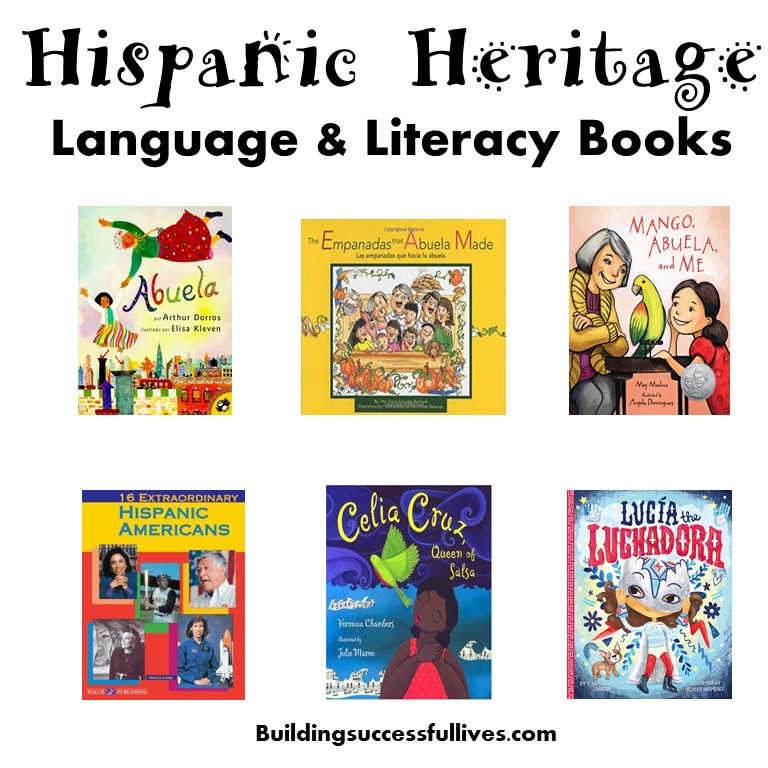
Hispanic American Heritage Language & Literacy Books
In the United States, September 15th-October 15th is known as Hispanic Heritage month. It is a selected time to nationally recognize and celebrate the contributions of Hispanics and Latinos in the fabric of U.S. society. The 15th marks the independence days of five Latin America countries: Costa Rica, El Salvador, Guatemala, Honduras and Nicaragua.
It is important to celebrate the culture, people, and achievements that the diversity of Hispanic and Latino culture provides to the United States.
Do you know the difference between the terms Hispanic or Latino? Hispanic refers to people who speak Spanish and those from Hispanic speaking countries. Latino encompasses people who speak Spanish or Portugese and were born in Latin America or their family are descendants from Latin America. Latin America includes Central America, South America, Mexico and certain Caribbean islands such as Dominican Republic, Puerto Rico and Cuba. Hispanic or Latino people are from various races. Although there are similarities, there is also diversity among Hispanic and Latino people. Each country of origin provides it’s own special contribution to the fabric of Hispanic and Latino society.
There are children’s literature authors that have purposefully wrote non-fiction and fiction books that highlight various aspects of this special culture. Here are a few book recommendations that speech-language pathologists, teachers, and parents can purposefully use with children. Children can learn about the diversity of the world while building language and literacy skills that are foundations for their life success.
16 Extraordinary Hispanic Americans by Nancy Lobb
This non-fiction book has various interesting biographies of Hispanic Americans that have influenced society in a positive way. Children can learn about the lives of labor/civil rights activist Cesar Chavez, astronaut Ellen Ochoa, author Sandra Cisneros, actress/dancer/singer Rita Moreno, politician Ileana Ros-Lehtinen, and other significant people. As an added bonus, the author provides comprehension questions at the end of each biography. Speech language pathologist and teachers can use this book to build children’s listening comprehension and vocabulary skills.
Abuela by Arthur Dorros
This is a beautiful story about a little girl, Rosalba who spends a day with her grandmother in New York city. They first travel on the bus and go to the park. They feed the birds and Rosalba imagines what it would be like to fly like a pajaro or bird. The rest of the storyline transports the readers and listeners on an adventure around New York city. Where will they go? What will they experience? What does Rosalba love most about her special day?This book uses many Spanish words throughout the story. It includes a glossary at the back with the English meanings and the Spanish pronunciations.
The Empanadas that Abuela Made by Diane Gonzales Bertrand
Las Empandas Que Hacia La Abuela
Diane Gozales Bertrand wrote this light hearted story as she recalled her experiences making and eating empanadas, a popular pastry, in Hispanic and Latino culture. I like that this is a bilingual book, written in English and Spanish. This book is good for speech-language pathologists or teachers to teach basic sequencing of events and learn about a food that is an intregal part of a Latino family’s culture . The story line is simple yet humorous as the readers and listeners are introduced to different characters and steps to make delicious empanadas with a fall ingredient, pumpkin. How will it taste? The author includes a recipe at the end of the book. There are definitely some savory and sweet ingredients like cinnamon and sugar in this loving family recipe.
Mango, Abuela, and Me by Meg Medina
This story describes a familiar story of many Hispanic and Latino families. In this story, Abuela, comes to live with her family because it was becoming too difficult for her to live on her own. The little girl will now share her room with her abuela or grandmother. After school, her grandmother watches her while her parents are at work. She is still learning English and the little girl doesn’t know a lot of Spanish. They share new experiences such as going to the park, making “meat pies” or empanadas, and learning new words together. One day, the little girl decides to buy a parrot when out shopping in the city with her mother. She names the parrot, Mango, because of his colors and as a gift for her Abuela who had a red parrot that frequently visited her mango tree in her home country. Mango becomes a new and special addition to the family. I recommend this book to teach vocabulary, listening comprehension, grammar in context, and to get a glimpse of Hispanic culture in a practical way.
Lucia the Luchadora by Cynthia Leonor Garzar
The author writes this entertaining and empowering story about Lucia, who likes to imagine that she is a superhero. One day some boys on the playground tell her that “girls can’t be superheroes.” What? When she goes home, she tells her grandmother or abuela all about it. Her abuela knows just what to do. She sews her an amazing and colorful superhero outfit and tells her all about the luchadoras, the strong and bold women from Mexico. Children will get a kick out of the rest of the storyline and the illustrations in the book. Just make sure that you have a discussion about fiction, non-fiction, school rules, and imaginative play! This is a fun book many young children will enjoy! Speech-language pathologists can use this book to work on vocabulary, story retell, and listening comprehension.
Celia Cruz Queen of Salsa by Veronica Chambers
Celia Cruz was a talented salsa singer and dancer from Havana, Cuba. She is well known in Latin America and influenced the culture. The illustrations are vibrant and the book is rich with vocabulary as it explains the life of Celia Cruz in a kid friendly way. She was an Afro-Cuban woman who overcame many obstacles in life while pursuing her entertainment career. She successfully achieved 7 Grammy awards and attained 23 gold musical albums. This children’s book also tells the story about her immigration to the United States and how she never got the opportunity to return to her home Caribbean island of Cuba. This book can be used in speech-language therapy or the classroom to teach story elements, basic comprehension, critical thinking, tier 2 vocabulary, and other language/literacy skills. There are numerous practice opportunities for children to build skills.
There are many other non-fiction and fiction books that are ideal for Hispanic Heritage interactive read alouds in speech language therapy, classroom, and/or at home. You may also like…
From North to South Del Norte al Sur by Rene Colato Lainez
Sonia Sotomayor Turning Pages, My Life Story
Harvesting Hope, The Story of Cesar Chavez by Kathleen Krull
The Princess and The Warrior by Duncan Tonatiuh
Waiting for the Biblioburro by Monica Brown
Amelia’s Show and Tell Fiesta by Mimi Chapra and Martha Aviles
Do you have favorites that you use in speech-language therapy or the classroom? Tell me in the comments below.

Back to School Language & Literacy Books
Most pediatric speech-language pathologists working in the school system and private practice enjoy using themes in speech language therapy sessions. August and September are great months to use Back to School themed books with young children to build communication, language, and literacy skills.
Here are a few of my favorite recommendations:
Amelia Bedelia’s First Day of School by Herman Parish
Amelia is very excited about going to school. She is still learning the meanings of many words and phrases. Her teacher, Mrs. Edwards is happy to have her in class. However, Amelia misunderstands many of the statements said by her teacher and classmates. She takes what is said very literally. This engaging storyline makes an ideal book for young learners to practice listening comprehension, vocabulary, and story retell. Here is a complimentary WH questions listening check for this book. WH Questions
The Name Jar by Yansook Choi
This is a well written realistic fiction story about a young Korean immigrant who is confronted with cultural assimilation at her new school. She thinks about choosing an American name because others can’t pronounce her real name. Her classmates start a name jar to put suggestions. Will she change her name? This book touches on many topics and is rich with vocabulary and opportunities for critical thinking. This book is great to use with 3rd-5th grade or middle school students with language disorders and learning disabilities. It’s an excellent instructional tool to use as a read aloud or mentor text in the general education classroom. Children can practice answering literal and inferential questions, tier 2 vocabulary in context, naming synonyms, and naming antonyms. Here are links to resources from my TPT store related to this book.
WH Questions Worksheets- Literal and Inferential
Elmer by David McKee
This author has a great series of books about Elmer, the patchwork elephant. This is a classic book that most children will enjoy. It has an excellent message for children to love who they are created to be. Elmer, the special patchwork elephant is unique, optimistic, and has a great sense of humor. In this book, he has an idea to blend in with all the rest, but learns to never dull his shine especially to be like others. This story teaches kids the value of embracing their individuality. There’s a special twist at the end of the book. This book is one out of several in a series skillfully written by David McKee. You’ll love the vivid illustrations too. This book is a perfect addition to your speech language therapy, classroom, or home library. Here’s the free listening comprehension check. WH Questions
Froggy Goes to School by Jonathan London
Jonathan London writes a humorous book series about Froggy! In this story, he is dreaming about his first day of school. In the dream, he forgets to do something very important before leaving home! This makes an interesting start to his school day. It’s a good thing that his dad wakes him up. This book is ideal for young language learners to practice identifying and naming tier 1 vocabulary of nouns, verbs, and adjectives. Speech-language pathologists and teachers should ask basic comprehension questions as well after an interactive read aloud. This is the WH Questions quick listening comprehension worksheet to accompany this engaging book. WH Questions.
Charlie Goes to School by Ree Drummond
This is a great story about a mother who homeschools her children. They live on a ranch and especially enjoy one of their favorite pets, Charlie, their dog. This is a realistic fiction book that is based on the life of the author Ree Drummond who lives in the country with her family. The story is interesting and the illustrations are beautiful as the author describes a typical school day of children who go to school at home and live on a ranch. This is an excellent book to use in speech language therapy, at home, or as a mentor text in the classroom. I recommend using this book to work on increasing listening comprehension, vocabulary, and the ability to compare/contrast. Children can practice describing similarities and differences about their school day whether they attend public, private, or homeschool. Click here for my accompanying complimentary WH Questions quick listening comprehension check.
Pete the Cat Rocking in His School Shoes by James Dean
I highly recommend this book for early language learners in preschool and elementary school. This simplistic yet engaging story has repetitive lines that are excellent for early communicators to practice oral language. They can imitate a speech-language pathologist’s or classroom teacher’s verbal modeling of key words and phrases during an interactive read aloud. This book is perfect for naming basic nouns like street, sidewalk, guitar, bookbag, desk, hall, library, lunchroom, playground, slide, swing, school, friends, and bus. Kids can practice labeling verbs like strolling, sitting, reading, eating, playing, painting, adding, writing, singing, and rocking. You can even target identifying and naming adjectives like sunny, tall, grassy, loud, colors, and size vocabulary based on children’s language needs. Then have them sing the catchy tune for this book. Check out the fun You Tube read aloud/sing along of this fantastic book! Use it with kids with autism, learning disabilities, and speech/language impairments. They will LOVE it and build communication, language, and literacy skills too!
What are some of your favorite books for Back to School?
Tamara Anderson, M.S., Ed.S., CCC-SLP
Speech-Language Pathologist
Education Specialist
