


Spring Into Literacy {Teaching Compare & Contrast}
I absolutely LOVE integrating literacy activities in my speech-language therapy sessions! There are so many skills that you can target while using fiction and non-fiction text.
Recently, I decided to use the 2 books pictured above, There Was An Old Lady Who Swallowed a Chick! and There Was An Old Lady Who Swallowed a Frog! to target teaching my lower grade elementary students the concept of compare & contrast. For them, I introduced the skill as explaining similarities and differences. During one session, I read aloud one of the stories and we talked about the sequence of events. Then we briefly talked about how that book was similar to others we read earlier in the year. For an extension activity, my students completed this book with assistance.

Then another session, I read aloud the book, There Was An Old Lady Who Swallowed a Frog! Then we talked about how that book was similar and different to the one that I read last session. Then they made their book.


I used non-fiction text to teach my 4th and 5th grade language therapy students the skill of compare and contrast. Over several sessions, I read aloud passages from my Historical Irish American unit. Then my students selected 2 people to write down on their Venn Diagram such as Walt Disney and Ronald Reagan or John F. Kennedy and Henry Ford. I modeled for them how to find similarities and differences from the text and then write them down in the correct part of the diagram. Lastly, they took turns verbally comparing and contrasting what they learned. This is a great activity for students to practice synthesizing what they have learned.
Here is a picture of 2 completed Venn Diagram for this unit.

You can purchase your copy of the Historical Irish Americans unit in my TPT store so you can teach this skill to your speech-language therapy or language arts students. Click here for direct access to the digital download of this product!
https://www.teacherspayteachers.com/Product/Historical-Irish-Americans-Speech-Language-Therapy-Curriculum-Unit-1770313
Thanks for reading the blog today!
Tamara Anderson

Recognizing African American History {Children’s Literature Reviews}
So many children today have a very limited knowledge about the influence of African Americans in the United States. A great way to teach students about this is by reading them biographies, historical fiction and non-fiction text. I enjoy reading aloud to children in my speech-language therapy lessons. They learn factual informational while also practicing their speech-language skills.
Here are 3 of my recommendations that I read and discussed with my students this month. Although Black History is celebrated during the month of February in the U.S., these books can be read at any time of the year. Likewise, students should continue to learn about African American History all year long as well.
This is an engaging biography that describes Hank Aaron’s determination to play professional baseball at a time when Jackie Robinson was the only other black player. The illustrations are excellent and truly help the story come alive as Hank Aaron beat Babe Ruth’s record of hitting the most home runs. In 1974, he hit his 715th home run! The book also tells the story about how he persevered despite the discriminatory threats that he received because of the color of his skin. My speech language students enjoyed learning that he played for the Atlanta Braves, when his original professional team, the Milwaukee Braves moved south to Georgia. That detail helped them connect to the story since we live in metro Atlanta, Ga.

Grandma’s Pride is a beautifully written historical fiction book told from the perspective of a little girl, Sarah Marie, who travels to the south with her family during the summer to visit her grandmother. The precious little girl quickly learns the differences between how blacks experience life in the northern U.S. versus the southern U.S. On her journey, she experiences having to sit in the back of a bus, not being able to use certain public restrooms, not being able to eat at certain downtown restaurants, and the tenacity of her grandmother whose pride would not allow her to ride the city bus. I like this book because it gives children a glimpse into what life was like during the civil rights era of the 1960s when Jim Crow laws were enforced. Through the voice of a child, they are also able to hear how in a later summer visit, the unjust rules of the south were no more!

Freedom on the Menu: The Greensboro Sit-Ins is another excellent historical fiction book that tells the story about a young girl, Connie, who sees first hand the boldness of four college students from North Carolina A & T. The young men, her brother’s friends, decided that enough was enough and they planned a “sit in” to quietly protest their lack of service at a lunch counter in Woolworth’s, a popular downtown department store. They sat at the lunch counter and requested to order food. They were denied and asked to leave due to the Jim Crow laws. This book will evoke questions and emotions from children. Most will empathize with Connie, who wanted to order a banana split at Woolworth’s the day she saw her brother’s friends. This story also comes full circle as the author summarizes events that this incident sparked such as more lunch counter “sit ins”, a visit to Greensboro by Dr. Martin Luther King, and additional non-violent protests for civil rights for African-Americans. I love that this story is also told through the eyes of a child who was able to sit at any lunch counter and enjoy her banana split after the Supreme Court ruling that those Jim Crow laws were unconstitutional!
There are so many great books out there to help children recognize and understand African American History in the United States! I also created a non-fiction curriculum unit so children can learn about historical African Americans. You may check out that resource here: https://www.teacherspayteachers.com/Product/Historical-African-Americans-Speech-Language-Therapy-Curriculum-Unit-1713341
Thanks for reading the blog today.
Tamara Anderson
January Children’s Literature Reviews {Winter Themed}
One of the best parts of winter is getting to read new fiction stories to my speech-language therapy students. Although I do not love cold weather, I do love reading winter themed stories. Here are my 5 favorite books that are ideal for January and even next month as the feeling of winter may still be very present in your area and even here in Atlanta!
I absolutely love the books written by Jan Brett!!! My speech-language therapy students are always engaged when I read aloud her stories. This week I had a break through moment when a student finally used her correct tongue placement for the /l/ sound during articulation practice during my read aloud! I was so excited!!! This is a student with moderate intellectual disability who struggled immensely with tongue elevation and placement for this sound and woila! She nailed it several times while reading The Three Snow Bears by Jan Brett!

This is a fun book that follows Aloo-ki a native Inuit girl on an adventure as she searches for her huskies or sled dogs. Along the way, she discovers an igloo and makes herself quite comfortable in the home of Papa, Mama, and Baby Polar Bear. I love this winter themed twist of Goldilocks and the Three Bears and my speech kiddos do too!! This book is great when working with articulation, speech fluency, and language students!
I also like, The Mitten as well as The Hat by Jan Brett. These books are ideal for preschool and early elementary aged kids who need practice with sequencing, verbal narratives, answering yes/no questions, and answering “wh” questions. Both books follow a simple story line. The Mitten is a Ukrainian Folktale about a boy, Nicki, who loses his white mitten made by his grandmother in the snow. Before he finds it, several animals make it their new home until the bear sneezes and they are all suddenly thrown out of their new dwelling.


The setting of The Hat is a Scandinavian farm where a little girl, Lisa, hangs her winter clothes on a clothesline. Hedgie, the main character, gets a wool stocking stuck on his head and he tries to convince his animal friends why it’s a good thing. Unfortunately, his friends tease him and tell him that he looks ridiculous! Lisa eventually finds Hedgie with her stocking meanwhile the other animals end up running around the farm wearing other winter clothes that they took from Lisa’s clothesline. At the end of hte story, Hedgie comments by saying, “Don’t they know animals should never wear clothes!”
My other favorite author of winter themed books is Caralyn Buehner. My students and I absolutely adore Snowmen At Night and Snowmen All Year because they enjoy seeing what activities the characters will do next.


Thanks for reading the blog today.
Tamara Anderson
October Children’s Literature Reviews
Here are my children’s literature reviews for books to use during the month of October. The first two books are ideal for addressing listening comprehension and vocabulary skills with children who are learning everyday Tier I words.

Here’s a snapshot from one of my favorite pages:


Fiction Book Series # 2 {Froggy}
As you may know, I love using literacy during my speech-language therapy lessons like most SLPs. I have many students who have speech objectives to verbally retell stories and answer literal/inferential questions from fiction text.
My younger elementary school aged students enjoy the Froggy series books by Jonathan London. The stories are engaging and the illustrations are great too!
The majority of these books are at a 2nd grade reading level. During speech-language sessions, I read aloud these stories with my students in grades K-3. The majority of my students with language impairment also have a language based learning disability and are reading below grade level. However, their listening comprehension skills are usually higher.
Here are four of the books from the Froggy series that I used within the last few weeks.

What are some series that your students or children enjoy? Follow the blog for more posts about other fiction book series.
Tamara

Fiction Book Series # 1 {Pirate Pete}
Apparently tomorrow, September 19th, is International Talk Like a Pirate Day. Say what?! This is certainly news to me because this day has always been and will forever be my dad’s birthday! Happy Birthday to an extraordinary man, a.k.a. Mr. Retiree, who I love dearly!

This week, I decided to introduce pirate themed fiction stories because I love literacy! Plus, I figured my students would get a kick out of knowing that there is such a holiday that celebrates pirates.
The First in the Series by Kim Kennedy is Pirate Pete. In this story, he travels to Mermaid Island in search of treasure. He is guided by the map that he mischievously took from the Queen. Pete gets side tracked on his voyage and visits other islands along the way. His loyal parrot gets him back on track to finding the treasure!

Then, there is Pirate Pete’s Giant Adventure. This time, he travels to Thunder Island in search of a Sea Fairy’s missing blue sapphire. On the island, Pete meets an unexpected antagonist who is determined to ruin his adventure.

There is also Pirate Pete’s Talk Like a Pirate. In this book, Pete eagerly recruits new crew members to begin another voyage. He is convinced that they must all know how to talk like a Pirate! Arrrr matey!

These books are great to use in speech-language therapy sessions, reading activities in the classroom, and to read with your child as well! Here are some ideas of children’s activities to address speech language objectives and literacy skills:
- articulation practice of /r/ words in the text
- answering literal and inferential questions
- verbal story retell
- written story retell
- compare and contrast the stories in the series
- context clues for unknown vocabulary

September Children’s Literature Reviews
Hey there! The official beginning of fall will be here in a few days. For you football lovers out there, I am sure that you have happily immersed yourself into cheering on your favorite team on GAME DAY!! I know there are plenty of die hard college football and/or professional football fans. I live in Georgia Bulldog country! Go DAWGS!! I have to admit though that I am not much of a football fan because I attended a HUGE BASKETBALL university!! GO TARHEELS!!


Literacy Website Review # 2 {Technology}
I am constantly adding new grade level fiction and non-fiction text to my speech-language therapy resources. It is critical that speech-language pathologists support developing children’s literacy skills on a regular basis. I do this by addressing listening comprehension and vocabulary IEP objectives related to text at students’ instructional reading level. An instructional reading level is the level of book that they can read with adult support.

I love the website http://www.readinga-z.com/ because there is a ton of information on this site!You can search for books by different categories. I go right to the literature genre and leveled book collections when I need language therapy materials.
If you are an SLP supporting the 3rd grade Common Core Reading Standards, you should click on the tab for Fables and access these books:
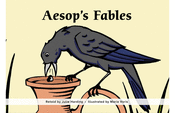
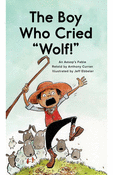
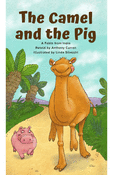
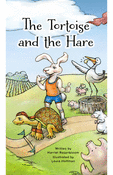
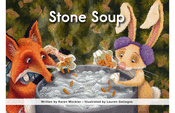
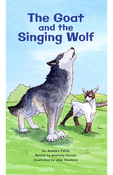
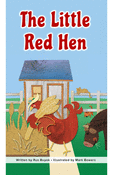
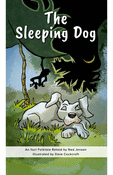
Each book is marked with an alphabetical letter that corresponds with a certain reading level. For example, the Boy who Cried Wolf is marked “Level E or 1st grade” but it supports the 3rd grade standard of teaching fables. I read aloud the stories to the children and have them follow along in a printed book. Then, I ask story comprehension and vocabulary questions. You can also have students practice story retell.
I love that this website also has vocabulary lists available that are already sorted into Tier I, Tier II, and Tier III words. How awesome is that! The SLP can teach kids how to use context clues to understand the meaning of the words.
You can also verbally model for your students how to verbally compare and contrast fiction/non-fiction text using the recommended paired book sets. Then have them practice this skill. This encourages kids to use higher level thinking skills to identify similarities and differences between the characters and events. Here is the link to access paired books by reading grade level: /http://www.readinga-z.com/book-related-resources/paired-books/
I frequently go to the leveled books tab when I want to differentiate instruction for my students. I will select a book for each child at their instructional reading level. For example, I may have a 4th grade student who is reading at a 3rd grade instructional level. So I may select level Q text such as:


Since I am a SLP, I read aloud the text so that the child is practicing their listening comprehension skills. However, I believe it is important to provide them access to books at their instructional reading level so they are not frustrated with their literacy practice. Their special education resource teacher addresses their reading decoding and comprehension objectives.
You may access some of this information on the site for free! However, I recommend paying for a subscription because it is well worth the money!
Thanks for visiting the blog today.
Tamara

Literacy Website Review {Technology}
Last school year, a friend of mine told me about roythezebra.com, a website that has an engaging fiction story, literacy worksheets, and interactive reading games. The story is divided into nine parts and features the main character, Roy the zebra. This is great to use as a group language therapy activity in the classroom.

This year, I am currently enjoying using this resource with two language therapy groups. Before reading the story, Roy the Tale of the Singing Zebra, I ask my students questions to help them make predictions about what the story will be about. Then I read aloud the story during a language therapy lesson in both a moderate intellectual disability class and a mild autism class. My students are enjoying viewing the story as it is displayed on the whiteboard and listening to my animated oral reading. In one of the classrooms, I am using Mimio software that allows me to easily click through the pages of the story by touching the stylus pen on the white board.
At the beginning of the story, Roy lives in a zoo where all his favorite activities of singing, dancing, and rolling around are banned. In part two, he is eager to escape from the horrible zoo and gets help from his friend George and his elephant friend Lucy. At the end of each part, my students want to know what happens next but they have to wait until the next weeks lesson.
I recommend that the SLP or teacher pause the reading of the story at times to model “think alouds” by asking questions. This helps check for story comprehension and teaches them to think while they are listening. This is especially necessary for students with language disorders because of the unknown vocabulary that is embedded in the story. There are discussion questions available for use after reading the story to further check for understanding.
There are 27 literacy worksheets available or 3 for each part of the story that may be used after listening to the story. The worksheets address skills such as sentence construction, correct use of punctuation marks, capitalization, story sequencing, rhyming words answering literal comprehension questions, and character perspective taking. I think the worksheets are great to use as extension activities by the speech-language pathologist or the teacher as appropriate by the skill taught. However, I typically ask students verbal questions and ask them to orally respond due to time constraints during language therapy lessons.
Additionally, this literacy website has interactive whiteboard lesson plans that can be paired with provided learning games to teach literacy skills. An associated worksheet is also available to be completed as classwork or homework. I have not personally used the interactive games, but have reviewed them online and told the special education teachers about them. Some of the learning games are free and some you have to pay $6.95 to access them.
Here is the list of the free learning games:
Alphabetical Order- sequence words in alphabetical order
Double Consonants- add word endings (ff, ss, bl, br, cl, cr, ck, ng)
Singular or Plural- sorting activity to distinguish between singular and plural nouns *This is a great activity for SLPs to use.
Long Vowel Phonemes- identify target sound blends by clicking on them to make new words *Certain sounds such as “er”, “ir”, “or” would be great to use with students practicing their speech articulation of vocalic /r/.
Rhyming words- identify words that sound the same or rhyme
Here is the list of the learning games available for purchase ($6.95):
Consonant Blends- targets phonological processing skill of blending and segmenting consonants to make CVCC words
Long Vowel Phonemes- complete access to learning game; add vowels to make new words
Tim Bowerbank in the creator of roythezebra.com. He was inspired to create the character Roy, after a trip to South Africa. He requests that all users register on the website and subscribe to his literacy newsletter before using the free resources.

I encourage you to integrate technology in your speech language therapy lessons or instructional time in the classroom. Thanks for the reading the blog today.
Tamara Anderson

August Children’s Literature Reviews
I love using children’s books in my speech-language therapy sessions with my students. I enjoy reading aloud to my students and popping in that oh so lovely CD to play an audio book for different group sessions. Either way it is a win win situation because students are typically engaged in the story and there are so many speech language objectives that can be addressed.
Last week, I used the audio CD that read aloud the book, Teacher’s Pets, by Dayle Ann Dodds. I was lucky to have multiple copies of the book so that my students could follow along with the read aloud. The audio teaches them to listen for a chime to turn the page.
This is a delightful book about Miss Fry and her elementary school aged students. In their class, each Monday is sharing day. One Monday, Winston has the creative suggestion for his classmates to share their pets. Your students will love turning the pages to find out the pet each character in the book brings to school. This is a great way to discuss sequencing of story events.
The first Monday, Winston brought in his pet rooster. The next Monday, Patrick brought his pet tarantula. Then the class got to see Roger’s cricket, Alia’s goat, Amanda’s dog, Jerry’s snake, Megan’s cat, Mitchell’s mice, and so on.
Last week I used this book with my speech-language students with co-occurring autism, moderate intellectual disability, and learning disabilities. They all smiled as they listened and eagerly turned the page with each chime! After listening to the story, they verbally answered literal “wh” questions about the characters, setting, and events in the story. One of my students in my intellectually disability group especially struggles with initiating oral expression. For her, I wrote out the questions and showed her a visual choice of 3-4 answer choices. After that, she did a fair job with indicating her responses with visual prompts from the story as needed.
The previous week, I read aloud, Charlies Goes to School, by Ree Drummond.
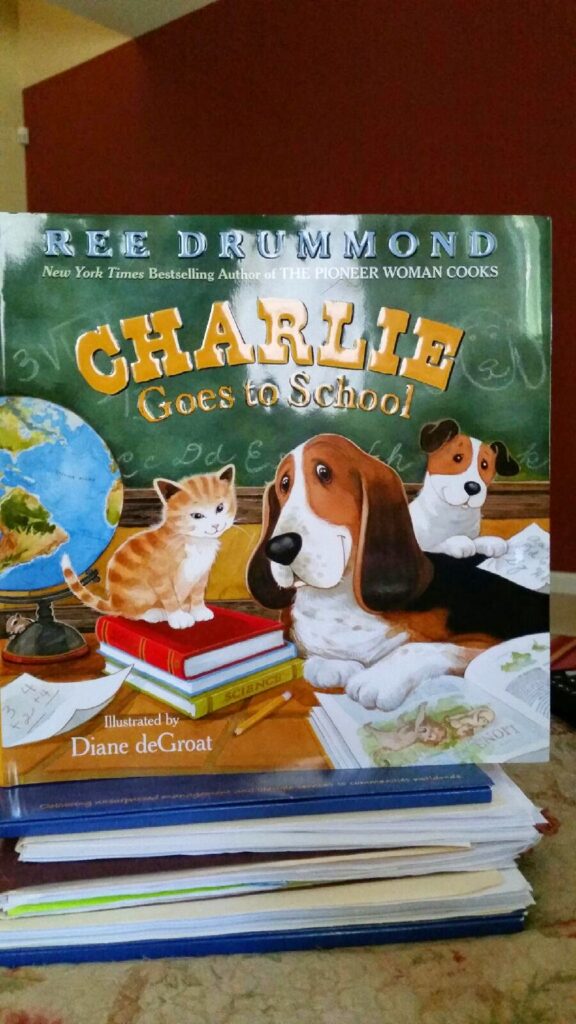
I love this story because the pictures are so vibrant as well as realistic and it is told from the perspective of Charlie, the ranch dog as he explores the ranch for the day. This is a great time to remind students about the meaning of the word fiction as the main character engages in activities that dogs don’t do in real life, such as teach school to animal friends. Charlie invites the reader to explore what life on the ranch is for his human and animal family.
He introduces us to the other characters: daddy, cowboy Josh, mama, the kids, Suzie the dog, Kitty Kitty, ranch horses, cows, and Walter the dog. He tells us that his human family goes to school at home and gets inspired to teach his animal family reading, math, and history. Well you can just imagine how well turns out for the animals! They have difficulty focusing, want to play, and Walter the dog even falls asleep.
Since I read Charlie goes to School aloud to my students, I modeled “think alouds” along the way by making additional comments and asking questions to check for story comprehension.
I definitely recommend these awesome books for use during speech-language therapy lessons or reading class.
I also recommend a rubric to measure students’ abilities to orally retell fiction stories. The SLP or teacher records a score of 5 to 0 in each performance element category: characters, setting, problem or rising action, solution or falling action/conclusion. To calculate a score, just add up the points in each category. To calculate a story retelling percentage of accuracy divide the score by 20, that is the total possible points. I recommend audio recording your student’s story retell for easier scoring using the rubric.
This product was revised last week and it is available in my TPT store here: http://www.teacherspayteachers.com/Product/Oral-Story-Retelling-Rubric-819201
Thanks for visiting the blog today! 🙂
Tamara Anderson
