


Summer Language & Literacy Books
Summer is a great time to introduce new books into speech-language therapy sessions, read aloud time at home, or extended school year classes for children with special needs. I enjoy using a variety of seasonal books during early intervention evaluations and speech-language therapy sessions. There are several authors that are my favorite to use to elicit and build growth of children’s receptive and expressive language skills.
Children tend to gravitate towards books with colorful pictures and characters. They are interested in looking at these types of books and will often attend during shared book reading. There are some children who have a limited attention span that will not sit during sharing book reading, but it’s always good to have great summer books available that may spark their interest. Here are few recommendations by authors and illustrators:
Bill Martin Jr & John Archambault– Authors, Lois Ehlert-Illustrator
Chicka Chicka ABC (20th Anniversary edition of Chicka Chicka Boom Boom)
This is a popular and engaging book for toddlers, preschoolers, and early elementary school aged children. The repetitive lines are great for children to develop early literacy skills while learning about the alphabet. This book is great for young kids to practice naming basic nouns (e.g. tree, coconut), adjectives (e.g. colors), spatial concepts (e.g. top, up, down). Have fun with this book by pairing the repetitive lines with clapping or other body movements. Model for children and have them imitate language and body movements. You’ll see how quickly many will learn to say some of the phrases in the book! Chicka Chicka Boom Boom!
Ten Little Caterpillars
This simple story book is great for kids who love bugs! During an interactive read aloud, a speech language pathologist, teacher, or parent can stop along the way and have children comment about what they see on the page. They can name and describe the objects such as flowers, caterpillar, jar, spider, leaves, stem, melon, bird, dragonfly, and butterfly. You may emphasize sequencing words such as first, second, third and verbs such as crawled, wriggled, and climbed. Make sure that you pause to see what children notice. It’s always important to give them time to comment. This book has one simple sentence for each illustrated page, yet provides multiple opportunities for an adult to facilitate children identifying and naming objects. Give children time to comment and build language. At the end of the story, they can practice counting, naming the type of caterpillar, and naming the type of type of butterfly or moth. A great extension activity is going on a nature hunt to see how many caterpillars or butterflies they can see outside in 30 minutes! Kids learn through experience!
Jonathan London– Author, Frank Remkiewicz- Illustrator
Froggy Learns to Swim
This is a fun story about Froggy, a little frog, who is nervous at first about learning to swim. His parents take him to the local pond and before you know it he masters what he was born to do! After all, frogs love hopping around on lily pads in the water, floating, and swimming. Young preschoolers and early elementary school age children like seeing the adventures of this character, Froggy. Jonathan London’s writing style follows a similar beginning in his books with Froggy waking up and bouncing out of bed ready for his new adventure! This one is sure to elicit great communication and language skills too!
Froggy Goes to Grandma’s
Many children have nice memories of visiting their grandma and so does Froggy! In this story, his grandmother has special activities planned for his trip. He goes with his parents and sister, Polly in a taxi and then flies on an airplane to get to his grandma’s house. Children will get to see, listen, and/or hear about Froggy going to a museum, baseball game, amusement park, and bowling alley. Kids will learn about his best day of all that was actually at home with his special grandma. Hmm…I wonder what they did. It involves food! Yum! This book is perfect for preschool and early elementary school aged children. Children can practice:
listening comprehension
story retell
sequencing
tier 1 vocabulary
basic concepts
oral language
compare/contrast
oral reading
reading comprehension
The speech-language pathologist, teacher, or parent can extend the interactive read aloud of the Jonathan London books by having children discuss a visit to their grandparents’ home or time at the pool. Everyday routines and special activities are a natural way to increase language & literacy skills.
Two of my other favorite children’s book authors are James Dean who writes Pete the Cat books and Chris Van Dusen who writes about Mr. Magee and other stories. They are also the talented illustrators of their books. Check out these fun books for use in summer speech/language therapy sessions!
Pete the Cat Scuba Cat by James Dean
Pete the Cat Pete at the Beach by James Dean
A Camping Spree with Mr. Magee by Chris Van Dusen
Thanks for reading the blog today. Stay connected to the website for updates! Check out this link for other summer children’s book recommendations. https://www.buildingsuccessfullives.com/tell-me-about-summer-stories/
Tamara Anderson, M.S., Ed.S., CCC-SLP
Speech Language Pathologist
Education Specialist

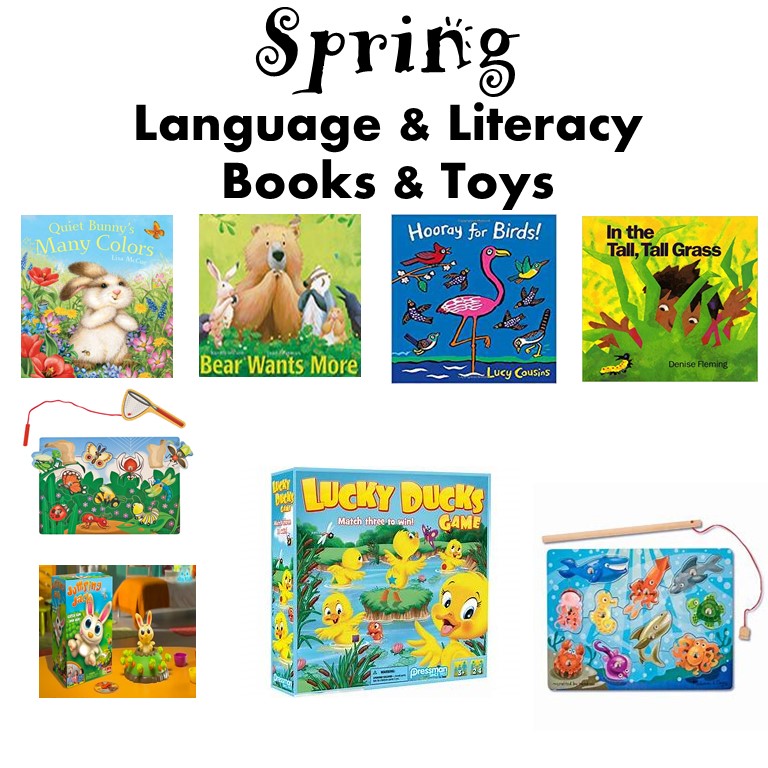
Spring Language & Literacy Books & Toys
There are many spring themed books and toys that may be used as therapeutic tools in speech-language therapy sessions with children. Speech-language pathologists may select the suggested resources recommended below in weekly therapy sessions. I prefer to have a variety of fiction books, toys, and activities ready to use. I often provide children a choice of 2-3 books, and have them select the one that they would like to hear read aloud. This helps keep preschool or elementary school aged children engaged when they have an active role in selecting the book.
Here are some suggested spring themed books:
Quiet Bunny’s Many Colors by Lisa McCue
This book has vibrant illustrations and a good message that teaches children that everyone is unique and that they should embrace their own individuality. The story is about a little bunny who loves spring and goes on an adventure discovering all the different colors of spring in the forest. He is amazed about all the various colors from the yellow dandelions, green lily pads, blueberries, and red tulips in the forest. Along his forest adventures, he wishes he could be more colorful until he meets a wise owl that reminds him that he is already special!
Therapy Ideas: Labeling (nouns, verbs, adjectives), Descriptions, Adjectives, Sequencing, Story Retell, Problem/Solution, Character Traits, Listening Comprehension
Bear Wants More by Karma Wilson
Many children enjoy this series of books. Bear awakens in the spring from his long winter sleep and he is hungry. First he nibbles on fresh blades of grass, but that doesn’t satisfy his appetite. His forest friends help him find more spring snacks. He enjoys the berries, clovers, fresh fish from the pond, and honey cakes. His friends even plan a spring party in his cave. There’s just one problem that needs solving for him to enjoy the party with his friends. What will they do?
Therapy Ideas: Sequencing, Story Retell, Problem/Solution, Character Traits, Listening Comprehension
Hooray for Birds by Lucy Cousins
This is an engaging and practical book for early language learners. Children are invited to imagine that they are birds. They see many species of birds busy in their natural habitats from morning time until night. They see a rooster, woodpecker, swan, parrot, starling, flamingo, peacock, flamingo, rooster, red robin, hummingbird, penguin, ostrich, peacock, and a night owl! Children will be focused on the colorful illustrations skillfully done by Lucy Cousins.
Therapy Ideas: Following Directions, Label nouns and verbs, Descriptions, Similarities, Differences, Build simple sentences
In the Tall, Tall Grass by Denise Fleming
This is an ideal book for early language learners who are learning basic vocabulary and how to communicate verbally and/or with AAC. This book also sparks children to imagine walking in the grass like the boy on the front cover. What are some living things that they might discover during the day? They will see caterpillars, hummingbirds, bees, birds, ants, snakes, moles, beetles, frogs, beetles, bunnies, fireflies, and even bats! Speech-language pathologists can pause during an interactive read aloud and have kids name the insects, birds, or animals. They can repeat simple sentences such as “I see the _________” , “I like the ____________” or “I don’t like the _____________.”
Therapy Ideas: Label nouns and verbs, Descriptions, Rhyming, Build simple sentences, Sequencing
Here are some suggested toys to use after an interactive read aloud and during follow up speech/language therapy sessions to build communication and language skills.
Melissa & Doug Insect Puzzle
Melissa & Doug Fishing Game
Lucky Ducks Game
Jumping Jack Game
These books and games may be used effectively in speech/language therapy to build skills in children with speech/language impairment, autism, learning disability, and/or intellectual impairment.
Guess What? There is a Spring Language & Literacy Contest today on Instagram. You may just have a chance to win one of these items or another great spring themed book or activity depicted in the IG contest photo.
These are a few other effective books with a spring theme that you may check out at your local library or purchase:
Turkey’s Eggcellent Easter by Wendi Silvano
*You may win this book and literacy companion in the IG contest!
There Was an Old Lady Who Swallowed a Chick by Lucille Colandro
Rain Drop Plop! by Wendy Lewison
The Very Hungry Caterpillar by Eric Carle
Pete the Cat and the Cool Caterpillar by James Dean
Spring for Sophie by Yael Werber
Pete the Cat: Big Easter Adventure by James Dean
There Was an Old Lady Who Swallowed a Frog by Lucille Colandro
Stay Connected to @buildingsuccessfullives on Instagram for contest details.

Building Critical Thinking Skills in Children & Adolescents
The majority of children and adolescents with language disorders struggle immensely with critical thinking skills that are essential to make effective decisions. They do not have the linguistic skills necessary for analytical thinking or adequate expressive language skills that are crucial for higher order language tasks. This requires comprehension of vocabulary, an ability to process language, background knowledge, and effective reasoning skills. When should you work on critical thinking skills in speech-language therapy?
It is important to work on these skills with upper elementary, middle, and high school students who have mastered learning tier 1 vocabulary words, answering literal wh questions, and have a basic understanding of a variety of vocabulary such as synonyms, antonyms, and multiple meaning words. If they have a language foundation in these areas they will be better equipped to answer more advanced language processing questions such as problem/solution, compare/contrast, cause/effect, making inferences, making predictions, and verbally expressing opinions and reasons.
As speech-language pathologists, it’s best to provide visual supports to help teach these skills. You may use pictures or videos to help children and adolescents identify problems, determine plausible solutions, or make inferences. You may give them written sentence starters to help them compare and contrast. The level of the support that is required for each student will vary based on his or her foundational skills. Remember, that they will need plenty of language scaffolding and prompts to understand these tasks initially. Over time, they should require less prompts and cues to answer critical thinking questions.
Here are a few suggested resources with activities that you may use to address developing higher order language skills in speech language therapy:
1. DOT Reasoning and Problem Solving – Speech Corner
2. Reasoning Workbook- Speech Corner
3. No Glamour Inferences- Super Duper Publications
4. Inferences Card Deck- Speech Corner
5. Treasure Trove Auditory Inferences- Speech Corner
6. Critical Thinking Quick Take Along Mini-Book – Super Duper Publications
7. Elementary Photo cards- LinguiSystems/Pro-ed
8. Language Empires App- Smarty Ears
9. Use your favorite picture books!
10. The Foundation for Critical Thinking Resources
K-3: http://www.criticalthinking.org/pages/elementary-educators-k-3/802/
4-6: http://www.criticalthinking.org/pages/elementary-educators-4-6/809
Are you not sure where to begin language therapy to address increasing critical thinking skills in children and adolescents?
I suggest using my informal Critical Thinking Progress Monitoring Tool. This will give you information about the child’s strengths and weaknesses with a variety of critical thinking skills.
Do you need more formal measures to assess these skills? I recommend the following standardized measures:
Test of Problem Solving 3 Elementary (TOPS-3)
Test of Problem Solving Adolescent (TOPS)
CELF 5: Semantic Relationships, Reading Comprehension subtests
CELF 5 Metalinguistics
CASL (Supralinguistic Subtests)
What are some resources that you enjoy using with success to increase critical thinking skills of children and adolescents with language disorders? I welcome your suggestions in the comments section.
Six Vocabulary Building Steps for Speech-Language Therapy
Vocabulary knowledge and expression is critical for children and adolescents’ success in communicating their ideas and summarizing curriculum information. But what about those with communication disorders, language disorders, and learning disabilities? They often have a limited vocabulary that hinders their ability to comprehend information and clearly express their thoughts. They need direct instruction from speech language pathologists to learn vocabulary building strategies. They need multiple exposures of a word to transfer it to their spoken vocabulary. They need opportunities to hear new words, speak them, read them, and write them in the appropriate context. Children and adolescents need to be taught high frequency tier 2 vocabulary words. However, young children also need therapeutic intervention to expand their semantic processing skills of Tier 1 everyday vocabulary. Did you know that there are six vocabulary building research based steps that speech-language pathologists can use during intervention? Yep. You may have activities that have words that you want to teach, but how do you go about it?
Where do you begin? First, you need assessments to determine where to start in speech language therapy sessions. I’ve got you covered as my Vocabulary Progress Monitoring tool directly addresses semantic processing skills. With information from these informal assessments you can effectively determine starting points in therapy and quickly determine growth over time. There is a hierarchy of progression for semantic processing of tier 1 vocabulary words and then kids move on to learning tier 2 words. Children typically learn to label, state functions, name word associations, convergent/divergent categories, explain similarities/differences of basic words, state antonyms, state synonyms and explain multiple meanings words (tier 2). I do not suggest teaching the words in the vocabulary progress monitoring tool, but you can determine where in the semantic/neurological hierarchy to target in therapy.
A metaanalysis of research studies confirmed that identifying similarities and differences had a 45 percentile gain in overall student achievement (Marzano 2001).
When children start kindergarten, they have varying levels of vocabulary knowledge and expression based on previous language exposure at home, preschool, and in their community. Speech-language pathologists may remind classroom teachers that they need to explicitly teach word building strategies to children. Teachers can use the Vocabulary Progress Monitoring tool for students in the Response to Intervention (RTI) process to evaluate what they know and monitor their progress after provided direct instruction.
Over the years, I have seen significant progress in children’s and adolescents’ communication and language skills when they are directly taught vocabulary and provided opportunities to learn and use new words.
In order to effectively instruct students during speech-language therapy, you must clearly understand the three tiers of vocabulary before you can implement the 6 vocabulary building steps.
Tier 1 words are high frequency vocabulary that are often heard everyday in conversation and learned by many children during incidental learning. These are basic level words. However, many young children with language disorders have a limited repertoire of these words and require direct instruction of these words.
Tier 2 words are high frequency and general academic vocabulary that are used across content areas. These include words such as analyze, compare, contrast, and multiple meaning words.
Tier 3 words are considered low frequency vocabulary because they are specific to curriculum subject matter such as social studies or science. These may be words such as topography, ecosystem, or molecule.
Speech-language pathologists should primarily focus on building Tier 1 and Tier 2 vocabulary skills for children and adolescents with language disorders because these are frequently occurring words in conversation and academic curriculum. So, what are the six vocabulary building strategies that SLPs may use in speech-language therapy? These are based on educational expert, Dr. Robert Marzano’s research over the years.
1. SLP describes a new word and provides an example.
This goes beyond saying the definition.
2. Child restates or describes the new term in his or her own words.
3. Child creates a non-linguistic representation of the word such as a drawing or acting out the word.
A metaanalysis of research studies confirm that non-linguistic representations led to a 27 percentile gain in overall student achievement (Marzano 2001).
4. Child completes an interactive activity to extend his or her understanding of the new word.
5. Child verbally discusses new vocabulary term with others.
He or she needs time for oral language practice. This is critical to deepening understanding of the word.
6. Child plays learning games to review new vocabulary.
I know that speech-language therapists provide countless descriptions of new words with visuals for children and adolescents during language therapy. Students complete many activities including word descriptions and play vocabulary learning games in therapy session. Nevertheless, it is important to keep in mind these 6 research based steps for vocabulary building. Dr. Robert Marzano’s research points out that it is important not to skip steps. Therefore, in clinical practice for SLPs, perhaps we should think about how many of these steps we are doing. Do our sessions have a emphasis at times on playing games in language therapy? Yes, it’s fun, but we must take the time to directly teach new vocabulary and not just jump to the activity or game. However, I do acknowledge that games such as Blurt do provide opportunities for the SLP and children to describe new words while participating in an interactive game. It is often in these opportunities that children can practice listening to descriptions, building word retrieval skills, and confirming their learning of new words. However, SLPs should try to implement the Six Steps for Building Vocabulary in their speech-language therapy sessions with children and adolescents. I acknowledge that SLPs have a limited time each speech language therapy session. Therefore, you most likely can not implement all 6 steps in 1 session. However, I encourage you to reflect on the suggested progression of steps proposed by Dr. Marzano and see if there are adjustments that you may make in your clinical practice to promote children’s semantic growth. As speech language pathologists, we are therapeutic specialists who can break down learning and give children multiple exposures to acquire new words both receptively and expressively.
Remember that “student’s vocabulary knowledge is directly tied to their success in school” (Marzano 2013).
References:
2013. Marzano, R., Simms, J. Vocabulary for the Common Core. Bloomington, IN: Marzano Research.
2004. Marzano, R., Building Background Knowledge for Academic Achievement. Research on What Works in Schools. Alexandria, VA: ASCD.
2001. Marzano, R., Pickering, D., Pollock, J. Classroom Instruction that Works. Research-Based Strategies for Increasing Student Achievement. Alexandria, VA: ASCD.
2007. Richard, G., Hanner, M. Language Processing Treatment Activities. LinguiSystems Inc. Austin, TX.
Do you want to read more articles about direct vocabulary instruction? Check out these previous posts on my blog.
Why Do You Teach Categorization in Speech-Language Therapy?
Why Teach Multiple Meaning Words?
Do you need activities to work on vocabulary building in speech-language therapy? I have several therapy activities for SLPs to use with children and adolescents available for digital download in my TPT store. You can also click on the vocabulary activities section under TOPICS on this blog. Just scroll back to the top to read more.

Say What? Listening Comprehension Progress Monitoring
Speech-language pathologists and educators know how important effective listening comprehension is for school and life success. Many children who have difficulty learning academic concepts and underlying language concepts struggle with listening comprehension. Active listening is an essential skill for children at school, home, and during everyday activities in their community. Often times, teachers notice when children are having a hard time listening, remembering details, and understanding what they are taught. The first thing to rule out or confirm is if children with suspected difficulty have hearing loss. After that, it is necessary to determine if children are having difficulty focusing and comprehending what is said, focusing only, or if they are focused but are still not comprehending what is said.
Children who have significant attention difficulties and truly have Attention Deficit Disorder (ADD) or Attention Deficit Hyperactivity Disorder (ADHD) may or may not also struggle with listening comprehension on a consistent basis. It will depend on if they have a system in place to manage their ADD/ADHD symptoms. Other children may be easily distracted or zone out in class due to medical needs (e.g. absence seizures) or social/emotional issues. It is important that service providers consider the possible reasons for a child’s behavior and academic performance. Other children may have difficulty with comprehending oral information because they don’t understand the vocabulary or are unable to make meaning of long sentences. Some children may also have difficulty with short term auditory memory and therefore struggle with remembering details during listening tasks.
Speech-language pathologists are frequently asked to consult on cases when children are struggling to follow verbal directions and comprehend verbal information from their teachers. Listening is one of 4 overall components of essential literacy skills for school and life success. The other 3 areas are speaking, reading, and writing abilities. Educators may use this informal assessment to evaluate children in preschool-5th grade. It will provide a quick overview of listening abilities of young children. Then teachers can select targeted intervention (RTI) to teach struggling students. Next they can monitor their progress by repeating relevant portions of the Listening Comprehension Progress Monitoring tool after children receive intervention for several weeks.
Similarly, speech-language pathologists can administer this tool to students already receiving speech-language therapy services. It can be given at the beginning of the school year for SLPs who work in the school system. It may also be given to children receiving private speech-language therapy services prior to receiving intervention in the area of listening comprehension. Use the portions of the Listening Comprehension Progress Monitoring tool that you determine is most appropriate for each student. There are basic 1 step directions, directions with embedded concepts (spatial, qualitative, quantitative, temporal, conditional), 1 sentence level questions, 3 sentence level questions, 5 fiction passages, and 5 non-fiction passages included in this product.
After several speech-language therapy or teacher intervention sessions, read aloud the same sections previously administered in this informal assessment tool. Each part of this tool may be given 3 additional times to monitor children’s progress over an extended period of time. If you prefer, you can administer a different fiction and/or non-fiction passage from this tool to monitor students’ progress after receiving speech-language therapy or Response to Intervention (RTI).
I recommend that you note observations and background information on this tool to help rule out and/or confirm potential related contributing factors to listening comprehension difficulty. Remember to note:
1) Hearing- within normal limits or not within normal limits (failed hearing screening, conductive hearing loss, sensorineural hearing loss)
2) Medical concerns- per parent report/file review (e.g. absence seizures, etc.)
3)Possible short term auditory memory difficulties- due to no response or incorrect responses to verbal instructions
3) Behavioral signs- distracted, appears to day dream, says “what” frequently, blank stare, appears frustrated, presents as lacking confidence, inattentive
You can see a preview of this product and gain direct access to this digital download in my TPT curriculum store.
If an SLP or teacher thinks certain children may have short term auditory memory weakness, they should receive an informal evaluation and RTI in that area. HearBuilder has a web based intervention program for auditory memory that may be beneficial to remediate children’s weak skills. It is also available as an app in the iTunes store. Private practice speech-language pathologists can also target remediating auditory memory difficulties as well.
If you have any questions or concerns about children with listening comprehension difficulties or with this tool, you may leave me a comment below or contact me here.

BUILDING LANGUAGE SKILLS THROUGH MINI LESSONS AND GUIDED INSTRUCTION
Keys to Successful Group Speech-Language Therapy Sessions
Speech-language pathologists who work in the schools have the responsibility of delivering effective group speech language sessions. Each child has various IEP goals and needs while the SLP’s job is to use therapy approaches that will contribute to each student’s progress. That lead me to think about how many teachers use mini lessons and guided instruction to yield students’ academic gains.
Mini lessons are taught by classroom teachers typically at the beginning of a reading or writing workshop. During the 10-15 minute brief lesson, a classroom teacher explains a specific skill or strategy, demonstrates how to use the strategy, and gives students an opportunity to practice the skill. After the mini lesson, the teacher gives instructions for students to participate in literacy centers, independent reading, or other independent assignments. While students are participating in different activities, the teacher speaks with children individually (conferring) or leads a guided reading group for more targeted instruction. Then they have 5-10 minutes at the end of reading workshop to review the skill of the day and for children to share about their reading work and progress.
Many school districts throughout the United States use this teaching and learning method in elementary, middle, and high school classrooms to build literacy skills. Several years ago, I completed a Reading Endorsement certification through Georgia State University. During this reading assessment and intervention training, I learned how literacy scholars such as Lucy Calkins implemented reading workshop and mini lessons as a part of their instruction to improve children’s language and literacy skills. The research shows that students make progress using this explicit instruction and practice.
I think school based speech language pathologists can use aspects of this methodology when providing group speech-language therapy sessions. This may be just what SLPs need to have more successful sessions.
MINI-LESSON +
GUIDED SPEECH/LANGUAGE INSTRUCTION +
CLOSING REVIEW= SUCCESS
By teaching a mini lesson, you focus on the skill that you want to teach, purposefully explain the skill, and provide verbal/visual models. Then you allow your students to practice. It’s important that speech-language pathologists don’t just skip to students’ practice of their IEP goals. The SLP must teach while providing verbal and visual models. I have used mini-lessons with many groups of students with speech-language impairment only as well as those with co-occurring specific learning disability and autism. However, use your clinical judgment to determine the students that are most likely to respond best to structured speech-language intervention that is not play-based. For those non-verbal or minimally verbal students, read this post for those therapy tips.
Here are 5 example mini lessons that you can teach:
1.Using a K-W-L chart to think about non-fiction
2.How can I compare and contrast vocabulary?
3.What are word associations?
4.Using context clues to identify challenging vocabulary
5.What is the difference between main idea & supporting details?
6.Story Elements or Story Grammar- What’s that all about?
Here are the related follow up speech-language activities:
1. Use No Glamour Reading Comprehension book in small group. Have students select a topic of interest and then a passage. Read aloud the passage. Tell them to listen carefully to information and be ready to share 1 new fact that they learned. Model for students how to write their new learning in the L section of the chart. During the mini lesson, the SLP should have guided them through completing the K and W sections about what they already know and what they want to learn.
2. Use LinguiSystems Elementary Photo Cards in small group. Give each student a card that contains two photographs of common objects. They should each get a turn to practice explaining how the words are similar and different. Give them written sentence starters such as “They are similar because they both__________” and “They are different because they _____________.”
3. You can use my Spring Word Associations packet to have students name related vocabulary words. This is a good activity to work on word retrieval and expressive vocabulary. This activity also allows the SLP to pre-teach spring theme vocabulary that can be used in future speech-language activities. I have other seasonal word associations packets in my online curriculum store.
4. Play a fun context clues game such as Context Clues Pirate Treasure by Learning Well Games. In this game, the SLP should read aloud the question card. Then, the students use the context clues strategy to make a prediction about the meaning of the underlined word. This game has multiple choice. If your students don’t need multiple choice, use the context clues cards from Vocabulary Chipper Chat. You may also use the context clues pages from my Non-fiction Bundle for guided practice. This gives them multiple choice. I usually have my students circle or highlight the vocabulary in the passage and I read the sentence while they think about the most logical meaning of the tricky word based on hints in the sentence.
5. Play Super Duper Publications’ What is the Main Idea? Fun Deck activity. Have your students listen for what the short paragraphs are mostly about. This activity provides them with multiple choice responses to help them think about the best answer. I also created main idea response sheets to keep track of the specific card numbers that they completed all year. This way they don’t repeat cards in sessions. Remind students that the details are the facts that are related to the topic or main idea.
6. Use the fiction story that you selected for Story Grammar Marker mini-lesson. Give your students the Story Grammar Marker manipulatives. Each student in the group can express parts of the story elements such as: character, setting, kick off, internal response, plan, actions, direct consequence, and resolution.
*If you think this vocabulary is tricky for your students to recall. You can teach them related vocabulary that the classroom teachers typically use (e.g. beginning/introduction, character, character trait, problem, middle, plot/events, solution, ending/conclusion). I also have a rubric with these story elements that you can use to measure students’ progress of oral story retelling skills.
Another option is to have them practice story elements vocabulary identification using my Guess What? Curriculum Vocabulary game. It’s available in my TPT store too.
Closing Review of Speech-Language Skill/Target
Before students leave the speech language room, make sure that you ask them, “What did you practice today?” or “What did you learn today?” If they can’t answer the question on their own, have them repeat a sentence that summarizes what they practiced. It is important that students understand what they are working on in speech-language therapy. The speech-language pathologist should review the teaching point to emphasize the focus of the session.
What is the evidence to support using mini lessons and guided instruction?
There is a ton of literature in the field of reading to support the use of reading workshop model that incorporates mini lessons and guided reading/explicit instruction.
Guided instruction is also an integral part of therapeutic intervention provided by speech-language pathologists. SLPs use evidence based strategies of verbal modeling, visual supports, prompting, cuing, expanding, recasting, and direct vocabulary instruction to guide students’ understanding and expression of specific speech-language targets. You can read more about these strategies here from my last blog post.
Here is the reference list for further information on this topic:
Atwell, Nancy (2010). The Pleasure Principle. Instructor Magazine. [electronic version] http://www2scholastic.com/browse/article.jsp?id=8132
Atwell, Nancy (2007). The Reading Zone: How to help kids become skilled, passionate, habitual, critical readers. New York: Scholastic Teaching Resources.
Atwell, Nancy (1998). In the middle. New understandings about writing, reading, and learning. New Hampshire: Boynton/Cook.
Fountas, I. C., & Pinnell, G. S. (2006). Teaching for comprehending and fluency: Thinking, talking, and writing about reading, K–8. Portsmouth, NH: Heinemann.
Fountas, I. C., & Pinnell, G.S. (1996). Guided reading: Good first teaching for all children. Portsmouth, NH:Heinemann.
https://www.scholastic.com/teachers/videos/teaching-content/reading-workshop-overview-0/
I know there are days when you may want to skip the mini-lesson, but don’t. It’s critical to your speech-language students’ success. Speech language pathologists do not have the same tasks as teachers to deliver instruction across content areas and academic standards. However, there are principles from a workshop model that may be adapted to therapy sessions while still maintaining a therapeutic focus. Remember…
MINI-LESSON +
GUIDED SPEECH/LANGUAGE INSTRUCTION +
CLOSING REVIEW= SUCCESS
ASHA states in their policy about the Roles and Responsibilities of Speech-Language Pathologists in Schools that “current research supports the interrelationships across the language processes of listening, speaking, reading, and writing. SLPs contribute significantly to the literacy achievement of students with communication disorders, as well as other learners who are at risk for school failure, or those who struggle in school settings. (ASHA, 2010)
Additionally, the April 2017 Language, Speech, and Hearing Services in Schools journal has a collection of articles about reading comprehension and the role of the SLP. Read the articles on ASHAWire, where you can access online journals related to the field of speech-language pathology. Previous articles in this journal contain relevant information about the need for explicit and guided instruction to improve literacy skills.
Speech-language pathologists should provide quality therapeutic instruction to improve the language and literacy skills of children and adolescents. Implementing mini lessons and guided instruction may be keys to improving these skills of those with language impairment in group speech language therapy sessions. You may also implement it during individualized sessions with children if you are lucky enough to have a few of those sessions. Watch your students learn and grow!
Strategies to Increase Students’ Success in Therapy and Beyond
Speech-language pathologists have a significant role in children’s communication success, learning and development. We are skilled at evaluating students with learning challenges and identifying those with communication disorders. We have the responsibility to provide speech-language therapy services using research based strategies and techniques to improve the communication and language abilities of children and adolescents. It is critical that we remain knowledgeable of these strategies as we provide speech-language therapy services. The therapy approaches and strategies used by speech-language pathologists will vary to some degree based on the disorder that they are treating and the severity. Here are strategies that SLPs can use to increase students’ success in therapy and beyond. Children and adolescents will learn to use many of these strategies as well during guided and independent practice so they can be independent communicators and life long learners.
ARTICULATION/PHONOLOGY
1. Auditory Bombardment (Wolfe, Presley, & Mesaris, 2003)
The speech-language pathologist exposes a child to the correct speech production of target phonemes during child centered activities. For example, the SLP may read aloud a story and emphasize words with the speech sound that the child needs to learn how to pronounce correctly. The SLP may read a list of words containing the target sounds. This will help kids enhance their phonological or sound awareness, rate of sound development, and generalization over time in their verbal communication. This is a component of speech sound perception training.
2. Auditory Discrimination Practice (Baker, 2010)
Children with articulation and phonological disorders need to be able to hear the distinct differences between phonemes. They can practice this skill during minimal pair drills that require them to identify and say words that vary by one sound.
3. Cycles Approach Practice (Hodson, 2010)
Children with phonological disorders and highly unintelligible speech benefit from the Cycles Phonological Pattern Approach that targets patterns of speech sound errors. During each therapy session, the SLP targets one or more phonological pattern error to improve speech intelligibility.
4. Phonetic placement and shaping/Gestural Cueing (e.g., Preston, Brick, & Landi, 2013)
The SLP teaches kids where to place their speech articulators to pronounce certain sounds. They can use physical prompts to help show them how to move their lips, tongue, or jaw to pronounce specific sounds that they are having difficulty pronouncing. In gestural cueing, the SLP demonstrates a motion or gesture to help the child visualize and remember the place or manner of production. This is used frequently in programs such as Lindamood Phoneme Sequencing Program (LIPS). Tactile cues such as PROMPT© (Prompts for Restructuring Oral Muscular Phonetic Targets) is a treatment method derived from touch pressure, kinesthetic, and proprioceptive cues (Hayden, Eigen, Walker, & Olsen, 2010).
After children learn the phonetic placement of the sound, the SLP provides practice for them to work on improving their speech articulation skills in a hierarchy moving from isolation, syllables, words, sentences, to conversation.
RECEPTIVE/EXPRESSIVE LANGUAGE
5. Verbal modeling and guided practice
In order to learn new skills, it is critical that children are first taught the skill and then provided several opportunities to practice. For example, if you want the child to learn how to explain similarities and differences, a speech-language pathologist must teach what each word means and then demonstrate the skill. During guided and independent practice, the speech-language pathologist should provide feedback about how the child is doing.
6. Visual supports
Most children with language disorders learn best when provided with visual aids. This may be a graphic organizer to help them remember and retell story elements or other visuals to help them remember how to complete semantic and syntax practice exercises. Children can also create their own visuals to illustrate vocabulary or content that they are learning in speech-language therapy and the classroom.
7. Direct vocabulary instruction (Marzano, 2004)
Children need repeated exposures of vocabulary words to truly comprehend them and to accurately use the words in their spoken and written language. Direct vocabulary instruction will increase their background knowledge, comprehension, and overall academic success.
8. Verbal prompts and cues
Speech-language pathologists provide students with verbal prompts and cues to support them in correctly answering questions related to their area of language need. This type of language scaffolding provides a bridge for students to link what they already know to new skills and content that they are learning. By providing verbal prompts and cues during a mini-lesson, the SLP scaffolds or breaks down the instruction in a manner that enables the student to learn a new skill and information. Other language scaffolding involves simplifying verbal directions. Prompts, cues, and language scaffolding should be faded over time.
9. Expansions
The SLP may expand or lengthen a child’s speech utterance to model additional vocabulary or a more complex syntax or sentence structure.
10. Recasts
The SLP modifies a child’s speech utterance by changing the type of sentence or voice. If a child says a statement, the SLP may recast or change it into an interrogative sentence. The SLP may also provide a verbal model by changing a sentence from active to passive voice to show variance of sentence styles.
11. Predictions/Inferences
The SLP may teach students how to make predictions or inferences based on illustrations in a book or the content of the fiction or non-fiction text. The SLP can help students connect what they already know (background knowledge) to deduce what will happen next or infer meanings of unknown words in language and literacy lessons.
12. Mental Imagery
Students practice visualizing what they hear or read to aid comprehension of information. SLPs can teach students to make a movie in their head so a story or topic comes alive or becomes more relatable.
13. Summarizing
The SLP can demonstrate how to summarize fiction or non-fiction information. Students can verbalize or write brief information highlighting the sequence of events or key points about what they hear or read.
14. Questioning
Students learn how to ask questions to ensure they are understanding what they hear or learn. They can write questions on reading passages to extend learning or seek clarification of information.
15. Think Alouds/Problem Solving
The SLP should demonstrate for students how to think critically during language and literacy activities. While reading a book, he or she should pause and model asking questions and making comments about what is going on. The SLP should provide multiple opportunities for children in speech-language sessions to answer critical thinking and inferential questions during a variety of age appropriate tasks.
FLUENCY
16. Speech modification/Fluency Shaping (Guitar, 2013)
These are strategies include pausing, easy onset, rate control, light articulatory contact, continuous phonation, and prolonged syllables.
17. Stuttering modification (Van Riper, 1973)
A child or adolescent will need to learn to recognize the moments of dysfluency by anticipating the non-fluent speech before it occurs, during a stutter, and after dysfluent speech. They will learn to use preparatory set, pull-out, or cancellation stuttering modification strategies to improve their speech fluency.
18 . Desensitization
This involves changing the student’s fear or apprehension about speaking in a variety of speaking situations. In speech therapy, the SLP can demonstrate pseudostuttering in a social scenario in which the client may stutter a lot such as talking on the phone or during a class presentation. The student should also practice this fake or voluntary stuttering as a part of his or her therapy regimen.
19. Cognitive Restructuring (Murphy 2007)
This involves the SLP teaching a student how to think about his or her feelings when they stutter. Any negative feelings must be addressed to reframe a child’s mindset about being a person who stutters. It is critical that the SLP address the emotional contributing factors to stuttering in order to effectively reduce stuttering episodes.
20. Generalization Activities
The SLP should provide opportunities for children and adolescents to practice fluency shaping and stuttering modification strategies outside of the therapy room. She or he could provide fluency strategy cards to use in the general education classroom. The SLP can help monitor the client’s communication in different settings and activities at school such as when checking out books in the library, talking with classmates, or giving a presentation in class.
In addition to these strategies, there are systematic therapeutic programs that SLPs can use to improve the speech-language skills of children and adolescents. However, the programs and techniques implemented will vary based on the clinical decisions of the therapist.
There are more approaches and strategies for students’ success available via ASHA’s Practice Portal for speech-language pathologists. This is an extensive resource that will ensure that SLPs have access to evidence for remediating communication disorders and improving their therapeutic efficiency. http://www.asha.org/practice-portal/

Using Play as a School SLP to Build Speech-Language Skills in Children and Adolescents
Play is a natural part of development for children that do not have learning delays. However, many of the students we work with in speech-language therapy have underdeveloped play skills. Play skills influence cognitive, social, communication, and language development. Speech-language pathologists are an important part of the school team that can help facilitate children’s and adolescents’ growth of the three main types of play: functional, symbolic, and game play. During structured speech-language therapy sessions, we can provide opportunities for children and adolescents to develop these essential skills while using strategies to increase their receptive and expressive language skills. Children can build functional and educationally relevant communication skills through play based activities.
Most speech language pathologists who work with preschoolers naturally incorporate functional and symbolic play based activities in therapy sessions. They do a great job of going in the classroom during center rotations or incorporating play during a circle time activity with their bag of fun toys. Young children learn how to build a tower with blocks, put a basic puzzle together, build Mr. Potato Head, and blow bubbles. They practice labeling nouns, expressing actions, making requests, and waiting for their turn during play. Speech-language pathologists may help preschool children engage in dramatic or pretend play with toys while eliciting communication skills.
As children get older, it is important to remember that SLPs can still play a role in facilitating functional, symbolic, and game play skills in elementary and middle school aged students. When you incorporate play in therapy sessions, students are typically more motivated to participate and initiate communication.
Here are 4 tips for elementary school SLPs to use while still addressing students’ IEP goals and objects:
1) Use toys as a reward after completing a speech/language task. Try using a First/Then chart with minimally verbal children. They should first participate in a structured activity such as listening to you read an interactive book and then play a fun learning activity such as sensory bin, puzzle, blocks, or play-doh.
2) Use Vocabulary, Grammar, or Social Skills Chipper Chat. Kids love earning tokens and playing with the magnetic wand. They practice turn taking skills with their classmates while working on their IEP goals.
3) Use learning games such as HedBanz, Blurt!, Vocabulary BINGO, or Jeepers Peepers to practice speech-language skills.
4) Play I Spy game in the speech room to work on following directions, speech articulation, identifying objects and describing objects using attributes.
Here are 4 tips for middle school SLPs to use while still addressing students’ IEP goals and objects:
1) Use a standard board game and language task cards that require them to problem solve, use context clues to explain meanings of words, explain cause/effect, make inferences, state fact/opinion, etc.
2) Play games such as Madlibs to work on parts of speech and syntax.
3) Play traditional games such as Apple to Apples, Jenga, and 20 Questions for kids to build skills.
4) Watch video clips about social scenarios and talk about the perspective of others, expected behaviors, and unexpected behaviors. Have your language students role play scenarios and you record them in action.
You may also use seasonal/themed open-ended reinforcer games to increase engagement of children and adolescents (e.g. basketball, St. Patrick’s Day theme, spring). I encourage you to think about how often you incorporate play based activities in your speech language therapy sessions. This is a valuable strategy that should extend beyond early intervention SLPs to those working with school aged children and across disability areas as well. If you work with students with Significant Developmental Delay (SDD), Autism, Moderate Intellectual Disability, Specific Learning Disability, or Speech Language Impairment only, incorporate play-based activities in weekly therapy sessions. They can build functional and educationally relevant communication and language skills using play-based learning activities. Kids will have fun and learn new speech-language skills too!
Resources:
Here’s a link to a Google document about Types of Play and Social Stages of Play.
https://docs.google.com/file/d/0B0CKyEb1Cv1jVElrMEpOYnVMNFE/edit
Here are links to free madlibs to work on parts of speech:
http://www.teach-nology.com/worksheets/language_arts/madlibs/
http://www.eduplace.com/tales/
You can purchase madlibs here (*Note: This specific madlib book seems appropriate for adolescents, yet others on website may not be kid or school friendly.):
http://www.madlibs.com/book/history-of-the-world-mad-libs-by-price-stern-sloan-9780843180756/
Here are links to free social skills videos:
https://www.youtube.com/playlist?list=PLtivQQ_34cJxNNo8fTpjE26zg3uXXqd9k

Effective Informal Assessments & Learning Activities From TPT { Top 20 List }
Over the last three and a half years, I have gathered an extensive collection of informal assessments and learning activities from Teachers Pay Teachers (TPT). Most speech-language pathologists (SLPs) and educators know that TPT is an educational website that has a massive amount of instructional products for elementary through high school aged students. These activities are specially created by SLPs and educators to improve the communication, language, literacy, and overall academic skills of students. I have been an SLP for almost 12 years and have created numerous assessments and therapeutic activities to promote gains in my students’ speech-language skills. Some of which are available in my TPT store. I truly love designing materials for my individual clients when I provide private speech language therapy and my elementary school aged students that I serve each week. Many of my resources are great for use by teachers with their students in the classroom as well to build language and literacy skills.
I have discovered that when working with children, it is necessary to have fun, engaging, and educationally relevant materials. It is definitely best practice to readily have informal assessments to gather baseline data that measure children’s knowledge prior to beginning therapy. This way you can accurately measure their growth and not target skills that they have already mastered. Similarly, it is important to have a variety of meaningful and interactive learning activities that will keep students motivated to learn. So, here is my top 20 list of Effective Informal Assessments & Learning Activities From TPT (Click on the link for direct access to products):
1)Speech-Language Therapy Informal Assessments Early Language
*This tool evaluates basic “wh” questions, yes/no questions, divergent categorization (naming items in a ategory), convergent categorization (naming category)
2) Basic Concepts Baseline Data & Progress Check Activity
* This activity evaluates spatial and qualitative concepts (prepositions/adjectives)
* There is also an instructional level of activity provided.
3) Vocabulary Progress Monitoring
* This is an informal assessment that measures students’ knowledge and expression of semantic processing skills: object function, associations, categories, similarities, differences, synonyms, antonyms, multiple meanings, oral definitions of tier 1 words with attributes, oral definitions of tier 3 words (academic), figurative language expressions
4) Speech Progress Monitoring
*This is a quick and easy data collection tool that measures speech fluency or occurrence of stuttering as well as speech intelligibility.
5) Oral Story Retelling Rubric
*Narrative development is a critical skill that is lacking in many preschool and elementary school aged children. I created this tool to have an informal assessment to measure their oral story retelling skills according to key story elements. It’s best to audio or video record a child’s speaking sample for an accurate analysis.
6) Speech-Language Therapy Curriculum Assessments
*These are a series of informal assessments that measure receptive E/LA curriculum vocabulary knowledge from the ommon Core State Standards.The assessments are in a cloze sentence (fill-in-the blank) format with a word bank.
7) English/Language Arts Vocabulary Progress Monitoring
* This is a curriculum vocabulary progress monitoring tool that measures children’s expressive E/LA vocabulary skills. There are 10 word lists with 105 total words in the areas of: story vocabulary, types of nouns, types of sentences, parts of sentences, parts of speech, types of literature, types of writing, text features, figurative language, and prefixes.
8) Guess What? Curriculum Vocabulary Bundle
* This bundle includes a series of 4 game sets to provide tons of practice for children to learn E/LA curriculum words. To play the game, a person selects a mystery word. Then others in the group use the included semantic maps or question prompts to guess the mystery word. The players take turns selecting a mystery word for others to guess. Kids have fun learning while playing!
9) English/Language Arts Comprehensive Categorization Bundle
* Categorization is a language organization skill that helps kids organize vocabulary, ideas, and academic concepts. They need direct instruction in this area to improve their memory, word retrieval, and overall language comprehension and verbal expression. This bundle provides tons of practice with categorization of curriculum vocabulary. There are 4 products included: sorting, memory game, category book, and categorization cards (tier I and tier III words).
10) English/Language Arts Common Core Standards Vocabulary
Bundle
* This is a task cards bundle that has 180 questions aligned with 2nd-5th grade E/LA common core standards. This product is great for language therapy or use in the classroom during small group instruction or whole group lessons. Skills address a variety of vocabulary, grammar, and E/LA content questions in a multiple choice format.
11) Back to School Baseline Bundle
* I use this product to collect baseline data as well as guided practice during speech-language therapy sessions. It includes practice with: synonyms, antonyms, homophones, homographs, irregular plural nouns, irregular past tense verbs, and word associations. I can easily differentiate instruction according to students’ learning needs during sessions by varying the questions asked.
12) Fall Speech-Language Activities Bundle
* In the fall, I use this bundle frequently for my students to practice fall themed vocabulary according to associations, multiple meaning words, and oral definitions with attributes (Tier I and Tier III terms). Kids can also practice identifying words when read definitions by the SLP or teacher from the included question prompts. The kids enjoy playing the fall themed game board all season.
13) The Mitten Speech-Language Activities
*In the winter, I use this book companion set with my students in grades 3-5. It includes articulation word lists, wh questions, synonyms, antonyms, and tier 2 vocabulary practice.
14) Valentine’s Themed Categories & Associations
*This is an engaging holiday themed activity to address 2 critical language language processing skills: ategories and word associations. Kids can verbally name items in categories and word associations as well as write responses on the included writing practice pages.
15) Winter Land: English/Language Arts Activities
*My students are always asking to play Winter Land. They love the game board from this product that I glued onto a larger poster board and then laminated. I use it all winter with the categorization task cards included and a variety of other learning questions.
16) Non-Fiction Language Bundle
* This bundle is excellent for use during speech-language therapy sessions or language arts lessons from February-March or year round. It includes a Historical African American Unit that has 7 non-fiction passages, 46 comprehension questions, 70 context clues questions (tier 2 vocab), compare/contrast pages, and 7 word association practice opportunities. The second product is a Historical Irish American Unit that has 6 non-fiction passages, 36 comprehension questions, 60 context clues questions, compare/contrast pages, and 7 word association practice opportunities. Additional units will be added such as Historical American Women.
17) Beach Themed Multiple Meanings Memory Activity
* Spring and summer are two of my favorite seasons. I created this product with beach photographs from my trips to Florida. The learning cards have homophones and homographs vocabulary that can be used to play a memory game. Children can also practice stating definitions of words or using them in sentences to convey the correct meanings.
18) Beach Themed Monster Trucks- Synonyms & Antonyms
*Many students struggle with word relationships including synonyms and antonyms. This free activity contains plenty of vocabulary practice for kids on task cards with “monster trucks” in the background. These photographs were also taken during a beach trip to Florida. My boy students especially enjoy this activity!
19) Parent Handouts for Communication Disorders
* This is a free resource guide that SLPs can give to parents that provides a quick overview of communication disorders. It briefly outlines the difference between speech sound disorders and language disorders. It also provides tips to improving speech-language skills including interactive websites.
20) Speech-Language Therapy Technology Resource Guide
*This is a complimentary resource guide to help SLPs integrate technology in therapy sessions. This will help vary activities in sessions and keep kids engaged during group sessions.
I know that this is a long list, but considering I have an extensive amount of products in my personal TPT library, I wanted to make sure that I give you my top 20 list from my TPT store! :) This is a great starting place for a new SLP/teacher or someone who wants some fresh materials to improve the communication, language, literacy, and academic skills of students.
Have a great remainder of the school year. Perhaps you can use a few of these effective informal assessment and learning activities with your students. I have 15 days remaining with my speech language students this year, but who’s counting! :)
Thanks for reading my blog today!
Tamara Anderson

Effective Year Round Speech-Language Therapy Materials {Top 15 List}
It’s official. This has been my busiest year working in the school system EVER! I have evaluated numerous students, provided direct speech-language therapy services for children in 1st-5th grade, served as one of my district’s team leaders, supervised a new SLP for her Georgia license. It’s been a great year overall despite it being hectic at times. There are just 19 days remaining for students!
Now that the end of the year is quickly approaching and my plate is not as full, I can reflect a bit about this school year. I always make sure that I have my frequently used materials literally within arms reach on the bookshelf by my therapy table.

I thought that you would like to know my top 15 effective speech-language therapy materials that I use year round. The students on my caseload have made progress on their IEP objectives using these resources. I purposefully did not include Teachers Pay Teachers (TPT) products or iPAD apps because I think those are worthy of a separate post. 🙂 Ok. Here is my top 15 list of effective year round materials categorized by disorder. I’ve listed the publisher in parentheses if you want to purchase the items (and no I don’t work for Super Duper Publications or other companies…lol).
Articulation/Phonology:
1) Webber’s Jumbo Articulation Book (Super Duper)
*Sometimes it’s best to KISS. Keep it so simple. This book is speech gold. It’s perfect for therapy and home practice. Plus, I had very few students with articulation or phonology disorders on my caseload so it was a great grab and go activity for speech sound drill work.
Speech Fluency/Pragmatic Language:
2) What Do You Say…What Do You Do…At School? (Super Duper)
*This is an excellent social skills game board. Kids can learn how to solve problems for real life scenarios. This game is great for kids to practice speech fluency strategies with oral reading, answering questions, and overall conversation.
3) The School-Age Child Who Stutters: Working Effectively with Attitudes and Emotions (Stuttering Foundation)
*I LOVE that this product has practical ideas for addressing the emotional aspects for children who stutter. I have several 1st-5th grade students on my caseload who stutter. They use components of this book to add pages to their personal fluency books that we create throughout the year. Their books have a ton of information about stuttering, their feelings, strategies, and therapy practice exercises.
Semantics/Sentence Building/Grammar:
4) Picturing Vocabulary Cards (Gander Publishing)
*These cards are ideal for labeling Tier I every day vocabulary, working on categorization skills, describing words, identifying attributes, and expressing simple sentences (e.g. I see the _____, I have the _______).
5) Webber Photo Cards- Verbs
*The title says it all, but I use these cards ALL the time. My students typically practice present progressive verb sentences with these cards (e.g The boy/girl is ______ + ing).
6) Define & Describe Double Dice Deck (Speech Corner)
*I like that this card deck has real photos of basic nouns. Kids can practice oral definitions with attributes or you place several pictures on the table and have them identify the card based on stated attributes.
7) Compare & Contrast Double Dice Deck (Speech Corner)
*I like that this card deck has real photos of basic nouns. The students love the “double dice” and selecting the card that matches the shape that they rolled. I use this often without the dice to increase the trials for oral language practice during group therapy when they describe similarities and differences of nouns.
8) Synonyms & Antonyms Double Dice Deck (Speech Corner)
*This deck has tons of Tier I and Tier 2 vocabulary for endless practice. I tend to use these cards if I want to increase the difficulty level for students working on naming synonyms and antonyms. I also like that the cards have pictures along with text for those that need visual cues.
9) Context Clues in Stories (Super Duper)
*My 3rd-5th grade students need plenty of tier 2 vocabulary practice. This product has 2 levels of cards. One has a short paragraph with a fill in the blank sentence for them to figure out the word from a field of 3 choices. The other has a color coded target word in a paragraph and a field of 3 choices for them to identify the definition.
10) Vocabulary Chipper Chat (Super Duper)
My students rarely complete worksheets in therapy sessions or play traditional board games, so they LOVE when they get to play this game. It’s amazing how earning tokens after answering learning questions with the added incentive of cleaning up the activity with the included magnetic wand keeps them motivated during a 30 minute session. This product is EXCELLENT to differentiate instruction based on your student’s vocabulary objectives! You can choose from these 12 skills: analogies, associations, attributes, categories, compare & contrast, context clues, figurative language, functions, homonyms/homographs, homophones, synonyms & antonyms, verbs
11) Grammar Chipper Chat (Super Duper)
This is a definite favorite activity for my students and ideal for differentiated instruction during group therapy. The kids each enjoy picking an animal themed game/token board. I like the variety of grammar skills that you can target and opportunities for oral language practice.
12) No Glamour Sequencing Cards (LinguiSystems now Super Duper)
*This product has a variety of colorful picture sequences. I typically give students only 3-4 cards and have them put them in order. I use these cards for kids to practice comprehension and expression of present, past, and future verb tenses. I pair the cards often with written text to assist them with comprehending/using different sentence structures.
General Receptive/Expressive Language
13) What is the Main Idea? (Super Duper)
*This resource is great for the majority of students on my caseload. They can practice their auditory comprehension skills by identifying the main idea from a field of 3 choices, retelling brief paragraph, or answering WH questions that you create.
14) Fiction & Non-Fiction Passages Binder (SLP created)
*I keep a binder of passages organized by reading levels that I can easily select. Many of my students have IEP objectives to increase listening/language comprehension skills when read aloud text and/or provided a copy of text at their instructional reading levels. They also have objectives to identify meanings of tier 2 vocabulary words using context clues from text. I use the instructional reading levels according to the level determined from reading assessments by their special education teacher. For example, I may have a 4th grade student who is reading at an instructional 2nd grade level. Therefore, I have found that my students improve their language and literacy skills over time when I use articles with specific readability levels.
*I use websites such as readworks.org, education.com, superteacherworksheets.com, and havefunteaching.com to print passages.
15) Fiction & Non-Fiction Books (My personal classroom library)
*Each month, I have a selection of books that I read aloud to my speech-language therapy students. I have seen tremendous progress in the speech and language skills of my students during literature based lessons. This is by far my favorite and most effective way to promote receptive and expressive language growth. My students truly enjoy when I read to them and are eager to name vocabulary, retell stories, identify problem/solution, identify cause/effect, and answer story elements/comprehension questions. They are proud when they correctly answer questions about the story. Most of the students on my caseload also have co-occurring language based learning disability, autism, moderate intellectual disability, and/or ADHD and I can honestly say that they are engaged when I use books in therapy. Make sure that you subscribe to my blog because I’ll share a list of my favorite seasonal/monthly books that I use throughout the year.
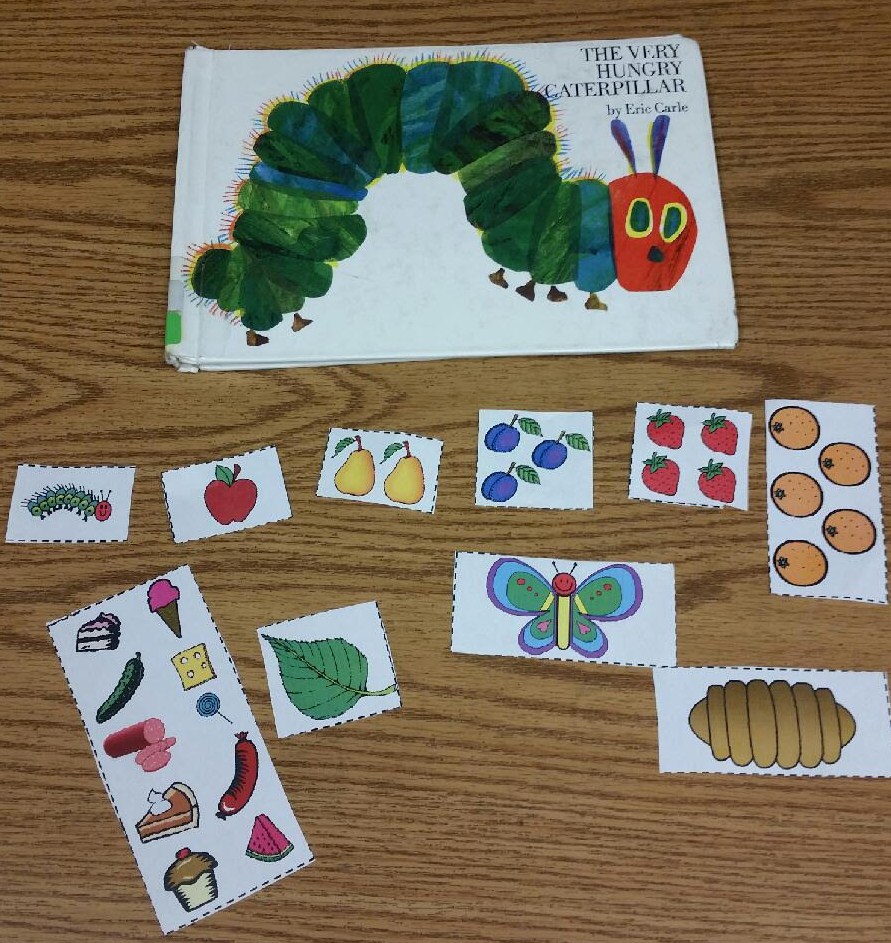
I hope that you enjoyed this post and have a few ideas about new products to use or new ways to target teaching speech-language skills using one of these resources that you already have.
Have a great remainder of the school year for all the school based SLPs! Check out my instagram: bslspeechlanguage for pictures of many of these products.
Tamara Anderson
