


Why Do You Teach Categorization in Speech-Language Therapy ?
Many children with language disorders struggle with understanding the skill of categorization. Pediatric speech-language pathologists frequently write objectives for children to improve their ability to name items in categories, name categories when given items in the group, and identify what items do not belong in a category. SLPs select these objectives in therapy often because a child did not demonstrate mastery of this skill on an assessment.
Do you really think about why this is such an important language concept for your client with communication disorder to master? As speech-language pathologists, we need to be able to readily explain to parents, special education teachers, and administrators, the reason we are targeting categorization in speech-language therapy as well as the skilled therapy techniques we use to improve this area.
Children need to learn categorization because it is a critical language processing skill. Semantic or vocabulary processing is a large part of how children understand language and effectively retrieve words. After young children learn to label basic nouns and express their functions (e.g. verbs) during their daily routines, they naturally progress to learn word associations. Categorization is typically the next skill in this developmental hierarchy.
Children need to learn categorization because when they do, it helps them effectively store new words and information in their brain. In doing so, they connect a new vocabulary word or concept to their schema or pattern of knowledge that they already know. For example, when a child learns the subcategory of desserts his or her brain makes an association because he or she already knows that is a type of food. When an older child learns about the water cycle, he or she can make meaning based on previous knowledge about weather, types of precipitation (rain, sleet, snow, etc.), and/or sequence of events.
Preschool children and children in grades K-2 with language disorders need to learn various categorization tasks with Tier I vocabulary words. They need to practice divergent naming task or expressing items in categories such as food, clothes, transportation, and shapes. They need to practice convergent naming tasks that require them to say the category name when told examples of items in that category. Similarly, they need to be able to distinguish what item does not match the group during an elicited task.
Children in grades 3-5 can further their development of categorization by practicing divergent and convergent naming tasks with Tier III academic vocabulary. Since many speech-language pathologists support teaching the language underpinnings of the common core state standards, they can teach their students how to categorize English/Language Arts vocabulary. For example, students can sort parts of speech vocabulary, types of nouns, types of literature terms, or figurative language vocabulary into groups. They can name Tier III words when given a category and state the category when given examples in this group.
So, what materials do you use to take data, instruct children, and provide language practice opportunities for categorization objectives? I have several items in my TPT store to work on these goals. Some of these include:
1) Categories Data Check- 8 forms to quickly assess Tier I vocab
* If you own my Vocabulary Progress Monitoring Tool, it will be updated with this expanded category data check. Email me if you have questions at [email protected]
2) My Speech Language Category Book- sorting Tier III E/LA
vocab
3) E/LA Comprehensive Categorization Bundle- Tier I & III vocab
4) E/LA Vocabulary Memory Concentration Activity
So the next time someone asks you why you teach categorization in speech therapy? You can remind them that you also provide language therapy and then effectively explain your rationale.
Thanks for reading my blog today!
Until next time,
Tamara Anderson

January 2016 Sale-bration! 1/20th-1/21st
I have some great news to share! My Teachers Pay Teachers (TPT) curriculum store will be on sale this Wednesday and Thursday! I am joining in on the fun for the Start Your Year Inspired TPT sale! You can save 28 % when you enter the sale code, START16, when you checkout. This is a great way to gain immediate access to some great speech-language therapy and English/Language Arts products. Don’t miss out on purchasing my specially created resources if you haven’t already!! Make sure that you follow my blog this week because it is also my 3 year Blogiversary and there will be other EXCITING announcements!!!!


It’s always great to have new activities to use in speech-language therapy and time-saving progress monitoring tools too! As busy SLPs or educators, it’s helpful when we have a variety of effective materials to improve the communication, language, and literacy skills of children! Thanks for reading my blog today. Until next time…
Visit my curriculum store here!
Tamara Anderson
Five Ways to Practice Speech-Language Skills Over Winter Break
Hey there everyone! Today is the last day of school for 2015 in my district and I am beyond excited about being on winter break for 2 weeks! I am sure that all the students are as well. Although the students will be on break from school, there are so many ways that they can practice their communication skills in their daily routines. I know that some of you will have private practice clients or a few days of work next week as school-based speech language pathologists. Make sure that you share these tips with parents.
5 Ways to Practice Speech-Language Skills Over Winter Break:
1) Retell events and experiences
*Children should practice describing specific family outings, activities, and experiences with as much detail as possible. They should try their best to recall and retell information in the correct sequence of events whether it is going to the ice skating rink or to grandma’s house.
2) Answer questions after listening to fiction or non-fiction story read by parents
*Children and families can visit the public library and check out books appropriate for their age. Parents should read aloud to their kids and ask them who, what, where, when, and why questions about the text.
3) Play speech-language games on interactive websites
*There are many websites that children can enjoy practicing their speech-language skills. Some of my top recommendations are
spellingcity.com, jacobslessons.com, do2learn.com, learninggamesforkids.com, and pbskids.org
You can access a more comprehensive list in Parent Handouts for Communication Disorders in my TPT store.
4) Play speech-language games on iPad
*Many children have either an iPad or android tablet. They can practice a variety of skills such as speech articulation, following directions, vocabulary, grammar, sequencing, and overall comprehension on apps. Parents can search for related apps in the app store by companies such as Speech with Milo, Super Duper, PocketSLP, Hamaguchi, I Can Do Apps, Smarty Ears and so many more! Many companies have free trial versions that enable kids to practice many skills while others will need to be purchased.
5) Use speech articulation and fluency strategies
*At home and in the community, children should practice using their best pronunciation of the sounds they are working on in speech-language therapy. Parents can remind their children to use the correct placement of speech muscles when asking questions, answering questions, and speaking to family and friends.
Overall, children can practice their speech-language skills in everyday routines! I hope you found these 5 tips beneficial. Have a great rest of 2015!
Tamara Anderson
Pete the Cat Holiday Freebie
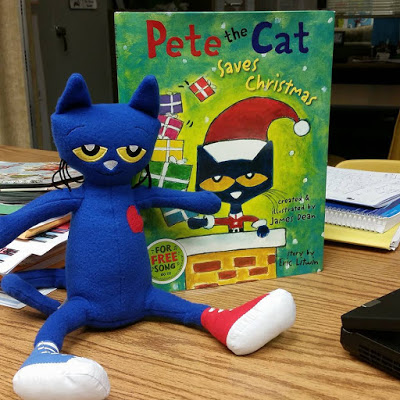
My speech language students LOVE when I read Pete the Cat stories to them. The holiday themed book, Pete the Cat Saves Christmas is no exception! This book is great to read aloud with preschool and elementary school aged kids on your speech language caseload. I created a quick “wh” questions comprehension check that has a field of 4 choices. You can access it in my TPT curriculum store.
Many of my students have IEP objectives that require them to answer literal questions from fiction text so this FREEBIE will be a great practice and work sample for that! I know many SLPs like having fun book companions with numerous activities, but I have found that sometimes it’s best to KISS. With this complimentary worksheet, you can keep it simple by having a quick and functional activity after your read aloud in a 30 minute session. I even used it with success in my moderate intellectual disability speech-language therapy groups!

Spring into Literacy: Teaching Phonological Awareness
Recently I have been working on phonological awareness skills with a 1st grade speech fluency student who also has difficulty with reading decoding and reading fluency. I provide services for an older elementary school student as well with language impairment that struggles immensely with basic literacy skills. From my observation, this is not an area that all speech-language therapists address. However, literacy is a part of our scope of practice according to ASHA.
These literacy areas are considered appropriate roles and responsibilities for SLPs: 1) preventing written language problems by fostering language acquisition and emergent literacy 2) identifying children at risk for reading and writing problems 3) assessing reading and writing 4) providing intervention and documenting outcomes for reading and writing 5) providing consultation to teachers, parents, students about effective literacy practices
Woah! Did you realize how in depth our responsibilities can extend in the area of literacy? SLPs can assist with reading & written expression. Say what? I know we have a lot on our plates working with the listening and speaking components of literacy so to think about helping with reading and written expression may be a bit daunting. After all, the resource special education teachers directly teach that for our IEP kiddos.
Nevertheless, a few years ago, I decided to get additionally training in the area of reading. I quickly observed that many of my students with speech-language impairment had a language based learning disability in the areas of reading and writing. Therefore, I completed a Georgia State University reading endorsement certification program. I learned valuable reading assessment and instruction best practices in this program that I can use when I provide consultation for students in the RTI process. It also helps me know what to do as I directly address phonological awareness with students from time to time.
So, what is phonological awareness? This is the term used to describe essential literacy skills that require a child to manipulate syllables, words, and sounds. These are auditory skills that generally begin at age three and are typically mastered by ages 6-7 if a child does not have a reading disability.
Here is what an SLP can do to teach this skill:
1) create word lists of rhyming and non-rhyming words
*Tell the child 2-3 words. Then ask, “do these words rhyme?”
*Give a child a target word and ask “What rhymes with ____?”
2) create word lists for syllable counting (segmentation) activities
*Tell and show a child a word and ask “How many syllables are in these words?”
3) create word lists with compound words and other multi-syllabic words * Have kids combine syllables to express words. For example, say “What word do you hear when I say hot…dog?
What is phonemic awareness? This is a component of phonological awareness and involves skills such as phoneme blending, phoneme segmenting, phoneme deletion, phoneme substitution.
Here are tips on how to work on these 4 skills:
*Use letters that you can manipulate such as these foam letters from Dollar Tree.
1) blend or combine sounds to say words
c-a-r, w-a-t-ch, b-o-o-k, p-e-n-c-i-l, p-l-a-y
2) verbally segment or separate sounds when given words
mom, dad, crayon, water, bear
3) verbally delete or omit a sound from a word to say a new word
say plate without /p/, say mat without the /m/
4) verbally change a sound to another sound
say /hat/, now take away /h/ and add /b/ or change /h/ to /b/
say /sun/, now take away /s/ and add /f/ or change /s/ to /f/
I highly recommend Hearbuilder Phonological Awareness program. It is available as an iPad or iPhone app or as paid subscription for use on the internet.
I hope you learned some new information or refreshed your memory about how to teach phonological awareness skills. These can be used in speech-language therapy sessions or shared while consulting with general education teachers as they deliver RTI interventions in the classroom.
Thanks for reading the blog today!
Tamara Anderson
*******
Reference: Lanza, Janet; Flahive, L. (2012) Guide to Communication Milestones. East Moline, IL: LinguiSystems, Inc.
Guess What? SLP Lingo & Test Prep Vocabulary
My speech-language therapy students are quite accustomed to me pulling out all sorts of vocabulary activities during their weekly sessions. I wanted a new way to help them practice saying the meanings of their key speech-language therapy and English/Language Arts words. So many of my students with language based learning disabilities struggle with verbally defining their curriculum vocabulary and many of them have memory deficits as well. After all, true mastery of a concept is when they can understand and explain the concept.
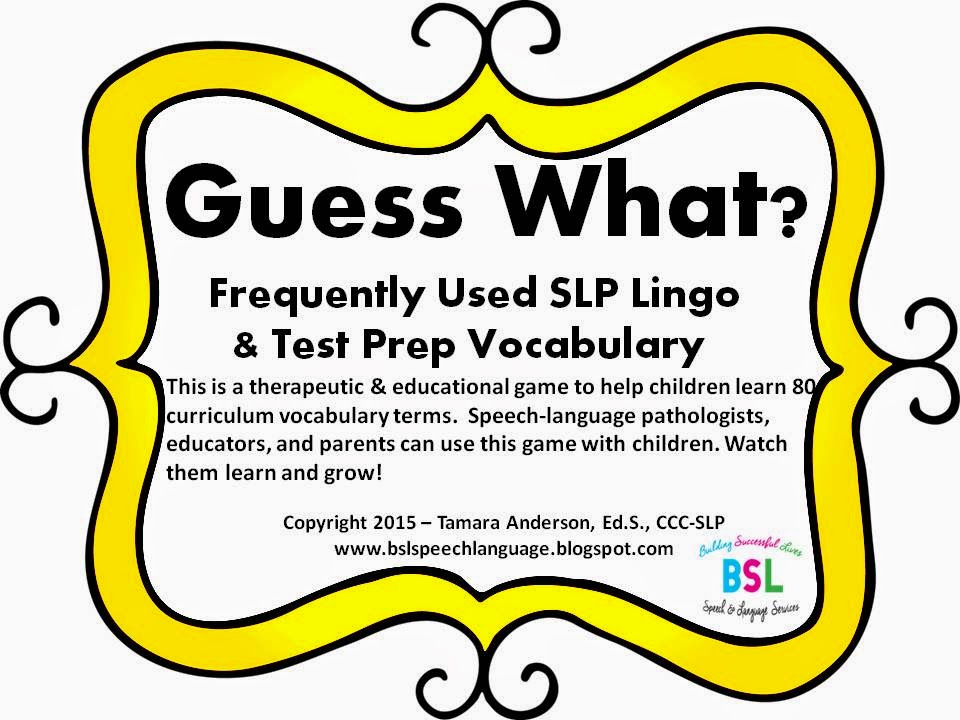
This was my motivation behind creating my Guess What? Frequently Used SLP Lingo & Test Prep Vocabulary Game. This is the 4th in this series. I wanted a fun way for my speech language kiddos to practice their curriculum vocabulary skills. This was an instant hit in my sessions!!!
To play this curriculum game, I select one semantic map from the set to focus on during a 30 minute session.
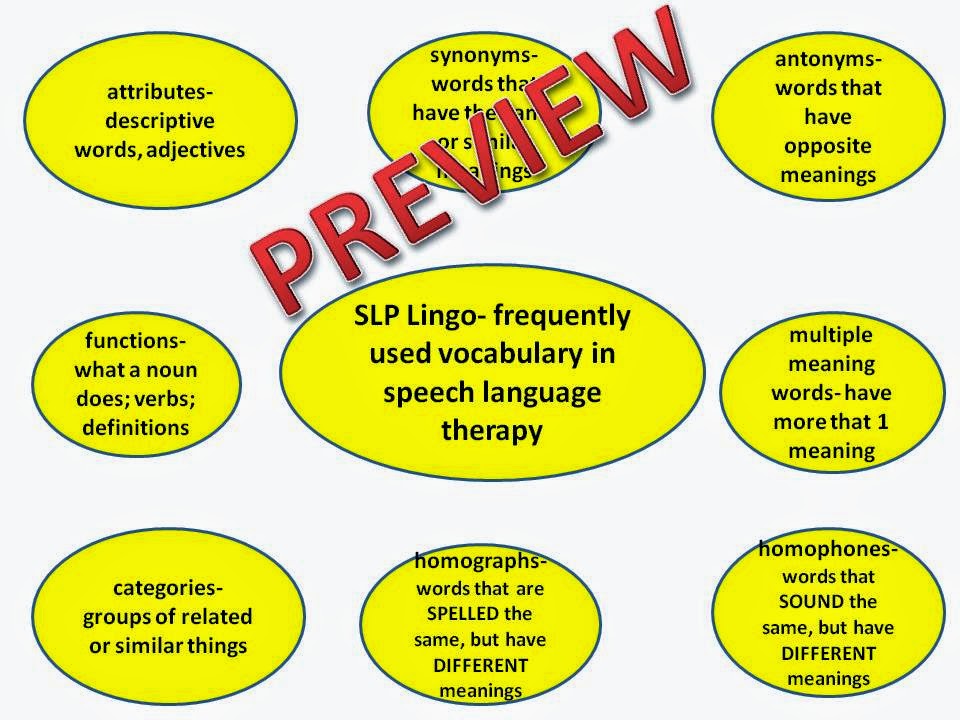
Research shows that the use of semantic or vocabulary maps is an excellent memory and learning strategy because it helps children successfully organize and retrieve information from their brains. Score! You can read more about that here as I did research on that as well when I completed my Education Specialist (Ed.S.) degree. http://bslspeechlanguage.blogspot.com/search/label/Brain%20Based%20Learning
Then I have each student in a group choose a mystery word and tell them to make sure they don’t let the others see it!

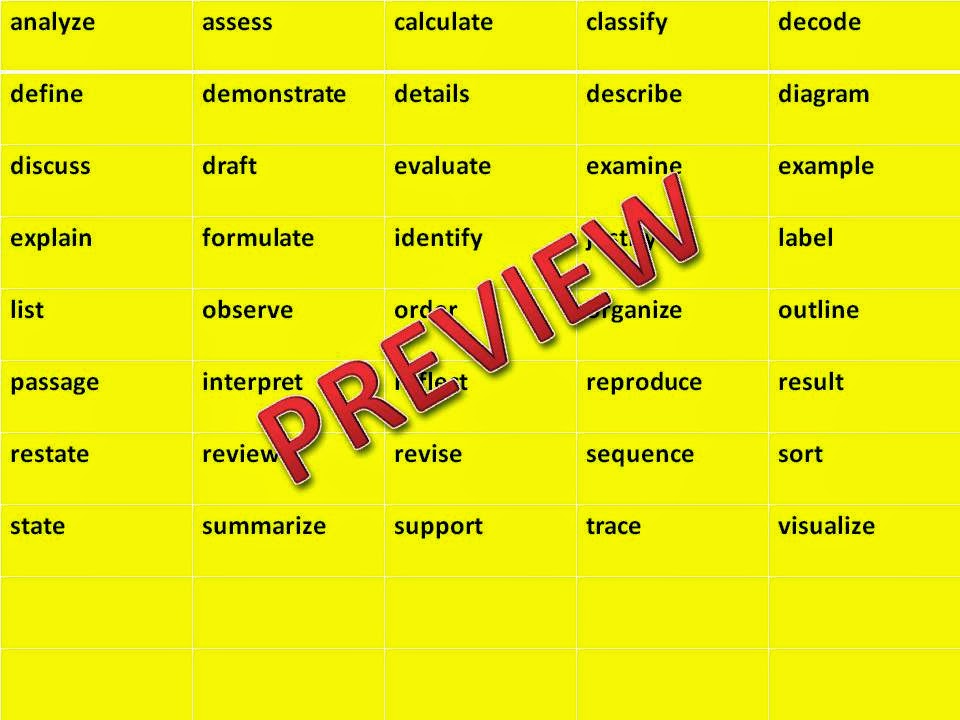

Then I put the question prompts page on the table and a word bank.


I love the variety of visuals available in this game because it allows you to differentiate instruction without your kids even knowing it.
For example, some kids may just need the semantic map when it’s their turn to ask a question while others will read directly from the question prompts page or another student will just need the word bank page to formulate his/her question.
Students will take turns asking their opponents a question to try to guess or figure out their mystery word. If someone guesses their word, they pick another word from the deck. The game continues until all the vocabulary from the selected semantic map are guessed.
My speech-language 4th and 5th graders absolutely LOVE this game and they get SUPER competitive too which I don’t mind because they’re practicing their learning objectives. This game will work well for middle school students too! There are 5 semantic maps with 40 Frequently Used SLP Lingo and 5 semantic maps with 40 Test Prep Vocabulary. Your students will have several weeks of language intervention to practice 80 words with this curriculum game!
You may purchase this product in my online TPT store here:
https://www.teacherspayteachers.com/Product/Guess-What-SLP-Lingo-Test-Prep-Vocabulary-1788007
I have three other Guess What? Curriculum Games in this series that are also favorites with my speech kiddos. They are available in my TPS store as well.
1) Guess What? Types of Literature, Story Elements, & Text Features
2) Guess What? Types of Sentences, Parts of Sentences, & Parts of
Speech
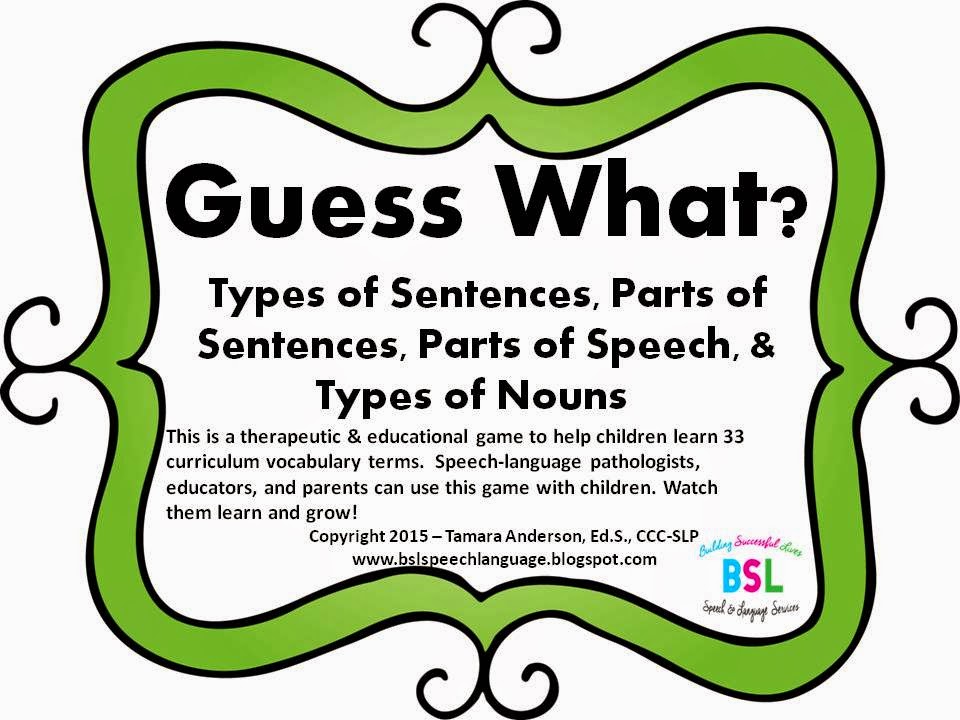
3) Guess What? Figurative Language, Prefixes, & Suffixes

https://www.teacherspayteachers.com/Product/Guess-What-Figurative-Language-Prefixes-Suffixes-1621952
Thanks for reading the blog today! 🙂
Tamara Anderson

Spring Into Literacy {Teaching Compare & Contrast}
I absolutely LOVE integrating literacy activities in my speech-language therapy sessions! There are so many skills that you can target while using fiction and non-fiction text.
Recently, I decided to use the 2 books pictured above, There Was An Old Lady Who Swallowed a Chick! and There Was An Old Lady Who Swallowed a Frog! to target teaching my lower grade elementary students the concept of compare & contrast. For them, I introduced the skill as explaining similarities and differences. During one session, I read aloud one of the stories and we talked about the sequence of events. Then we briefly talked about how that book was similar to others we read earlier in the year. For an extension activity, my students completed this book with assistance.

Then another session, I read aloud the book, There Was An Old Lady Who Swallowed a Frog! Then we talked about how that book was similar and different to the one that I read last session. Then they made their book.


I used non-fiction text to teach my 4th and 5th grade language therapy students the skill of compare and contrast. Over several sessions, I read aloud passages from my Historical Irish American unit. Then my students selected 2 people to write down on their Venn Diagram such as Walt Disney and Ronald Reagan or John F. Kennedy and Henry Ford. I modeled for them how to find similarities and differences from the text and then write them down in the correct part of the diagram. Lastly, they took turns verbally comparing and contrasting what they learned. This is a great activity for students to practice synthesizing what they have learned.
Here is a picture of 2 completed Venn Diagram for this unit.

You can purchase your copy of the Historical Irish Americans unit in my TPT store so you can teach this skill to your speech-language therapy or language arts students. Click here for direct access to the digital download of this product!
https://www.teacherspayteachers.com/Product/Historical-Irish-Americans-Speech-Language-Therapy-Curriculum-Unit-1770313
Thanks for reading the blog today!
Tamara Anderson

Spring Time Speech-Language Activities
Spring is finally here and I am thrilled because it is one of my favorite seasons of the year. Although today is a rainy day in Atlanta, I actually don’t mind it because that means my garden will look beautiful very soon! Plus, aside from going to church this morning, I had a nice day at home.
Guess What? There are only 38 school days left for the year in my district! It is definitely full speed ahead with therapy sessions, eligibility meetings, IEP meetings, and a few re-evaluation meetings remaining. I want to share with you my therapy intervention recommendations that will carry you through the spring! Click on the pictures to go directly to the product links in my TPT store.
First, I have a freebie that I created back in 2013 to address word associations. This is an essential part of language processing. The photos are from my own flower garden. I got my green thumb from my grandmother and mom! 🙂


These are my recommendations to equip you with successfully leading therapy sessions and instruction with children. I wish your students and clients continued speech, language, and academic success!!
Tamara Anderson
7 Days Until Vacation! Say What? Celebrate with a Sale!
I am thrilled that I will soon be on winter break until 2015! I can not wait. Now is a great time to add new resources to your speech/language therapy materials to make your sessions a breeze for the rest of the year and beginning in January. My TPT store is on sale 20 % off starting today-Thursday December 18th. I definitely recommend my progress monitoring tools and winter themed activities. You can find these easily in my store at the top of the page at: www.teacherspayteachers.com/Store/Tamara-Anderson
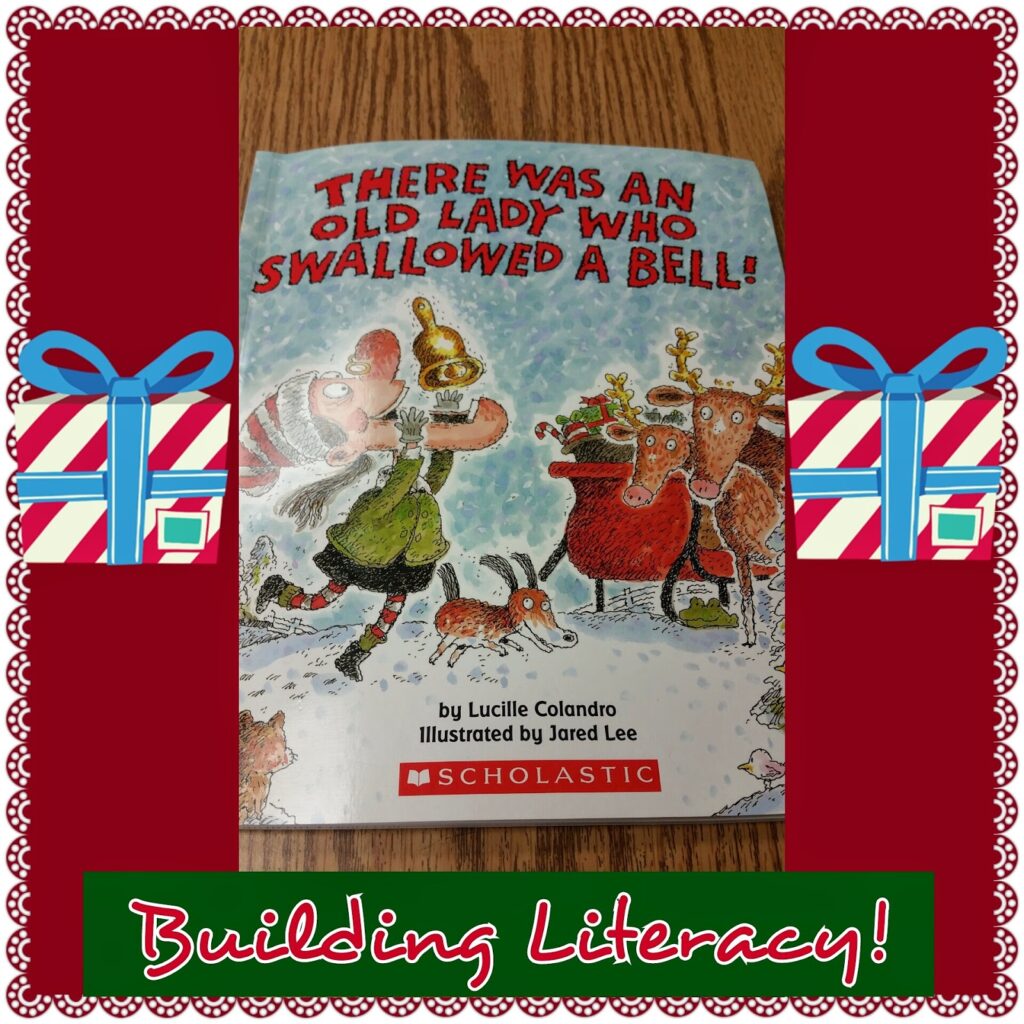
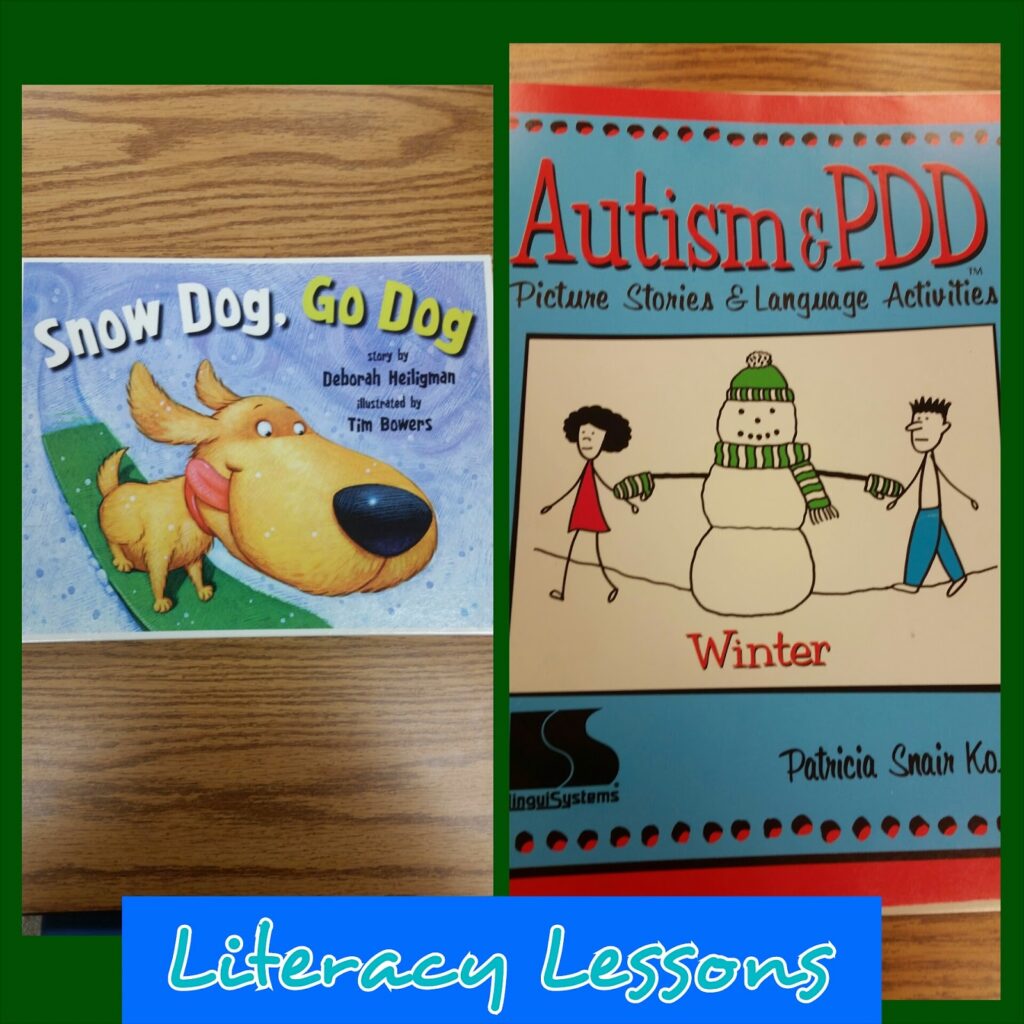
I have been doing lots of winter themed activities to keep my students’ interest and of course to provide their necessary speech/language interventions. This week, I read aloud, There was an Old Lady Who Swallowed a Bell, Snow Dog Go Dog, and Matt & Molly snowman story with various groups.
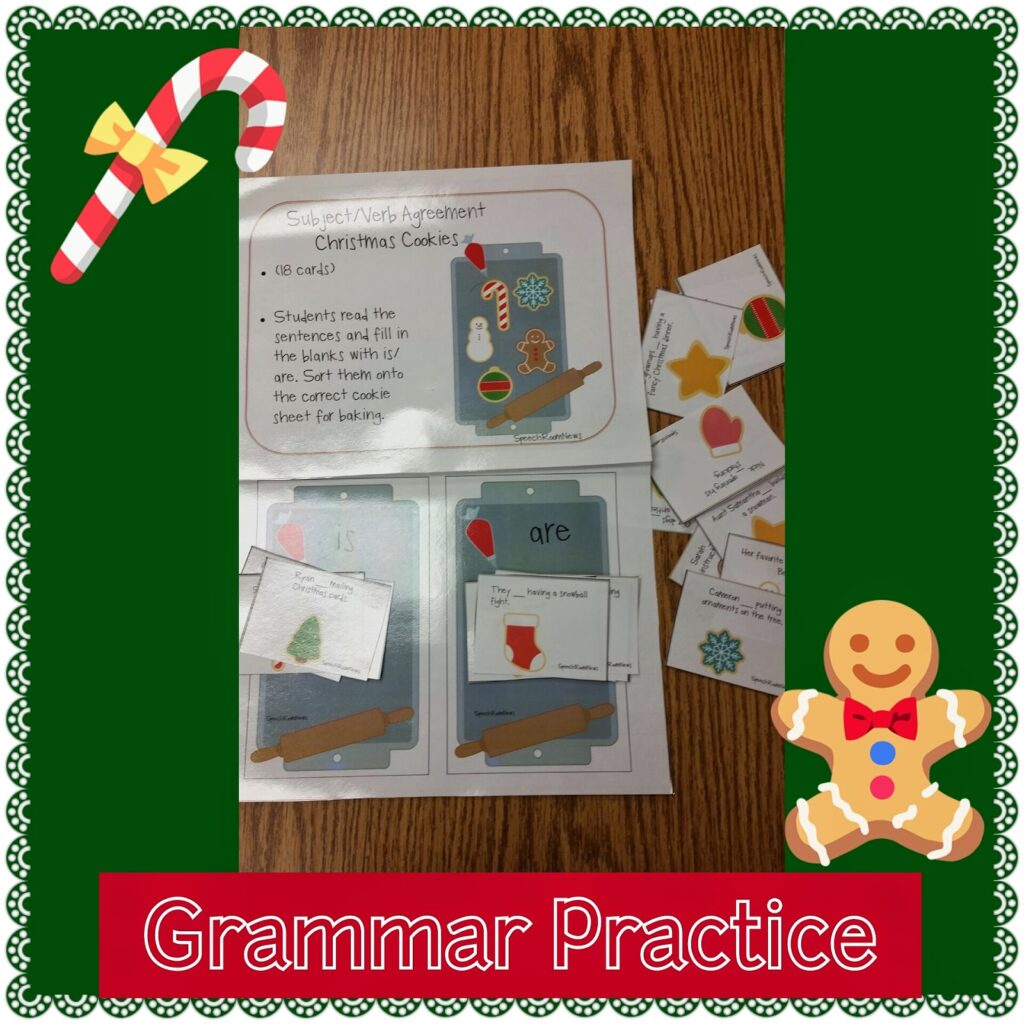
My students also practiced oral language skills with correct subject/verb agreement. I also used lots of activities to build their receptive grammar knowledge such as is/are sorting with fill-in-the blank sentences.
My 5th grade students practiced Tier II vocabulary by using context clues to figure out the meanings of words in written sentences and paragraphs. Some groups made semantic maps to review Tier III or English/Language Arts vocabulary by making semantic maps. For example, a few of them were struggling with remembering the differences between the types of writing so I modeled how to make a semantic map for these key words. Making and using semantic maps to recall content is an evidence based strategy to improve comprehension of vocabulary and key ideas.
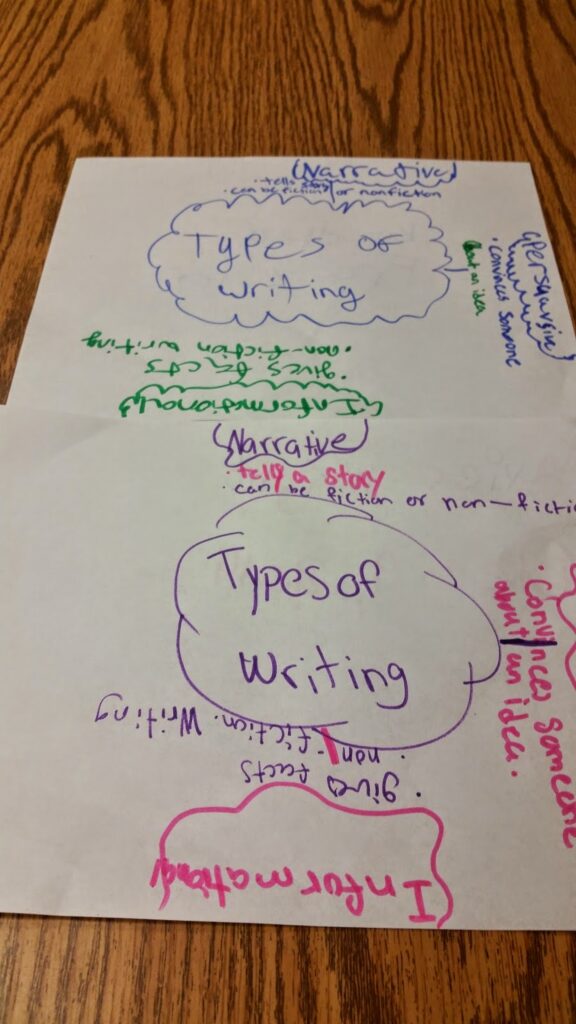
Always remember that as SLPs, we frequently make adjustments in our intervention approaches and activities based on the responses of our students. So its always great to have a few resources available each session that you can use to instruct students and to switch it up as needed.
Get your time-saving resources:
www.teacherspayteachers.com/Store/Tamara-Anderson
Tamara

August Children’s Literature Reviews
I love using children’s books in my speech-language therapy sessions with my students. I enjoy reading aloud to my students and popping in that oh so lovely CD to play an audio book for different group sessions. Either way it is a win win situation because students are typically engaged in the story and there are so many speech language objectives that can be addressed.
Last week, I used the audio CD that read aloud the book, Teacher’s Pets, by Dayle Ann Dodds. I was lucky to have multiple copies of the book so that my students could follow along with the read aloud. The audio teaches them to listen for a chime to turn the page.
This is a delightful book about Miss Fry and her elementary school aged students. In their class, each Monday is sharing day. One Monday, Winston has the creative suggestion for his classmates to share their pets. Your students will love turning the pages to find out the pet each character in the book brings to school. This is a great way to discuss sequencing of story events.
The first Monday, Winston brought in his pet rooster. The next Monday, Patrick brought his pet tarantula. Then the class got to see Roger’s cricket, Alia’s goat, Amanda’s dog, Jerry’s snake, Megan’s cat, Mitchell’s mice, and so on.
Last week I used this book with my speech-language students with co-occurring autism, moderate intellectual disability, and learning disabilities. They all smiled as they listened and eagerly turned the page with each chime! After listening to the story, they verbally answered literal “wh” questions about the characters, setting, and events in the story. One of my students in my intellectually disability group especially struggles with initiating oral expression. For her, I wrote out the questions and showed her a visual choice of 3-4 answer choices. After that, she did a fair job with indicating her responses with visual prompts from the story as needed.
The previous week, I read aloud, Charlies Goes to School, by Ree Drummond.
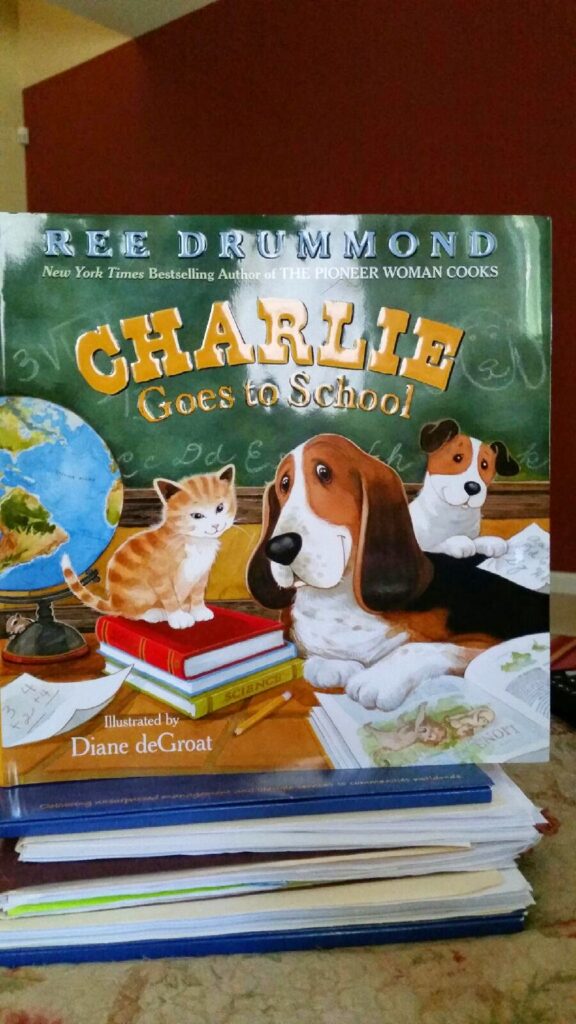
I love this story because the pictures are so vibrant as well as realistic and it is told from the perspective of Charlie, the ranch dog as he explores the ranch for the day. This is a great time to remind students about the meaning of the word fiction as the main character engages in activities that dogs don’t do in real life, such as teach school to animal friends. Charlie invites the reader to explore what life on the ranch is for his human and animal family.
He introduces us to the other characters: daddy, cowboy Josh, mama, the kids, Suzie the dog, Kitty Kitty, ranch horses, cows, and Walter the dog. He tells us that his human family goes to school at home and gets inspired to teach his animal family reading, math, and history. Well you can just imagine how well turns out for the animals! They have difficulty focusing, want to play, and Walter the dog even falls asleep.
Since I read Charlie goes to School aloud to my students, I modeled “think alouds” along the way by making additional comments and asking questions to check for story comprehension.
I definitely recommend these awesome books for use during speech-language therapy lessons or reading class.
I also recommend a rubric to measure students’ abilities to orally retell fiction stories. The SLP or teacher records a score of 5 to 0 in each performance element category: characters, setting, problem or rising action, solution or falling action/conclusion. To calculate a score, just add up the points in each category. To calculate a story retelling percentage of accuracy divide the score by 20, that is the total possible points. I recommend audio recording your student’s story retell for easier scoring using the rubric.
This product was revised last week and it is available in my TPT store here: http://www.teacherspayteachers.com/Product/Oral-Story-Retelling-Rubric-819201
Thanks for visiting the blog today! 🙂
Tamara Anderson
