


Recognizing African American History {Children’s Literature Reviews}
So many children today have a very limited knowledge about the influence of African Americans in the United States. A great way to teach students about this is by reading them biographies, historical fiction and non-fiction text. I enjoy reading aloud to children in my speech-language therapy lessons. They learn factual informational while also practicing their speech-language skills.
Here are 3 of my recommendations that I read and discussed with my students this month. Although Black History is celebrated during the month of February in the U.S., these books can be read at any time of the year. Likewise, students should continue to learn about African American History all year long as well.
This is an engaging biography that describes Hank Aaron’s determination to play professional baseball at a time when Jackie Robinson was the only other black player. The illustrations are excellent and truly help the story come alive as Hank Aaron beat Babe Ruth’s record of hitting the most home runs. In 1974, he hit his 715th home run! The book also tells the story about how he persevered despite the discriminatory threats that he received because of the color of his skin. My speech language students enjoyed learning that he played for the Atlanta Braves, when his original professional team, the Milwaukee Braves moved south to Georgia. That detail helped them connect to the story since we live in metro Atlanta, Ga.

Grandma’s Pride is a beautifully written historical fiction book told from the perspective of a little girl, Sarah Marie, who travels to the south with her family during the summer to visit her grandmother. The precious little girl quickly learns the differences between how blacks experience life in the northern U.S. versus the southern U.S. On her journey, she experiences having to sit in the back of a bus, not being able to use certain public restrooms, not being able to eat at certain downtown restaurants, and the tenacity of her grandmother whose pride would not allow her to ride the city bus. I like this book because it gives children a glimpse into what life was like during the civil rights era of the 1960s when Jim Crow laws were enforced. Through the voice of a child, they are also able to hear how in a later summer visit, the unjust rules of the south were no more!

Freedom on the Menu: The Greensboro Sit-Ins is another excellent historical fiction book that tells the story about a young girl, Connie, who sees first hand the boldness of four college students from North Carolina A & T. The young men, her brother’s friends, decided that enough was enough and they planned a “sit in” to quietly protest their lack of service at a lunch counter in Woolworth’s, a popular downtown department store. They sat at the lunch counter and requested to order food. They were denied and asked to leave due to the Jim Crow laws. This book will evoke questions and emotions from children. Most will empathize with Connie, who wanted to order a banana split at Woolworth’s the day she saw her brother’s friends. This story also comes full circle as the author summarizes events that this incident sparked such as more lunch counter “sit ins”, a visit to Greensboro by Dr. Martin Luther King, and additional non-violent protests for civil rights for African-Americans. I love that this story is also told through the eyes of a child who was able to sit at any lunch counter and enjoy her banana split after the Supreme Court ruling that those Jim Crow laws were unconstitutional!
There are so many great books out there to help children recognize and understand African American History in the United States! I also created a non-fiction curriculum unit so children can learn about historical African Americans. You may check out that resource here: https://www.teacherspayteachers.com/Product/Historical-African-Americans-Speech-Language-Therapy-Curriculum-Unit-1713341
Thanks for reading the blog today.
Tamara Anderson

SLPs Have Ways of Making You Speak & Understand { Link up & Purchase SLP Products}
Pediatric speech-language pathologists have an awesome job of teaching children the skills they need to communicate verbally, using picture exchange, or using a communication device! We also enable them to improve their comprehension of numerous language skills that are the underpinnings for attaining communication, academic and social success!
Guess what? Today is a special day because my entire TPT store is on sale 20 %. Plus, you will get an additional 8 % off when you use the discount code: HEROES at checkout!
I am also linking up with Jenna, SLP at speechroomnews.com to share my recommendations of products in my store and also what I plan to purchase from other fantastic SLPs.

From my store, I recommend these resources to ensure that your speech-language therapy sessions are educationally relevant while addressing your students objectives:
Non-fiction Language Intervention with Tier II Vocabulary


Tier I Vocabulary Informal Assessment


Tier III Curriculum Vocabulary Intervention

Tier III Curriculum Vocabulary Informal Assessment

Here are some items that I plan to purchase:
Twin Speech Language & Literacy LLC


Maureen, The Speech Bubble SLP

Kim, The School SLP

Thanks for reading the blog today. Make sure you click the link here to see other suggestions on awesome SLP resources:
http://thespeechroomnews.com/2015/02/whats-in-you-cart-linky-party-hero-sale.html
Tamara Anderson
Speech-Language Success Stories # 5
It is important to remember to be patient and optimistic when providing pediatric speech-language therapy services. Often times, children will not immediately learn speech language strategies. It takes repetitive verbal modeling, visual cues, and tactile cues for kids to acquire new skills.

Speech-Language Success Stories # 4
We had recently talked about the meaning of the idiom “You dodged that bullet.” One of my students took his turn and rolled a six. The Daddy hadn’t “woken” in awhile, so we all assumed the student was going to get it! When he didn’t wake Daddy, another one of my students said, “Wow, you missed that bullet!” SUCCESS!!! Now, he didn’t get the idiom exactly correct, but we had been working on understanding idioms more than using them, and he had spontaneously used the idiom in correct context. I was ecstatic! It’s that kind of moment that makes it all worth it, don’t you think?


For The Love of Speech & Language: Valentine’s Categories & Associations
I know it’s not Valentine’s Day yet, but some SLP blogger friends and I want to give you a head start on your speech-language therapy activities for February. After all, today is February 1st and Superbowl Sunday! Your brain may be thinking about all those commercials and game day snacks/beverages rather than planning lessons for this month!
Well I am eager to use all the Valentine’s themed speech-language activities that I have. Lyndsey at Speech to the Core and Elizabeth at The Speech Owl are hosting a blog hop where you can follow 28 speech-language pathologists to collect 28 different therapy activities! How awesome is that! I hope I have enough ink! Ha! Some may be used on your IPAD or computer too so no worries there.
My newest SLP resource will be FREE from February 1st- February 4th in my TPT store.

This resource is geared towards 2nd-5th graders who need practice with categories and word associations. Some of my language disorders students with co-occurring learning disabilities definitely still need practice with verbally naming items in a category and associated words. This activity will allow kids to practice Tier I or basic everyday vocabulary in a fun way related to Valentine’s Day. This product also has a few pages so that kids can write responses as well. I suggest having a stash of candy during your sessions for the love of speech and language! 🙂

Visit my TPT store to download my digital SLP resource & make sure to follow me there to stay current with updates: https://www.teacherspayteachers.com/Product/Valentines-Themed-Categories-Associations-1681179
The next SLP participating in this amazing blog hop is Susan Berkowitz from Kidz Learn Language. Click below to visit her blog and link to her complimentary Valentine’s therapy resource on sequencing.

Thanks for reading the blog today!
Tamara Anderson
Instagram:bslspeechlanguage
Facebook: https://www.facebook.com/BSLSpeechLanguage?ref=hl
January Children’s Literature Reviews {Winter Themed}
One of the best parts of winter is getting to read new fiction stories to my speech-language therapy students. Although I do not love cold weather, I do love reading winter themed stories. Here are my 5 favorite books that are ideal for January and even next month as the feeling of winter may still be very present in your area and even here in Atlanta!
I absolutely love the books written by Jan Brett!!! My speech-language therapy students are always engaged when I read aloud her stories. This week I had a break through moment when a student finally used her correct tongue placement for the /l/ sound during articulation practice during my read aloud! I was so excited!!! This is a student with moderate intellectual disability who struggled immensely with tongue elevation and placement for this sound and woila! She nailed it several times while reading The Three Snow Bears by Jan Brett!

This is a fun book that follows Aloo-ki a native Inuit girl on an adventure as she searches for her huskies or sled dogs. Along the way, she discovers an igloo and makes herself quite comfortable in the home of Papa, Mama, and Baby Polar Bear. I love this winter themed twist of Goldilocks and the Three Bears and my speech kiddos do too!! This book is great when working with articulation, speech fluency, and language students!
I also like, The Mitten as well as The Hat by Jan Brett. These books are ideal for preschool and early elementary aged kids who need practice with sequencing, verbal narratives, answering yes/no questions, and answering “wh” questions. Both books follow a simple story line. The Mitten is a Ukrainian Folktale about a boy, Nicki, who loses his white mitten made by his grandmother in the snow. Before he finds it, several animals make it their new home until the bear sneezes and they are all suddenly thrown out of their new dwelling.


The setting of The Hat is a Scandinavian farm where a little girl, Lisa, hangs her winter clothes on a clothesline. Hedgie, the main character, gets a wool stocking stuck on his head and he tries to convince his animal friends why it’s a good thing. Unfortunately, his friends tease him and tell him that he looks ridiculous! Lisa eventually finds Hedgie with her stocking meanwhile the other animals end up running around the farm wearing other winter clothes that they took from Lisa’s clothesline. At the end of hte story, Hedgie comments by saying, “Don’t they know animals should never wear clothes!”
My other favorite author of winter themed books is Caralyn Buehner. My students and I absolutely adore Snowmen At Night and Snowmen All Year because they enjoy seeing what activities the characters will do next.


Thanks for reading the blog today.
Tamara Anderson

Speech-Language Success Stories- # 3
Welcome Carly Fowler!
Today, I will share successful tips for providing speech-language services for adolescents.
Why Following a Child’s Lead Isn’t Just for Early Intervention
is not that easy with high school students, trust me sometimes I feel like I am pulling teeth in order to get any kind of data.

2nd Year Blogiversary Raffle Winners!

The 3 finalists with the most entries from all 5 days are: Dreya Gotti, Carly Fowler, and Meagan Lawson. A grand prize winner was randomly selected. The winner is: MEAGAN LAWSON!!!
Your grand prize is a collection of my favorite and most frequently used speech-language therapy and instructional resources that I specially created.
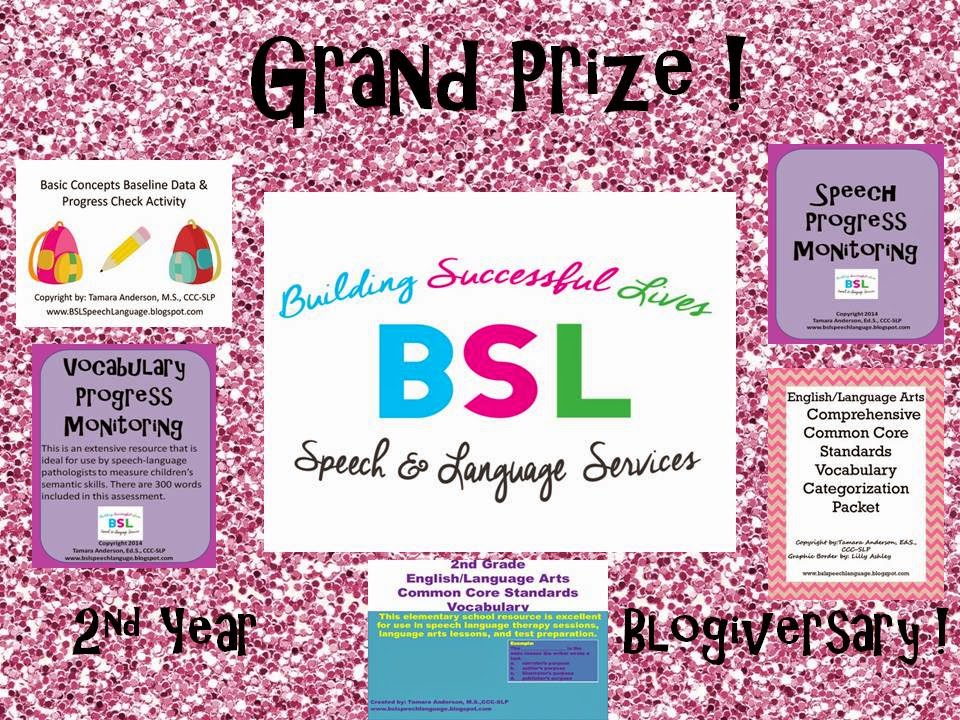
Dreya Gotti and Carly Fowler, you may select 2 of the above resources! All prizes will be emailed to the winners! Thanks again to all the SLP sponsors who contributed products for the giveaways as well. I have something special for you too! I will contact you regarding that soon! 🙂
I look forward to all that is in store for BSL Speech & Language this year. Make sure that you subscribe to this blog and follow me on Instagram, Facebook, and Twitter to stay connected to all the time-saving resources and therapeutic/instructional best practice tips!
Tamara Anderson, Ed.S., CCC-SLP
Speech-Language Pathologist

Speech Language Success Stories- # 2
Welcome Susan Berkowitz from Kidz Learn Language!
I have been a speech-language pathologist for 35 years, before which I taught kids with autism. I have been in the classroom, therapy room, and worked as an administrator. I have worked in public and nonpublic schools. I currently specialize in alternative-augmentative communication for nonverbal students and in training staff to implement aac in their classrooms. I provide local and national workshops on augmentative communication and on teaching literacy skills to students with complex communication needs.
This is an article that I wrote on my blog in November of 2014. I am happy to be BSL Speech Language’s guest blogger this week. Check out this aac success story!
One of my favorite student success stories is one I tell over and over again. While you may have noticed I am a big fan of using and teaching core vocabulary, I am also a huge user of PODD communication books. That is Pragmatic Organized Dynamic Display books, designed by Gayle Porter, a speech pathologist in Australia. She has been using this system very successfully with children for decades.
I have been to trainings with Gayle, and with Linda Burkhart, when they have presented them here in the States. A week with Gayle is mind-numbing – in a good way. The first workshop I took with her was a week of 9 hour days and we learned so much it was amazing! I don’t honestly think I could have absorbed one more idea by the end of Friday. She is one of those rare people who are both a wealth of information and a master at transmitting it to others. (Of course, you have to work your way around her accent).
I have been using PODD books with my nonverbal students with autism for the past several years, and with great results. Teachers usually get that ‘deer in the headlights’ look in their eyes when I walk in with a 125 page communication book. I’m very careful to talk about taking it slowly as they get familiar with it and begin using it with their student(s).
I’ve taken to using this story. The story of Aaron. Aaron was a 16 (then) year old student with autism in a classroom for students with severe disabilities. When I first met him, Aaron had a single page PECS (Picture Exchange Communication System) “system” by which he could request his favorite reinforcers. He had no other appropriate mode of communication. What Aaron did have was a history of self-injurious behaviors. He has done permanent neurological damage to himself.
On the day I arrived in the classroom with his new, >100 page PODD communication book, both his teacher and aide regarded me with looks of …. outrage? amazement? overwhelming dismay? I spent some time going over how the book was constructed and how it worked. I reviewed the navigation conventions and where and how vocabulary was stored. I gave them examples and phrases to try. We talked about Aided Language Stimulation and how it worked. And I carefully explained how to begin with a single activity, gradually increasing use of the system as their comfort level increased.
Aaron was lucky. His aide was extraordinary. She did a wonderful job of learning and doing and being consistent. TWO weeks later the teacher called me. I could hear her jumping up and down. The excitement was palpable. The day before, Aaron had been upset because A.P.E. had been cancelled and he needed some time to run off some of his energy. He had started out, she told me, by starting to engage in his SIB. But he stopped himself. He looked at the communication system. He pointed to “More to say,” and then proceeded to move from the feelings page (“angry”) to the people page (“no APE teacher”) to the activity page (“run” and “outside”) to the places page (“baseball field”). With a string of single word responses he told a perfect narrative, expressed his feelings, and told what he wanted – needed – to do. The aide, of course, took him straight outside to the baseball field to run around. I’m pretty sure she was crying most of the way. I know I was when I heard the story.
Now of course, most students need more than 2 weeks of consistent teaching to learn to communicate so effectively. But this certainly speaks to the power of appropriate aac intervention.
How are your students learning to use their aac systems?
Here is the direct link to my original post on my blog: http://kidzlearnlanguage.blogspot.com/2014/11/more-from-aac-case-files-how-much-can.html