


Basketball Challenge- Speech, Language, and Academic Skills
Wow! I can’t believe it’s June already. I am thankful to have completed another successful school year. My summer break started 2 weeks ago. Hooray! The last 2 months of school was quite busy with the usual tasks of group speech-language therapy sessions, testing students, IEP meetings, special education team meetings, staff meetings, committee meetings, and tons of paperwork/computer work. Let’s not forget our beloved high stakes CRCT, the state test here in Georgia. Among all those important and urgent activities, I made a deliberate effort that my students have fun while learning and practicing their speech and language skills in my therapy classroom.
I am pleased to share with you one of my newest resources that I created and used with my students during the months of April and May. The Basketball Challenge-Speech, Language, and Academic Skills is an awesome interactive activity that kept my students engaged during their 30 minute speech-language therapy sessions. I primarily used my English/Language Arts Common Core Vocabulary questions (http://www.teacherspayteachers.com/Product/4th-Grade-EnglishLanguage-Arts-Common-Core-Standards-Vocabulary-652220) with this activity. Here is how to play this basketball challenge. Most of my groups have 4 students, so they would divide into 2 teams, and select a name for their team.
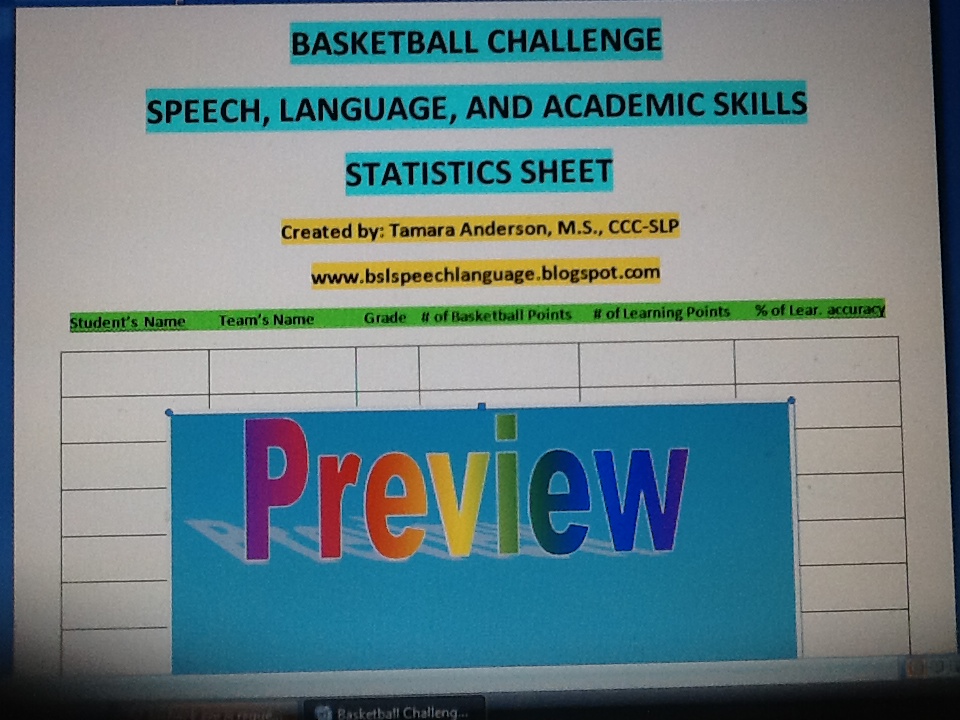
I would write the name on the statistics sheet shown here.
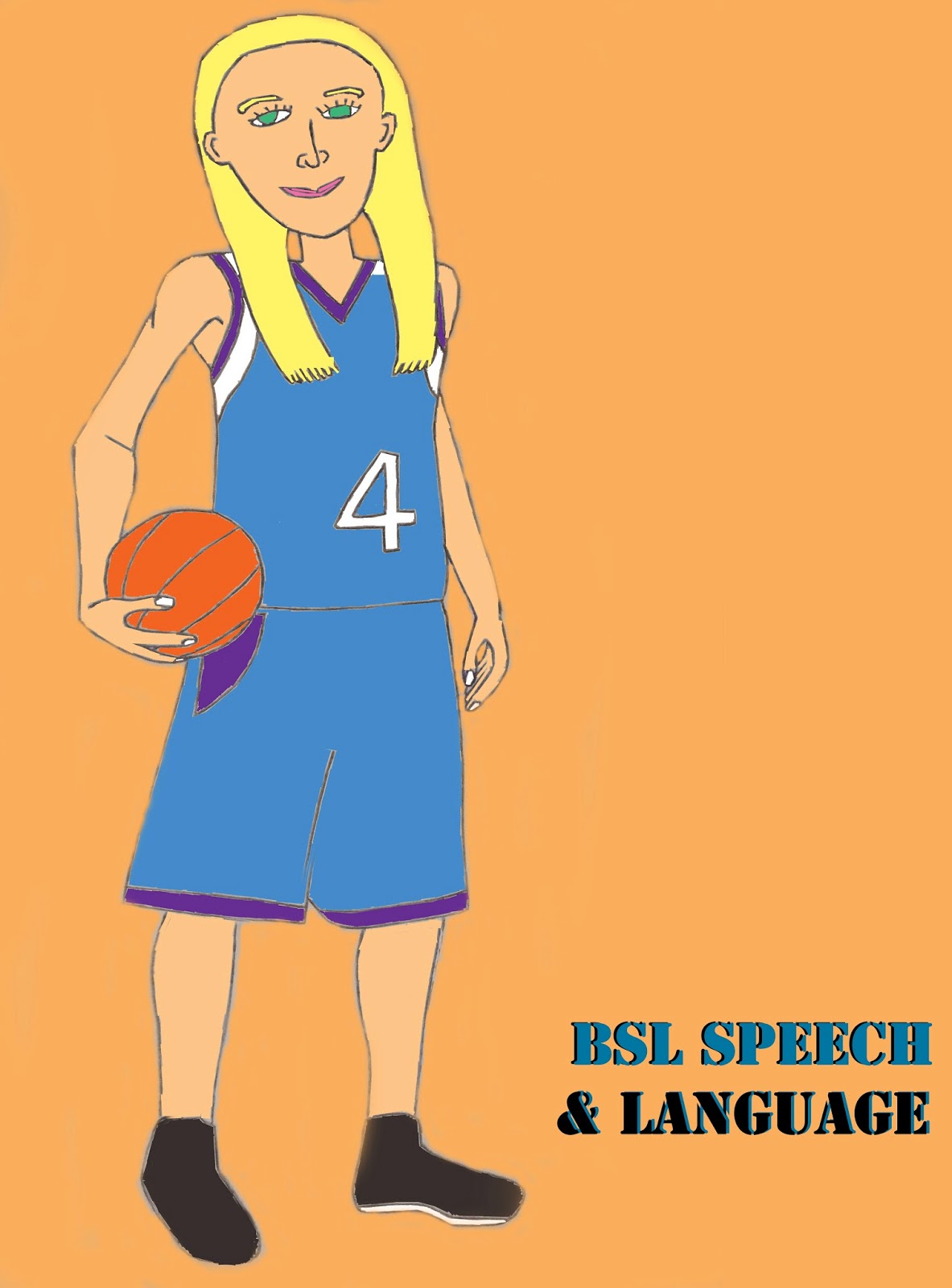
Then, they would choose a basketball player.
.jpg)


I would place the basketball court and 2 nets on the table.



I would then place all the basketballs face down on the table.

Each student took turns answering a learning question, then they would pick up a basketball, dribble the ball to the net, and shoot the ball. It was the luck of the draw if they would get 1 point, 2 points, or 3 points.
During the game, I recorded the number of basketball points each student earned and the number of learning points they earned by answering questions correctly on the statistics sheet.
The game would end when their speech-language therapy session time was over. I would then calculate the accuracy percentage for answering their speech, language, and academic questions.
My students were so excited to see if their team won the game and also what individual player had the most basketball points and learning points.
This activity is definitely a win-win for both the students and the SLP. You can purchase it here to use with your students: http://www.teacherspayteachers.com/Product/Basketball-Challenge-Speech-Language-and-Academic-Skills-717131
Thanks for visiting my page today!! I will have several new posts and therapy/educational products available next school year.
Tamara Anderson, M.S., CCC-SLP
Speech-Language Pathologist on Summer Break!
March Mania & Spring Fever: English/Language Arts Common Core Style
My school district is already in the final stretch for the school year as we are in the midst of the final nine weeks of instruction and have ONE more week before SPRING BREAK!! This is the time of year when speech-language pathologists and teachers focus on the remaining skills we desire for our students to learn. In the speech-language classroom, the typical vocabulary echoes throughout the room: story elements, main idea, supporting details, fiction, non-fiction, antonyms, synonyms, homonyms, word associations, BREATHE, basic concepts, following directions, idioms, similes, compare, contrast, cause, effect, fact, opinion, BREATHE, parts of speech, irregular plural nouns, irregular past tense verbs, types of sentences, summarize, and REPEAT!! Last month, my school had a “March Madness” theme and many students received extra instructional time during SPECIALS (e.g. music, art, P.E., etc.) to improve either English/Language Arts or Math skills that needed remediation.
For the past 3 weeks, I focused on reviewing English/Language Arts common core standards questions with my 2nd, 3rd, and 4th grade speech-language students in their usual therapy sessions. I created a set of 36 English/Language Arts questions based on common core standards relevant to skills that I address in my speech-language therapy sessions with my students.
During each session, I put a red token next to each learning question card. Each page had 6 questions and 6 tokens. Students got to pick up a token when they answered a question correctly. They were very competitive and eager to see who would earn the most tokens. I told them that their goal is always to try and beat their highest individual score. I have to admit that it has been quite exciting and interesting in the speech room lately. Most of my students are happy and cheer when they earn the most tokens or “learning points” while I’ve had one to cry because he didn’t win. The latter moment is when I switch into my unofficial title of counselor, mentor, listening ear and shoulder to cry on! YIKES! The joys of elementary education…I digress…
Anyhow, here are links to the awesome and time saving materials I created:
After a few sessions reviewing questions using my classroom original, I photocopied individual learning packets of these questions for my students. We completed the packets in class by circling the correct responses from a field of 4 choices and writing the correct vocabulary word in the cloze sentences. My students took the packet home after each session for independent practice.
This is a great way to incorporate the English/Language Arts Common Core Standards into speech-language therapy sessions and also help prepare students for end of year state tests.
The 4th grade and 5th grade learning sets are coming soon!!! The 4th grade set has 42 learning questions including questions related to idioms and similes!
These learning activities may be used with an accompanying basketball game. The custom made illustrations and game pieces will be available soon. Check back again soon!!
4/8/13 Update The 4th grade English/Language Arts Common Core Standards learning packet is available and now has 48 questions. Don’t hesitate to click on the link below! 🙂 http://www.teacherspayteachers.com/Product/4th-Grade-EnglishLanguage-Arts-Common-Core-Standards-Vocabulary
Thanks for visiting today!! 🙂

Spring Word Associations Freebie!!
I absolutely love spring time! I love the weather, emergence of colors in the blooming flowers, and I love SPRING BREAK which is 3 weeks away for me here in Atlanta! Most importantly, I am grateful that Jesus Christ loved mankind so much that he made the greatest sacrifice for us. Spring is a season to reflect on his death, resurrection, and free gifts of GRACE, MERCY, and FORGIVENESS to all those who believe in him.
In anticipation of spring, I want to share a gift that you can use in your classroom so I specially created a Spring Word Associations Freebie for you to use with your students.
Click on the link to download the resource: http://www.teacherspayteachers.com/Product/Spring-Word-Associations
In the download, you will see photographs I took over the past few years of plants from my garden (green hosta, pink lily, yellow lily, pink knock out rose), my mother’s garden (white magnolia bloom), and my Aunt Pauline’s garden (orchids). I hope you enjoy the activity and photos!


Fiction Book of the Week: Green Shamrocks
This week, some of my speech-language students in grades K-2 listened to a CD with a reading of the fiction book Green Shamrocks by Eve Bunting. The learning objectives for the lesson were for them to answer listening comprehension questions, sequence the story events, and verbally retell the story. I have one student in kindergarten who stutters so he also practiced his speech fluency using his slow and easy speech.
I was lucky to have multiple copies of this book, so each student had a chance to do their own “picture walk” by looking at the illustrations in order to make predictions about what the story would be about. The students did a great job naming the characters before they heard the story and shared their thoughts about what was going to happen in the story.
They did a great job answering literal who, what, where, when, and why questions that were directly stated in the story. They needed some verbal prompts to sequence the events and orally retell the story.
I see most of my students 2-3 times a week for speech-language therapy. So, on the 2nd therapy day we completed an arts & craft activity. Here are a few photos:
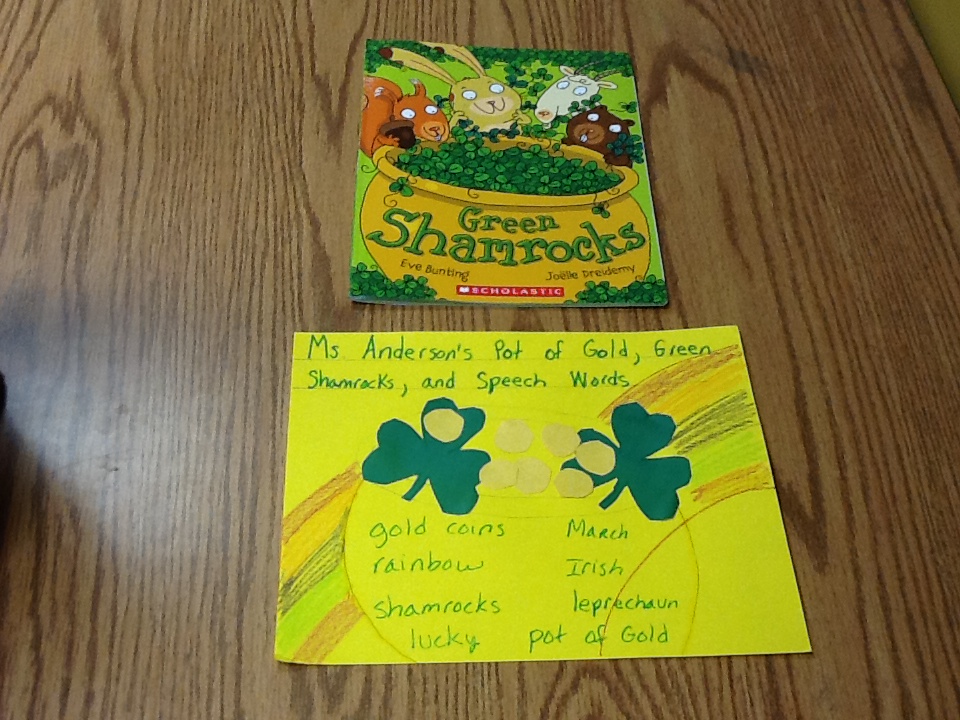
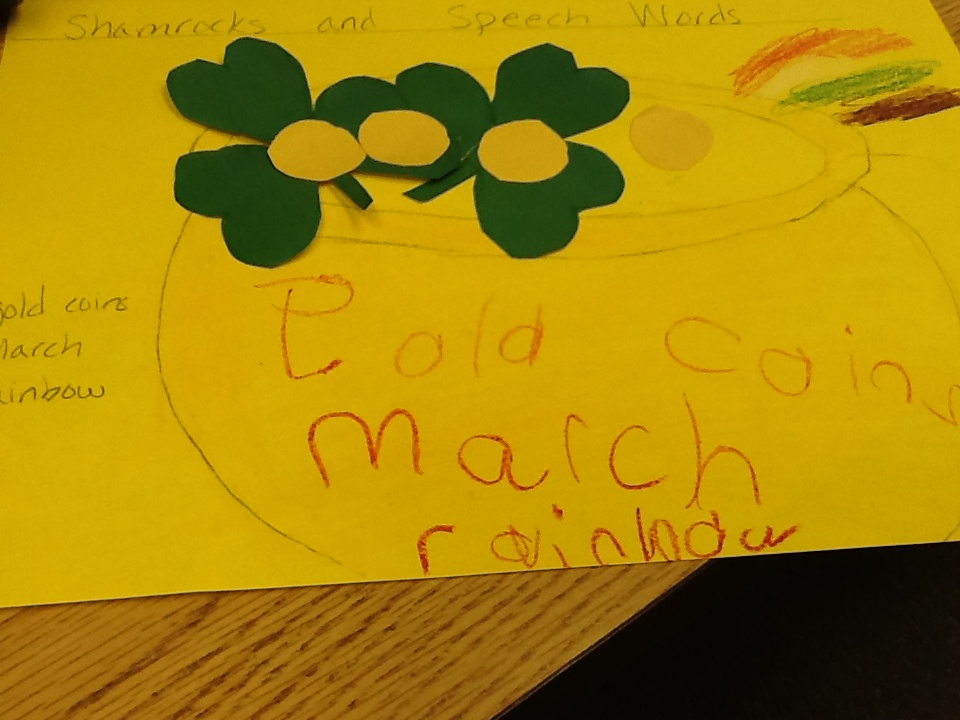

Thanks for visiting the blog! Happy early St. Patrick’s Day!
Why Teach Multiple Meaning Words?
A student with a language disorder walks into a regular education classroom where he or she is bombarded with multi-step teacher directions in a fast paced classroom. The student struggles to get out all the materials for the first academic subject much less comprehend what the teacher is saying. “Students, get out your math book and journal. Turn to page 25 and write your name on the right hand side of the next blank page in your practice journal. Our class is going to spend the next hour learning about measurements and we are going to measure and record the size of our hands, feet, and height. We will use a ruler, yard stick, and tape measure to record the inches and feet.” Student A says “awesome, I’m going to have a ball because I’m the tallest kid!!” Student B says”huh?” “I thought we were going to make and record a song!!” Teacher….blank stare!!
Now imagine that some of the students in the class are also bilingual and are learning English. However, they don’t have a solid foundation in their primary language and they are language disordered. They would be confused by the teacher’s lengthy instructions and most likely not understand several of the vocabulary words. These students struggle processing and understanding a variety of language concepts including multiple meaning vocabulary.
Students who have language disorders often need direct vocabulary instruction with multiple meanings. The speech language pathologist is key to providing this instruction. Most elementary school students are familiar with the terms: homonyms, homophones, and homographs. However, they easily confuse the meanings and need plenty of receptive and expressive language practice with examples of these words.
In my speech language therapy sessions, I instruct my students on the 2 categories of homonyms or multiple meaning words. Then, I take baseline data to see what words they understand and can effectively use in a sentence. I suggest:
http://www.teacherspayteachers.com/Product/Multiple-Meanings-Vocabulary-Baseline-Progress-Check-Data-Forms
Then I provide multiple opportunities to practice increasing their vocabulary skills with a variety of activities and learning games. I have my students practice verbally describing 2 meanings of the target terms and I provide verbal and visual prompts as needed. I also like using cloze sentence (fill in the blank) tasks or semantic absurdities activities in which students have to correctly identify/name the correct homonym.
Here is a list of some of the activities and resources I use to address developing
this skill:
1. Go for the Dough Board Game by Super Duper
My students love this activity and it addresses multiple meaning words , synonyms, antonyms, categories, and more.
2. Homophones Photo Fun Deck by Super Duper
3.Homographs Fun Deck by Super Duper
4. Multiple Meanings Deck and Homonyms Photo Fun Deck by Super Duper
5.Homophones I PAD application by AbiTalk
6.Bluster I PAD application by McGraw Hill Center for Digital Innovation
My students are always eager to participate in the homophones activities. There are also fun activities to target word roots, prefixes, suffixes, synonyms, rhyming words, and adjectives.
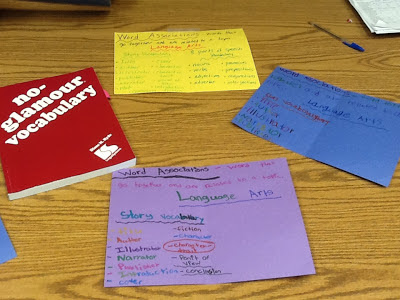
7.No Glamour Vocabulary book by Linguisystems
This book has great worksheets for guided practice and homework review. I tend to use worksheets after the skill has been practiced orally in therapy a few times.
8.Numerous SLP created products available at : teacherspayteachers.com
What additional resources or methods do you find successful with teaching multiple meaning words?
EVIDENCE BASED PRACTICE:
Johnson, C., Ionson, M., and Torreiter, S. (1997) state that direct vocabulary instruction in the area of multiple meaning words is essential for successful comprehension of spoken and written language. In their study, the research results indicated that children with language learning difficulties are able to provide adequate verbal definitions when target meanings were presented in sentence context compared to tasks that did not provide a context. How should I use this knowledge in my classroom? SLPs and teachers should directly teach vocabulary and provide opportunities for students to practice their word knowledge using context clues in sentences.
Reference
Johnson, C., Ionson, M., and Torreiter, S (1997). Assessing children’s knowledge of multiple meaning words. American Journal of Speech Language Pathology. (6) 77-86.
Thanks for visiting the blog today! 🙂

Celebrating Dr. Seuss in Speech-Language Therapy
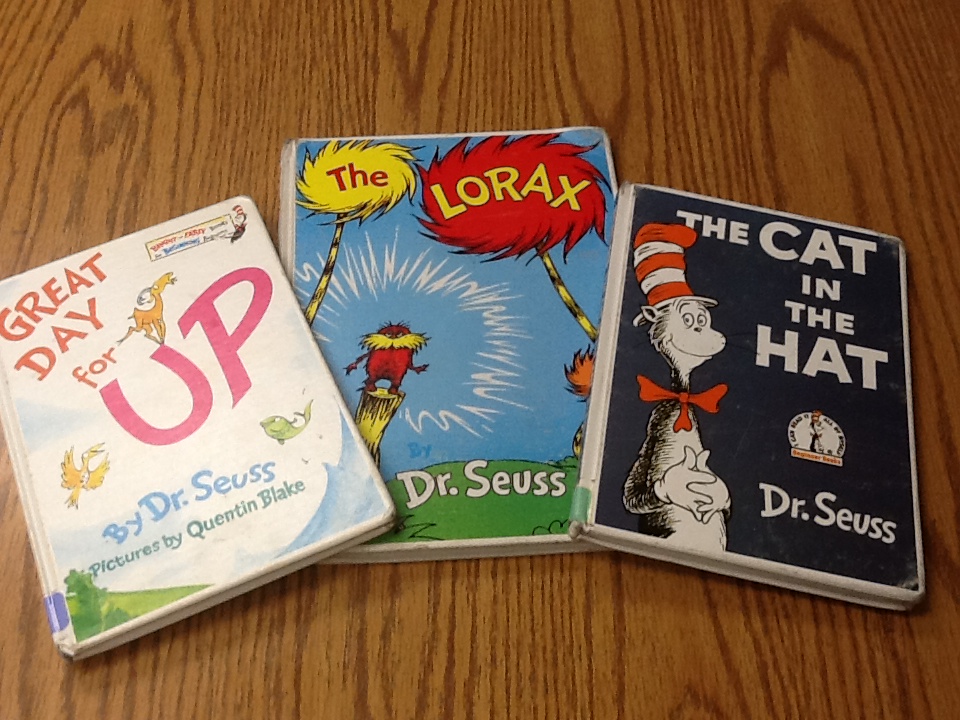
Last week, my school had a celebration for Read Across America Week and Friday was a celebration in honor of Dr. Seuss’ Birthday. Some of my speech-language students had the opportunity to practice language arts vocabulary, orally summarizing story events, sequencing events, and speech articulation skills during Dr. Seuss themed activities. One of my favorite activities of the week involved using the book: The Lorax. I differentiated or modified instruction as needed for my students based on their IEP goals. Here is a picture of books I used:
I previewed relevant language arts vocabulary that we typically discuss with fiction stories. For example, I asked my students to name the title, author, and illustrator prior to reading the story. I pointed out the publisher and explained that I would be their narrator. During the story, I modeled “think alouds” and had my students name the characters, describe the characters’ traits, and point of view of the story. After the story, we summarized the plot and compared/contrasted what happened at the introduction vs. conclusion of the story.

I love this book because at the end of the story it promotes preserving the environment and restoring the Bar-ba-loot Bears’ habitat by planting trees. So, my students eagerly created their own “Truffula Forest” from the seed that the Once-ler had at the end of the story after he selfishly cut down all the trees for his “Thneed” clothing manufacturing business. Here are some examples of my students’ beautiful and colorful creations:
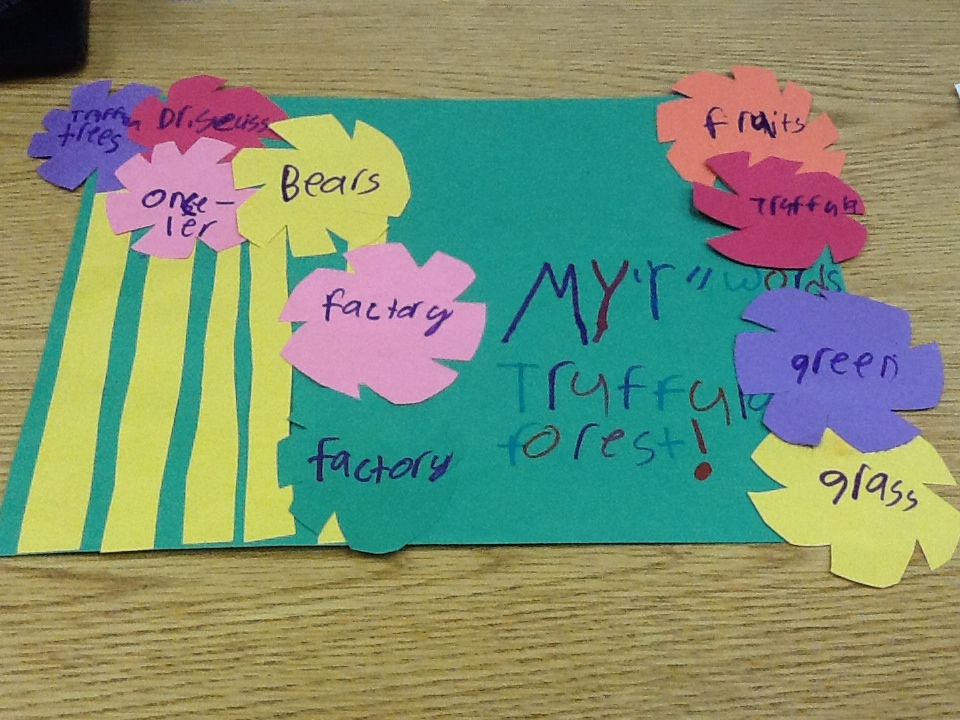


Here was our inspiration page for the craft activity:

These bright colors have me looking forward to fun speech-language craft activities with spring and summer themes during lessons in my speech-language therapy classroom!! Oh yeah…I should mention that I am eager DESPITE the light snow flurries we had in Atlanta over the weekend.
Thanks for stopping by the blog today!! Stay tuned for resources to support the English/Language Arts and Reading Common Core Curriculum Standards.
Why Teach Word Associations?
As speech-language pathologists, we recognize the significance of providing direct vocabulary instruction for students who have language impairments on a weekly basis. Students need to improve their receptive and expressive vocabulary skills so that they can improve their functional communication, listening comprehension, reading comprehension, and overall understanding of their grade level curriculum.
Teaching word associations is essential to students’ vocabulary acquisition and understanding of word relationships.
What are the advantages of teaching word associations?
1) increases receptive and expressive vocabulary skills
2) increases students’ abilities to understand and explain similarities/differences
3) prerequisite skill for students to understand grade level/curriculum level compare and contrast activities
4) prerequisite skill for students to understand word relationships in analogies that requires students to use basic level deductive reasoning skills
5) supports common core English/Language Arts standards
6) reinforces skill of categorization that requires students to sort items into groups, name items according to group, identify/name items that don’t belong in a group
7) increases understanding of age level, grade level, and curriculum vocabulary
8) research supports direct instruction of word associations
Evidence based practice
Research supports the need for direct vocabulary instruction. Marzano (2004) agrees that there is a strong case for the importance and usefulness of direct vocabulary instruction. He states “the research indicates that wide reading probably is not sufficient in itself to ensure that students will develop the necessary vocabulary and consequently the necessary academic background knowledge to do well in school. In contrast, direct vocabulary instruction has an impressive track record of improving students’ background knowledge and the comprehension of academic content.”
What resources can SLPs and teachers use to address these skills?
Word Associations Baseline and Progress Check Data Forms: Grades 1- 5
Available in my TPT store: http://www.teacherspayteachers.com/Product/Associations-Baseline-Progress-Check-Data-Forms
The Packet includes the following pages:
1) Cover page
2) Instructions page
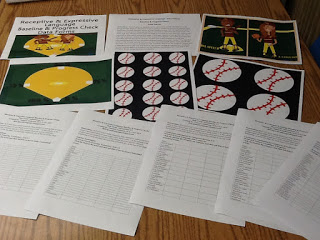
3) Boy and girl baseball players; custom made illustrations for BSL Speech Language
4) Baseball field custom made graphics for BSL Speech Language
5) 2 pages of different size custom made baseball graphics for BSL Speech Language
6) 2 General Associations lists (Grades 1-3)
7) 1 Language Arts Associations List (Grades 3-5)
8) 1 Science Associations List (Grades 3-5)
9) 1 Social Studies Associations List (Grades 3-5)
No Glamour Vocabulary book by Linguisystems, Inc.

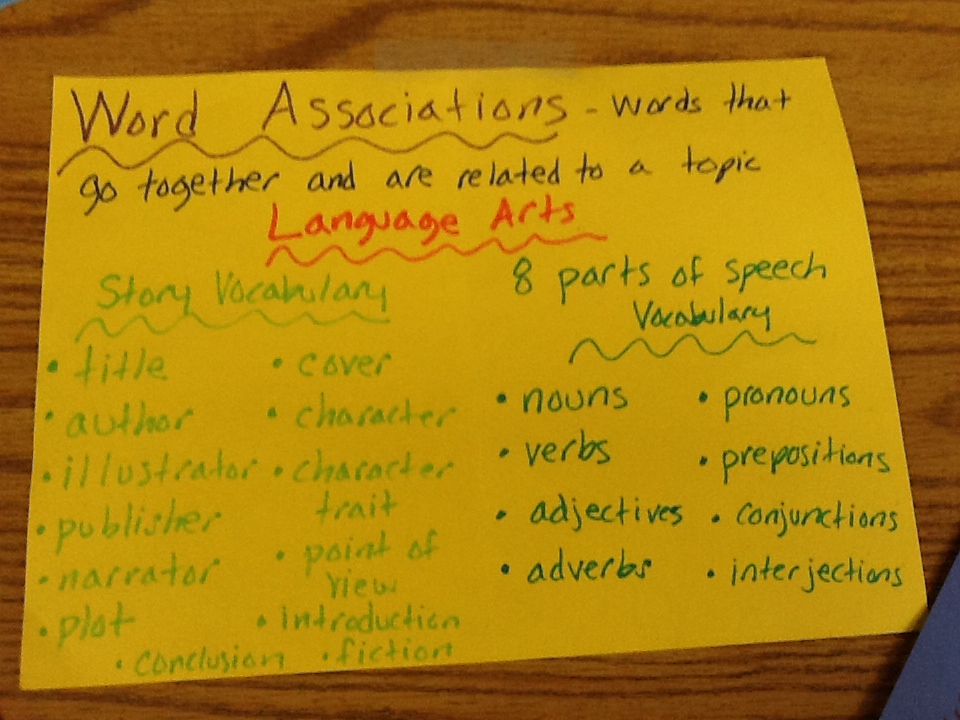
Today in language therapy, I reviewed word associations with 2 of my 3rd grade groups. First, I reviewed the meanings of word associations. Then, I did a mini lesson and guided practice activity. I listed basic words such as dog, apple, and bookbag and had them name associated words as I wrote them on a mini dry erase board. Then, I had them look at our “word wall” of language arts words that had story vocabulary listed (e.g. character, character traits, author, illustrator, narrator, etc.). I asked them: What is the category or topic of these vocabulary words? My students required prompting to answer, so I asked them exclusionary questions: Are these math vocabulary? Are these science vocabulary? Are these social studies vocabulary? Are these language arts vocabulary? After that, I modeled making a graphic organizer to review the lesson and we used markers to make the vocabulary more visually appealing (plus using markers are more fun!!). Here is the one I created:
Additional Resources to teach word associations:
Help for Word Finding book by Linguisystems, Inc.
Pair Ups Association Cards by Linguisystems, Inc.
I PAD app Word to Word by MochiBits: best used with 4th, 5th, and middle school students
Numerous TPT resources created by SLPs
* For those that love using technology, I suggest saving a selection of frequently used TPT activities in iBooks on your IPAD for easy access in speech-language therapy sessions. I recently started doing this and it is a great addition and time saver!!
*I suggest purchasing/adding Pocket Game Super Pack by Danielle Reed in iBook. The activity has activities to address word associations via analogies that target action/object, characteristics, location, and part/whole analogies
* I suggest purchasing/adding Rachel Lynette’s tasks cards for analogies in iBook and printing/laminating to create a file folder activity
What educational resources do you use to teach word associations?
Kindly share your comments!! Thanks for visiting the blog today.
Reference
Marzano, R. (2004).
Building background knowledge for academic achievement: research on
Alexandria, VA: Association for Supervision and Curriculum
Valentine’s Word Associations
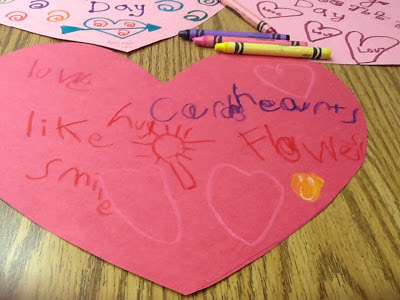
Today, I worked on Valentine’s word associations with some of my speech-language students during an arts & craft activity. They chose either red or pink construction paper and traced a large heart. I explained to them that word associations are words that go together or are related. I told them to share words they know that are related to Valentine’s day.
Here is an example of the heart my kindergarten student who has a significant fluency disorder made:

I then used the First Words Valentine IPAD application by Learning Touch to review the word associations. This application has cute graphics depicting each key word and then provides an opportunity for the students to drag each letter to spell the word. My kindergarten student was eager to place the letters in the correct spot as the background had a faded letter that told him how to spell the words and voiced the letter as he did so. He seemed to enjoy the game as it reinforced some of the words he stated when making his heart. Since he is a student with a fluency disorder, I directed him to practice saying his words in slow and easy sentences using his fluency strategies. He did a great job using his fluency strategies in structured sentences.
Here is another picture from a 3rd grade language therapy session today. The top left was an example I made. The remainder here are the beginning of my students’ word associations work. This group will write their associations on the back and practice using the words in oral sentences. I plan to read a short story to them later this week related to Valentine’s Day and have them identify word associations and also practice verbally summarizing and sequencing the story events.


Baseball Themed Baseline & Progress Check Data Forms
I am excited to share that I have completed receptive and expressive language packets that include baseball themed data collection forms to address synonyms & antonyms, associations, multiple meanings, and irregular plural nouns/irregular past tense verbs. I decided to create these materials because I have several activities to use when providing speech-language services for my students. Although my students love when I use different games and activities to target their vocabulary and grammar activities, the words elicited are not always the same each session and I needed a way to effectively measure their language progress over time.
My solution for this dilemma was to make a quick way to keep track of my students’ knowledge and use of specific vocabulary and grammar targets versus solely using data from a variety of question probes each session. I love my new data tracking forms and have already starting using them to record my students’ accuracy with each skill (baseline data) and will recheck their percentage of accuracy after additional language therapy sessions. In the field of education, these forms are called criterion referenced tests or CRTs. This is because you are informally measuring students’ knowledge about a set skill and monitoring their progress over an extended period of time.
In my school district, we use an online documentation system to create Individualized Education Plans (IEPs). SLPs and other special education teachers are required to enter a percentage for baseline data at each annual review and then update progress online each 9 weeks for each goal/objective using a percentage of accuracy.
These forms will be great to record data for my elementary school aged children and I am sure other SLPs can utilize them as well!! You can administer the probes across 4 data collection days with this informal assessment tool. This will make your data collection much easier and reliable.
Here is a picture of the materials that I used with my students recently:
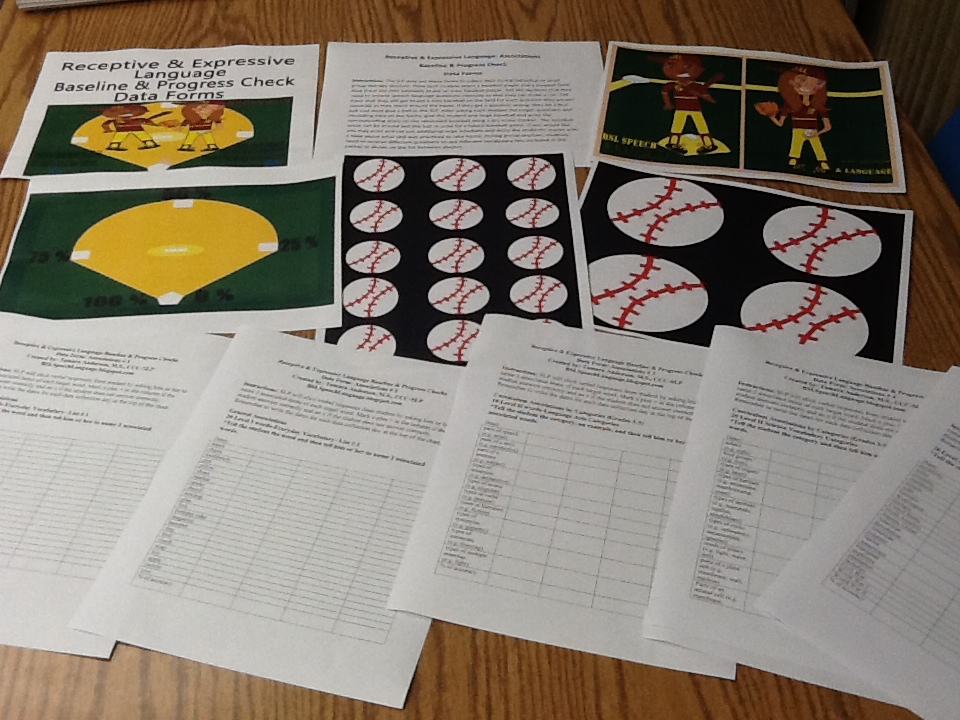
I first used the synonyms data tracking form during a “baseball game” with one of my students who has mild autism and receptive/expressive language disorder. He was eager to play the game by naming synonyms as we have been practicing this skill for a while in therapy. He liked getting to put the mini baseballs on the field when he answered questions and made his way around the bases. After the student finished answering his questions, I wrote his score on a large baseball with a note about what language skill he practiced during therapy. He thought it was awesome that he got to take home a baseball ! You would have thought that it was a real baseball and NOT just a paper version. He left my speech room with a big smile!! Small joys! 🙂
These resources are available at my Teachers Pay Teachers Store at:http://www.teacherspayteachers.com/Product/Synonyms-Antonyms-Baseline-Data-Progress-Check-Forms
Here is what you will receive in the Synonyms & Antonyms Packet:
1) Cover page
2) Instructions page
3) Boy and girl baseball players; custom made illlustrations for BSL Speech Language
4) Baseball field custom made graphics for BSL Speech Language
5) 2 pages of different size custom made baseball graphics for BSL Speech Language
6) 2 Synonyms lists
7) 2 Antonyms lists
Kindly leave your feedback in my TPT Store.
Thanks for reading the blog today,
Tamara Anderson
Baseline & Progress Check Data Forms…..coming soon!

