


Fiction Book Series # 2 {Froggy}
As you may know, I love using literacy during my speech-language therapy lessons like most SLPs. I have many students who have speech objectives to verbally retell stories and answer literal/inferential questions from fiction text.
My younger elementary school aged students enjoy the Froggy series books by Jonathan London. The stories are engaging and the illustrations are great too!
The majority of these books are at a 2nd grade reading level. During speech-language sessions, I read aloud these stories with my students in grades K-3. The majority of my students with language impairment also have a language based learning disability and are reading below grade level. However, their listening comprehension skills are usually higher.
Here are four of the books from the Froggy series that I used within the last few weeks.

What are some series that your students or children enjoy? Follow the blog for more posts about other fiction book series.
Tamara

Fiction Book Series # 1 {Pirate Pete}
Apparently tomorrow, September 19th, is International Talk Like a Pirate Day. Say what?! This is certainly news to me because this day has always been and will forever be my dad’s birthday! Happy Birthday to an extraordinary man, a.k.a. Mr. Retiree, who I love dearly!

This week, I decided to introduce pirate themed fiction stories because I love literacy! Plus, I figured my students would get a kick out of knowing that there is such a holiday that celebrates pirates.
The First in the Series by Kim Kennedy is Pirate Pete. In this story, he travels to Mermaid Island in search of treasure. He is guided by the map that he mischievously took from the Queen. Pete gets side tracked on his voyage and visits other islands along the way. His loyal parrot gets him back on track to finding the treasure!

Then, there is Pirate Pete’s Giant Adventure. This time, he travels to Thunder Island in search of a Sea Fairy’s missing blue sapphire. On the island, Pete meets an unexpected antagonist who is determined to ruin his adventure.

There is also Pirate Pete’s Talk Like a Pirate. In this book, Pete eagerly recruits new crew members to begin another voyage. He is convinced that they must all know how to talk like a Pirate! Arrrr matey!

These books are great to use in speech-language therapy sessions, reading activities in the classroom, and to read with your child as well! Here are some ideas of children’s activities to address speech language objectives and literacy skills:
- articulation practice of /r/ words in the text
- answering literal and inferential questions
- verbal story retell
- written story retell
- compare and contrast the stories in the series
- context clues for unknown vocabulary

September Children’s Literature Reviews
Hey there! The official beginning of fall will be here in a few days. For you football lovers out there, I am sure that you have happily immersed yourself into cheering on your favorite team on GAME DAY!! I know there are plenty of die hard college football and/or professional football fans. I live in Georgia Bulldog country! Go DAWGS!! I have to admit though that I am not much of a football fan because I attended a HUGE BASKETBALL university!! GO TARHEELS!!


Literacy Website Review # 2 {Technology}
I am constantly adding new grade level fiction and non-fiction text to my speech-language therapy resources. It is critical that speech-language pathologists support developing children’s literacy skills on a regular basis. I do this by addressing listening comprehension and vocabulary IEP objectives related to text at students’ instructional reading level. An instructional reading level is the level of book that they can read with adult support.

I love the website http://www.readinga-z.com/ because there is a ton of information on this site!You can search for books by different categories. I go right to the literature genre and leveled book collections when I need language therapy materials.
If you are an SLP supporting the 3rd grade Common Core Reading Standards, you should click on the tab for Fables and access these books:
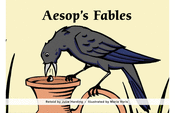
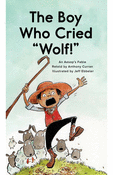
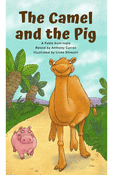
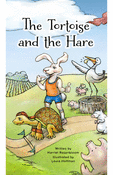
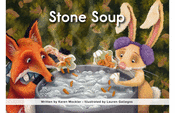

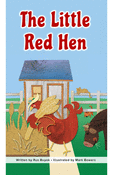
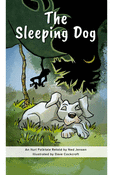
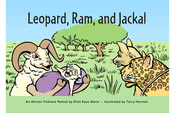
Each book is marked with an alphabetical letter that corresponds with a certain reading level. For example, the Boy who Cried Wolf is marked “Level E or 1st grade” but it supports the 3rd grade standard of teaching fables. I read aloud the stories to the children and have them follow along in a printed book. Then, I ask story comprehension and vocabulary questions. You can also have students practice story retell.
I love that this website also has vocabulary lists available that are already sorted into Tier I, Tier II, and Tier III words. How awesome is that! The SLP can teach kids how to use context clues to understand the meaning of the words.
You can also verbally model for your students how to verbally compare and contrast fiction/non-fiction text using the recommended paired book sets. Then have them practice this skill. This encourages kids to use higher level thinking skills to identify similarities and differences between the characters and events. Here is the link to access paired books by reading grade level: /http://www.readinga-z.com/book-related-resources/paired-books/
I frequently go to the leveled books tab when I want to differentiate instruction for my students. I will select a book for each child at their instructional reading level. For example, I may have a 4th grade student who is reading at a 3rd grade instructional level. So I may select level Q text such as:


Since I am a SLP, I read aloud the text so that the child is practicing their listening comprehension skills. However, I believe it is important to provide them access to books at their instructional reading level so they are not frustrated with their literacy practice. Their special education resource teacher addresses their reading decoding and comprehension objectives.
You may access some of this information on the site for free! However, I recommend paying for a subscription because it is well worth the money!
Thanks for visiting the blog today.
Tamara

Literacy Website Review {Technology}
Last school year, a friend of mine told me about roythezebra.com, a website that has an engaging fiction story, literacy worksheets, and interactive reading games. The story is divided into nine parts and features the main character, Roy the zebra. This is great to use as a group language therapy activity in the classroom.

This year, I am currently enjoying using this resource with two language therapy groups. Before reading the story, Roy the Tale of the Singing Zebra, I ask my students questions to help them make predictions about what the story will be about. Then I read aloud the story during a language therapy lesson in both a moderate intellectual disability class and a mild autism class. My students are enjoying viewing the story as it is displayed on the whiteboard and listening to my animated oral reading. In one of the classrooms, I am using Mimio software that allows me to easily click through the pages of the story by touching the stylus pen on the white board.
At the beginning of the story, Roy lives in a zoo where all his favorite activities of singing, dancing, and rolling around are banned. In part two, he is eager to escape from the horrible zoo and gets help from his friend George and his elephant friend Lucy. At the end of each part, my students want to know what happens next but they have to wait until the next weeks lesson.
I recommend that the SLP or teacher pause the reading of the story at times to model “think alouds” by asking questions. This helps check for story comprehension and teaches them to think while they are listening. This is especially necessary for students with language disorders because of the unknown vocabulary that is embedded in the story. There are discussion questions available for use after reading the story to further check for understanding.
There are 27 literacy worksheets available or 3 for each part of the story that may be used after listening to the story. The worksheets address skills such as sentence construction, correct use of punctuation marks, capitalization, story sequencing, rhyming words answering literal comprehension questions, and character perspective taking. I think the worksheets are great to use as extension activities by the speech-language pathologist or the teacher as appropriate by the skill taught. However, I typically ask students verbal questions and ask them to orally respond due to time constraints during language therapy lessons.
Additionally, this literacy website has interactive whiteboard lesson plans that can be paired with provided learning games to teach literacy skills. An associated worksheet is also available to be completed as classwork or homework. I have not personally used the interactive games, but have reviewed them online and told the special education teachers about them. Some of the learning games are free and some you have to pay $6.95 to access them.
Here is the list of the free learning games:
Alphabetical Order- sequence words in alphabetical order
Double Consonants- add word endings (ff, ss, bl, br, cl, cr, ck, ng)
Singular or Plural- sorting activity to distinguish between singular and plural nouns *This is a great activity for SLPs to use.
Long Vowel Phonemes- identify target sound blends by clicking on them to make new words *Certain sounds such as “er”, “ir”, “or” would be great to use with students practicing their speech articulation of vocalic /r/.
Rhyming words- identify words that sound the same or rhyme
Here is the list of the learning games available for purchase ($6.95):
Consonant Blends- targets phonological processing skill of blending and segmenting consonants to make CVCC words
Long Vowel Phonemes- complete access to learning game; add vowels to make new words
Tim Bowerbank in the creator of roythezebra.com. He was inspired to create the character Roy, after a trip to South Africa. He requests that all users register on the website and subscribe to his literacy newsletter before using the free resources.

I encourage you to integrate technology in your speech language therapy lessons or instructional time in the classroom. Thanks for the reading the blog today.
Tamara Anderson

August Children’s Literature Reviews
I love using children’s books in my speech-language therapy sessions with my students. I enjoy reading aloud to my students and popping in that oh so lovely CD to play an audio book for different group sessions. Either way it is a win win situation because students are typically engaged in the story and there are so many speech language objectives that can be addressed.
Last week, I used the audio CD that read aloud the book, Teacher’s Pets, by Dayle Ann Dodds. I was lucky to have multiple copies of the book so that my students could follow along with the read aloud. The audio teaches them to listen for a chime to turn the page.
This is a delightful book about Miss Fry and her elementary school aged students. In their class, each Monday is sharing day. One Monday, Winston has the creative suggestion for his classmates to share their pets. Your students will love turning the pages to find out the pet each character in the book brings to school. This is a great way to discuss sequencing of story events.
The first Monday, Winston brought in his pet rooster. The next Monday, Patrick brought his pet tarantula. Then the class got to see Roger’s cricket, Alia’s goat, Amanda’s dog, Jerry’s snake, Megan’s cat, Mitchell’s mice, and so on.
Last week I used this book with my speech-language students with co-occurring autism, moderate intellectual disability, and learning disabilities. They all smiled as they listened and eagerly turned the page with each chime! After listening to the story, they verbally answered literal “wh” questions about the characters, setting, and events in the story. One of my students in my intellectually disability group especially struggles with initiating oral expression. For her, I wrote out the questions and showed her a visual choice of 3-4 answer choices. After that, she did a fair job with indicating her responses with visual prompts from the story as needed.
The previous week, I read aloud, Charlies Goes to School, by Ree Drummond.
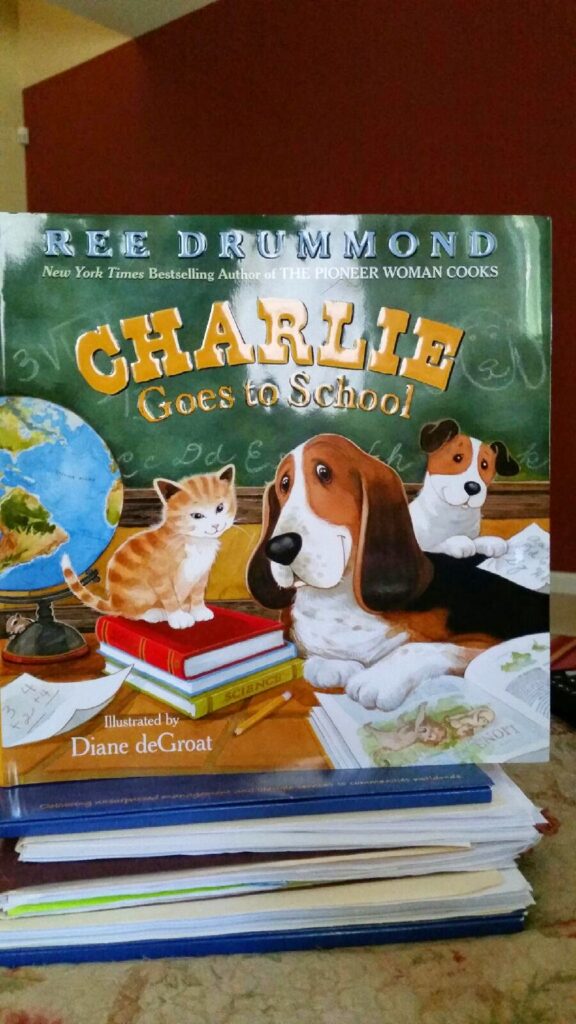
I love this story because the pictures are so vibrant as well as realistic and it is told from the perspective of Charlie, the ranch dog as he explores the ranch for the day. This is a great time to remind students about the meaning of the word fiction as the main character engages in activities that dogs don’t do in real life, such as teach school to animal friends. Charlie invites the reader to explore what life on the ranch is for his human and animal family.
He introduces us to the other characters: daddy, cowboy Josh, mama, the kids, Suzie the dog, Kitty Kitty, ranch horses, cows, and Walter the dog. He tells us that his human family goes to school at home and gets inspired to teach his animal family reading, math, and history. Well you can just imagine how well turns out for the animals! They have difficulty focusing, want to play, and Walter the dog even falls asleep.
Since I read Charlie goes to School aloud to my students, I modeled “think alouds” along the way by making additional comments and asking questions to check for story comprehension.
I definitely recommend these awesome books for use during speech-language therapy lessons or reading class.
I also recommend a rubric to measure students’ abilities to orally retell fiction stories. The SLP or teacher records a score of 5 to 0 in each performance element category: characters, setting, problem or rising action, solution or falling action/conclusion. To calculate a score, just add up the points in each category. To calculate a story retelling percentage of accuracy divide the score by 20, that is the total possible points. I recommend audio recording your student’s story retell for easier scoring using the rubric.
This product was revised last week and it is available in my TPT store here: http://www.teacherspayteachers.com/Product/Oral-Story-Retelling-Rubric-819201
Thanks for visiting the blog today! 🙂
Tamara Anderson

Seven Keys for a Successful School Year {SLPs and Teachers}
Build relationships with students, parents,
and staff.
Keep focused on the academic & social
successes of your students.
Communicate kindly with colleagues.
Keep calm and learn to juggle!
Coffee is your friend!
Flexibility is key.
It is okay to laugh out loud!

Seven Keys For a Successful School Year {Parents}
Encourage your child to work hard and ask questions.
Enroll your child in non-academic activities
(e.g. sports, music, dance).
Listen to your child.
Join the Parent Teacher Association (PTA) and
volunteer.
Set boundaries for your children.
Stay calm and talk to the teachers, speech
language therapists, and all service providers.
SLP Resources for Back to School
Many students will return to school this week in the Atlanta area and other school districts will begin the new school year soon. This is a great time to gather new speech language therapy resources for students on your caseload with communication disorders.
Have a great week!

On a Mission {Build Successful Lives}
Hey there! I just got back to Atlanta yesterday from an awesome weekend trip to Dallas, Texas! It was my first time visiting the state and was impressed with the beauty and diversity of the area. The people were quite friendly as well. This was a great way to finish my summer break as I return to work full time tomorrow!
Here is a picture of me in Uptown aka West Village.

By the way the pizza at Union Bear is delicious! Everyone in Dallas loves this place.
Here is a picture of my friend and I visiting the African American History Museum.

This is a must see and has great history about the community of North Dallas.
While in Dallas yesterday, I visited my friend’s church and the pastor was talking about being on a mission daily to serve others in our community. I was sitting there thinking….hello…that is my personal and professional mantra!! In my life, my relationship with Jesus Christ/Yeshua is of # 1 importance, followed by my family, friends, career, etc. I truly believe that my belief in my savior, my guide, Jesus Christ/Yeshua enables me to do all that I do and provides me with my next steps. So to hear the pastor talk about that yesterday in church was another confirmation that God/Yahweh is amazing and personal!

Dallas Skyline
